Renormalization destroys a finite time bifurcation in the $Φ^4_2$ equation
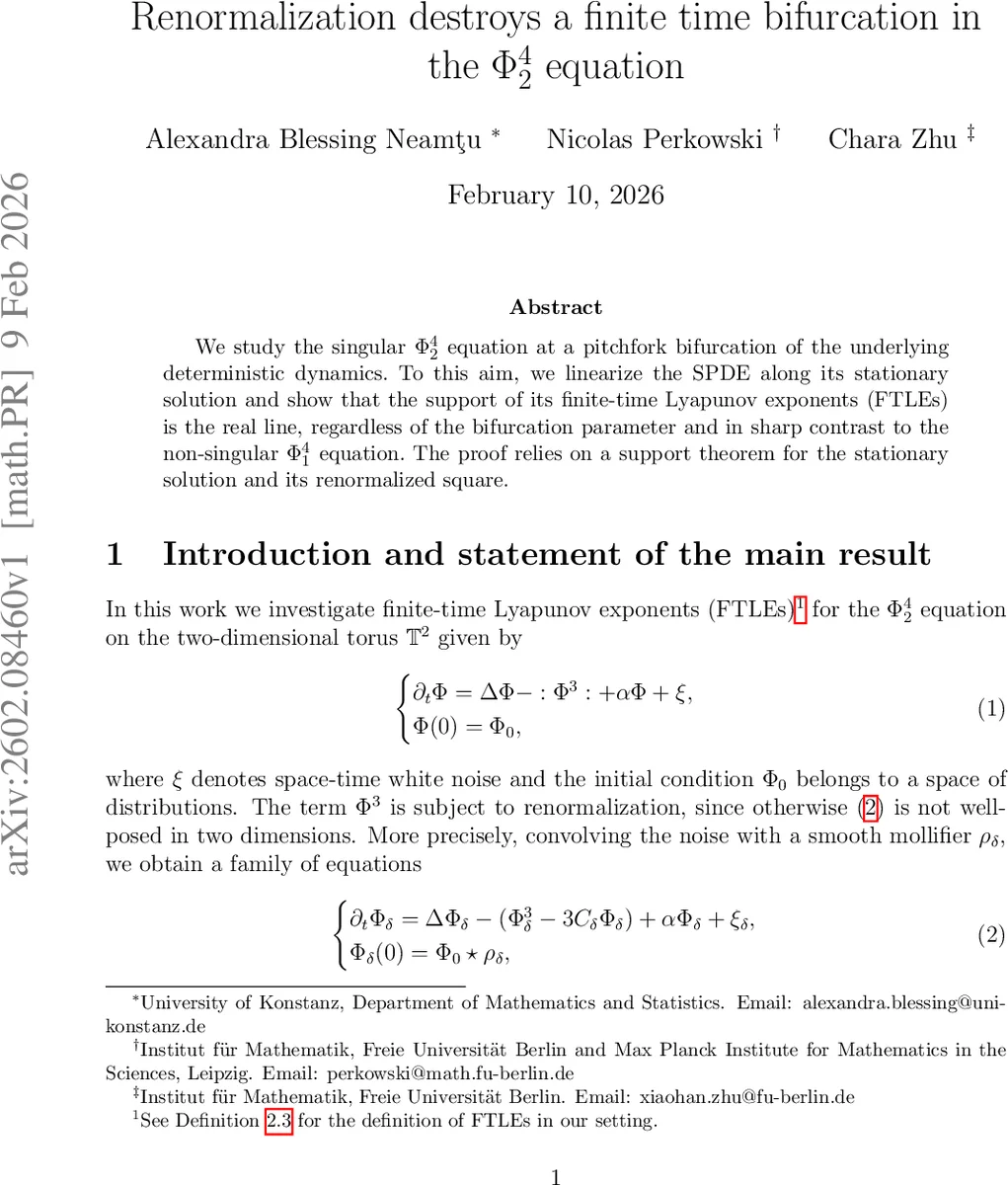
We study the singular $Φ^4_2$ equation at a pitchfork bifurcation of the underlying deterministic dynamics. To this aim, we linearize the SPDE along its stationary solution and show that the support of its finite-time Lyapunov exponents (FTLEs) is the real line, regardless of the bifurcation parameter and in sharp contrast to the non-singular $Φ^4_1$ equation. The proof relies on a support theorem for the stationary solution and its renormalized square.
💡 Research Summary
This paper investigates the effect of renormalization on a pitchfork bifurcation in the two‑dimensional stochastic Φ⁴ equation (Φ⁴₂) posed on the torus 𝕋². The deterministic counterpart exhibits a classic supercritical pitchfork at the parameter value α = 0, where the trivial equilibrium loses stability and two symmetric non‑trivial equilibria appear. When additive space‑time white noise ξ is added, the cubic nonlinearity becomes ill‑posed in two dimensions and must be Wick‑renormalized. The authors introduce a mollified approximation with a smooth kernel ρ_δ, leading to the regularized equation
∂ₜΦ_δ = ΔΦ_δ – (Φ_δ³ – 3C_δΦ_δ) + αΦ_δ + ξ_δ,
where the counterterm C_δ diverges as δ → 0. Taking the limit δ → 0 yields a mathematically rigorous solution Φ taking values in a negative‑regularity Hölder‑Besov space C^{‑ε}.
A central object of study is the stationary solution a_α(t) of the renormalized dynamics, which is distributed according to the invariant Gibbs measure μ_{Φ⁴₂}. The authors prove a support theorem for the joint law of (a_α(t))_{t∈
Comments & Academic Discussion
Loading comments...
Leave a Comment