The Connection between Kriging and Large Neural Networks
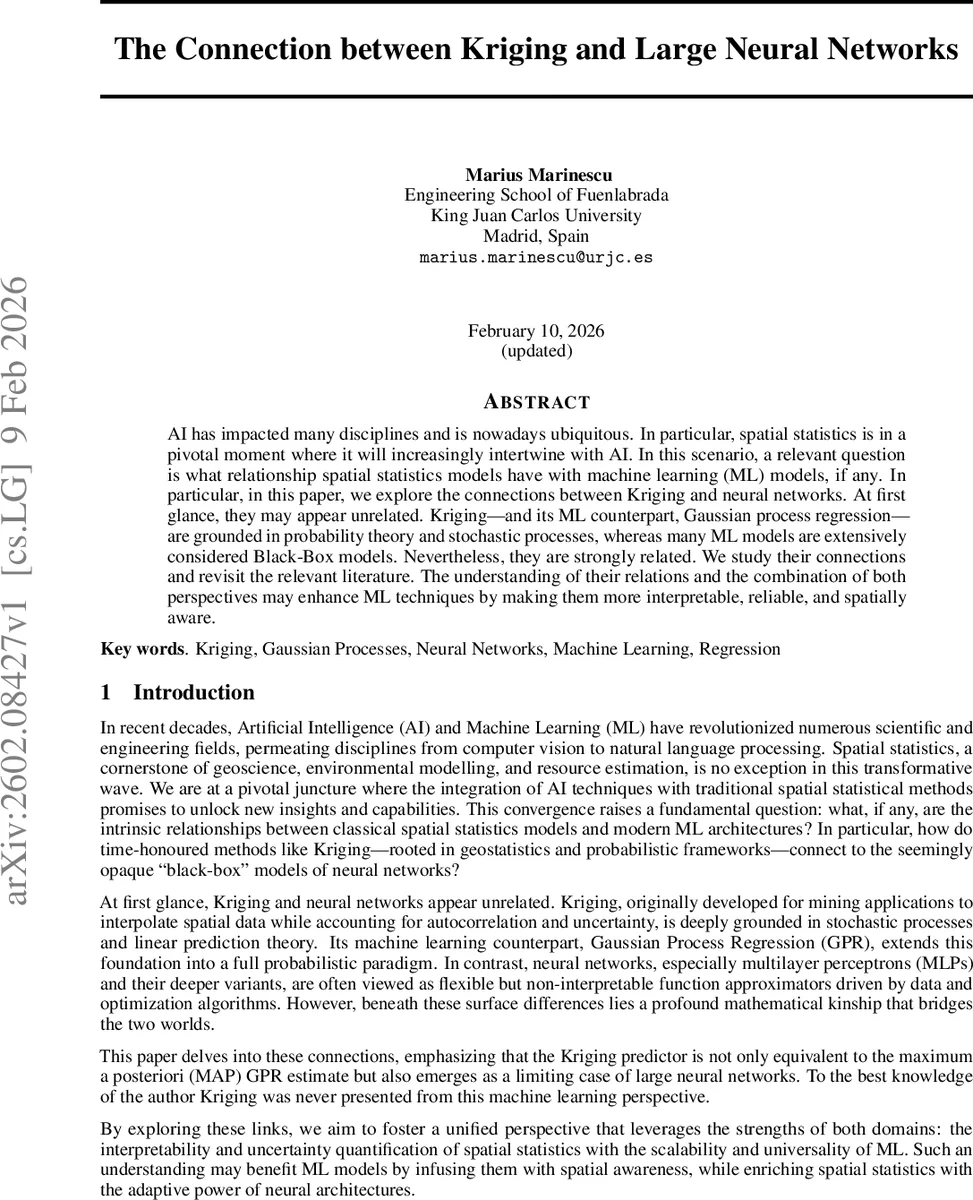
AI has impacted many disciplines and is nowadays ubiquitous. In particular, spatial statistics is in a pivotal moment where it will increasingly intertwine with AI. In this scenario, a relevant question is what relationship spatial statistics models have with machine learning (ML) models, if any. In particular, in this paper, we explore the connections between Kriging and neural networks. At first glance, they may appear unrelated. Kriging - and its ML counterpart, Gaussian process regression - are grounded in probability theory and stochastic processes, whereas many ML models are extensively considered Black-Box models. Nevertheless, they are strongly related. We study their connections and revisit the relevant literature. The understanding of their relations and the combination of both perspectives may enhance ML techniques by making them more interpretable, reliable, and spatially aware.
💡 Research Summary
The manuscript investigates the deep mathematical connections between Kriging—a cornerstone method in spatial statistics—and large neural networks, specifically multilayer perceptrons (MLPs) with many hidden units. It proceeds in three logical stages.
First, the authors demonstrate that ordinary Kriging (also called simple Kriging when the mean is known) is mathematically equivalent to Gaussian Process Regression (GPR). Starting from the observation model (Y(x_i)=Z(x_i)+\varepsilon_i), where (Z) is a second‑order random field with mean function (m(\cdot)) and covariance kernel (k(\cdot,\cdot)), they write the Best Linear Unbiased Predictor (BLUP) as
\
Comments & Academic Discussion
Loading comments...
Leave a Comment