Optimizing Spectral Prediction in MXene-Based Metasurfaces Through Multi-Channel Spectral Refinement and Savitzky-Golay Smoothing
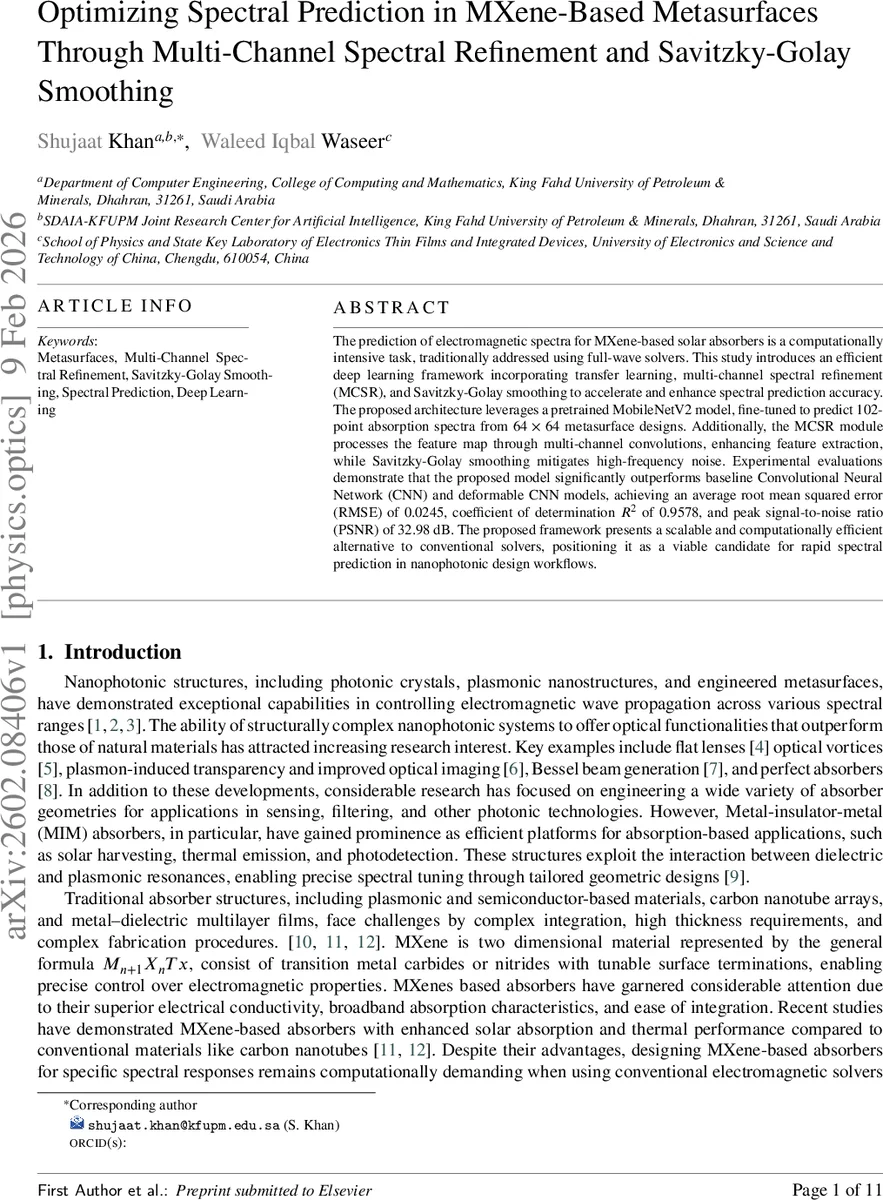
The prediction of electromagnetic spectra for MXene-based solar absorbers is a computationally intensive task, traditionally addressed using full-wave solvers. This study introduces an efficient deep learning framework incorporating transfer learning, multi-channel spectral refinement (MCSR), and Savitzky-Golay smoothing to accelerate and enhance spectral prediction accuracy. The proposed architecture leverages a pretrained MobileNetV2 model, fine-tuned to predict 102-point absorption spectra from $64\times64$ metasurface designs. Additionally, the MCSR module processes the feature map through multi-channel convolutions, enhancing feature extraction, while Savitzky-Golay smoothing mitigates high-frequency noise. Experimental evaluations demonstrate that the proposed model significantly outperforms baseline Convolutional Neural Network (CNN) and deformable CNN models, achieving an average root mean squared error (RMSE) of 0.0245, coefficient of determination ( R^2 ) of 0.9578, and peak signal-to-noise ratio (PSNR) of 32.98 dB. The proposed framework presents a scalable and computationally efficient alternative to conventional solvers, positioning it as a viable candidate for rapid spectral prediction in nanophotonic design workflows.
💡 Research Summary
The paper addresses the computational bottleneck of predicting electromagnetic absorption spectra for MXene‑based metasurface absorbers, which traditionally relies on full‑wave solvers such as FDTD, FEM, or RCWA. To overcome this, the authors propose a deep‑learning framework that combines transfer learning, a Multi‑Channel Spectral Refinement (MCSR) module, and Savitzky‑Golay (SG) smoothing.
Dataset: 500 distinct metasurface geometries are simulated in CST Microwave Studio. Each geometry consists of a three‑layer metal‑insulator‑metal (MIM) stack (40 nm MXene, 200 nm SiO₂, 200 nm Ag) and is rendered as a 64 × 64 grayscale image. For each design, absorption is sampled at 102 wavelength points, yielding a 102‑element vector.
Model architecture: A MobileNetV2 backbone pretrained on ImageNet is fine‑tuned for regression. After the backbone, a dense layer reduces the 1028‑dimensional feature vector to 512 dimensions, followed by another dense layer that outputs a 102‑point spectrum. The raw spectrum is fed into the MCSR block, which first expands the single‑channel vector to five parallel 1‑D convolutional channels and then collapses them back to a single channel. This multi‑scale processing captures subtle spectral features that conventional 2‑D CNNs often miss.
Savitzky‑Golay smoothing: The MCSR output is smoothed with an SG filter (window length = 11, polynomial order = 2). The filter coefficients are derived analytically using a Vandermonde matrix, ensuring that the smoothing step adds negligible computational overhead while preserving peak shapes.
Training: Adam optimizer (lr = 0.001), batch size 32, MSE loss, He initialization, and early stopping (no improvement for 50 epochs) are employed. The dataset is randomly split into 80 % training, 10 % validation, and 10 % test, and the entire experiment is repeated ten times to obtain mean and standard deviation statistics.
Results: The proposed model achieves an average RMSE of 0.0245 ± 0.0062, R² of 0.9578 ± 0.0305, and PSNR of 32.98 dB ± 1.83 across the ten runs. Compared with a baseline CNN (RMSE 0.0430, R² 0.8883, PSNR 27.86 dB) and a deformable CNN (RMSE 0.0347, R² 0.9010, PSNR 29.57 dB), the new approach reduces RMSE by ~29 %, raises R² by ~6 %, and improves PSNR by over 3 dB.
Model complexity: The network contains ~2.93 million parameters—more than the baseline CNN (1.14 M) but less than the deformable CNN (≈5 M). Despite the moderate increase relative to the simple CNN, inference speed remains suitable for real‑time design loops.
Explainability: Grad‑CAM visualizations reveal that the model focuses on specific geometric patterns (e.g., feature size, periodicity) that strongly influence absorption peaks, providing physical insight into the learned mapping.
Conclusion: By leveraging transfer learning, multi‑channel spectral refinement, and classic signal‑processing smoothing, the authors deliver a scalable, data‑efficient, and highly accurate predictor for MXene metasurface spectra. The methodology can be extended to other 2‑D materials, multi‑physics outputs, and inverse design tasks, potentially accelerating nanophotonic device optimization pipelines.
Comments & Academic Discussion
Loading comments...
Leave a Comment