Highly Polarized and Long Range Dissipationless Spin Transport Due to Counterflowing Electron and Hole Edge Channels
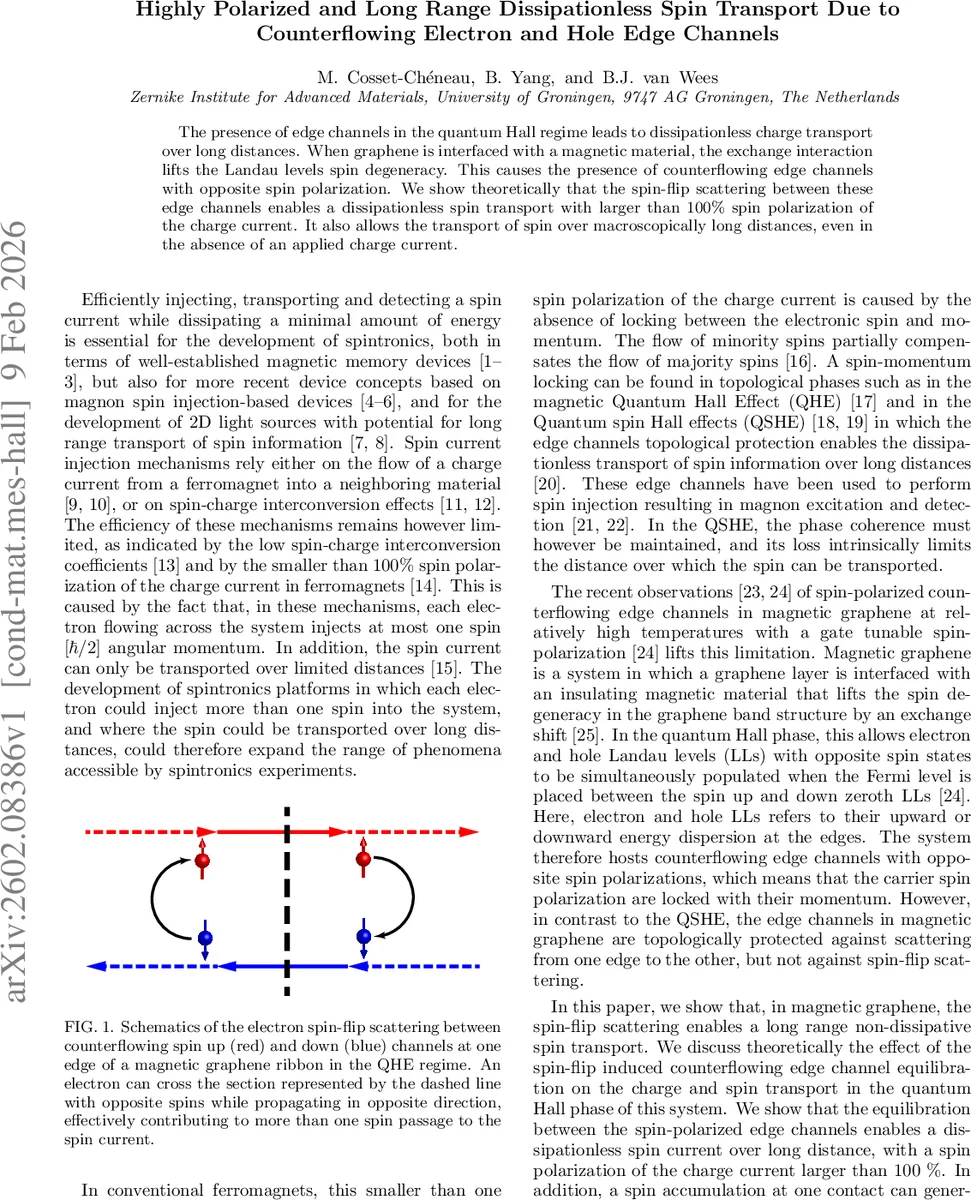
The presence of edge channels in the quantum Hall regime leads to dissipationless charge transport over long distances. When graphene is interfaced with a magnetic material, the exchange interaction lifts the Landau levels spin degeneracy. This causes the presence of counterflowing edge channels with opposite spin polarization. We show theoretically that the spin-flip scattering between these edge channels enables a dissipationless spin transport with larger than 100% spin polarization of the charge current. It also allows the transport of spin over macroscopically long distances, even in the absence of an applied charge current.
💡 Research Summary
The paper presents a theoretical study of spin transport in magnetic graphene—graphene interfaced with an insulating magnetic material—operating in the quantum Hall regime. Exchange interaction with the magnetic substrate lifts the spin degeneracy of the zeroth Landau level, creating spin‑up and spin‑down Landau levels that are energetically separated. When the Fermi energy is positioned between these split levels, both electron‑like and hole‑like edge channels become populated, flowing in opposite directions with opposite spin polarization. These counter‑propagating edge channels exhibit spin‑momentum locking: the direction of motion is tied to the electron’s spin.
A central result is that spin‑flip scattering between the opposite‑spin edge channels leads to equilibration of their electrochemical potentials along each edge. The equilibration length λ depends on the intrinsic spin‑flip length λ₀ and on the numbers of spin‑up (N↑) and spin‑down (N↓) channels, λ = λ₀
Comments & Academic Discussion
Loading comments...
Leave a Comment