Remainder terms and sharp quantitative stability for a nonlocal Sobolev inequality on the Heisenberg group
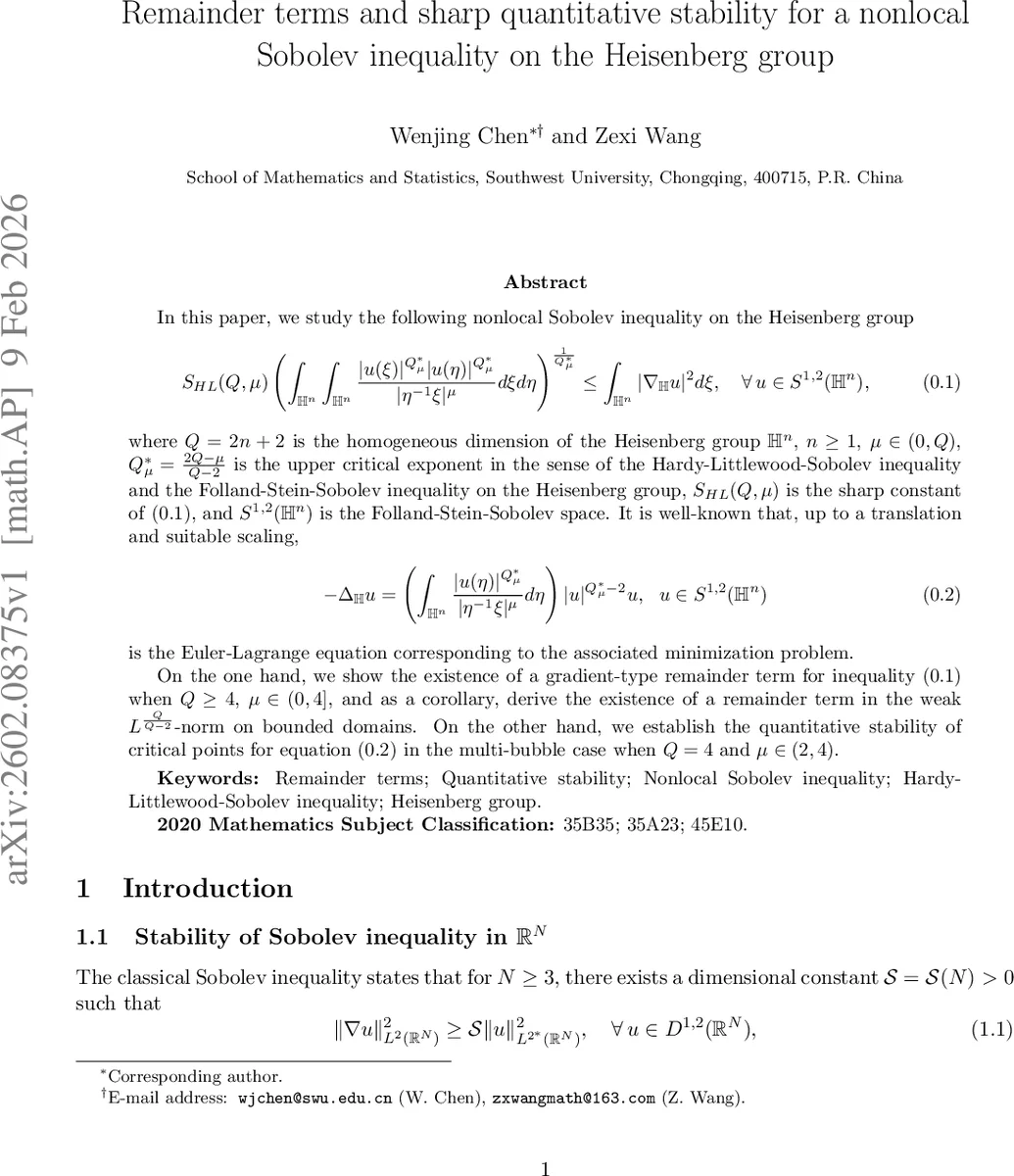
In this paper, we study the following nonlocal Sobolev inequality on the Heisenberg group \begin{equation}\label{eq:HLS} S_{HL}(Q,μ) \left(\int_{\mathbb{H}^{n}}\int_{\mathbb{H}^{n}}\frac{|u(ξ)|^{Q^{\ast}μ}|u(η)|^{Q^{\ast}μ}}{|η^{-1}ξ|^μ}{d}ξ{d}η\right)^{\frac{1}{Q^{\ast}μ}}\leq \int{\mathbb{H}^{n}}|\nabla{\mathbb{H}}u|^{2}dξ,\quad \forall , u\in S^{1,2}(\mathbb{H}^{n}), \end{equation} where $Q=2n+2$ is the homogeneous dimension of the Heisenberg group $\mathbb{H}^{n}$, $n\geq1$, $μ\in(0,Q)$, $Q^{\ast}μ=\frac{2Q-μ}{Q-2}$ is the upper critical exponent in the sense of the Hardy-Littlewood-Sobolev inequality and the Folland-Stein-Sobolev inequality on the Heisenberg group, $S{HL}(Q,μ)$ is the sharp constant of \eqref{eq:HLS}, and $S^{1,2}(\mathbb{H}^{n})$ is the Folland-Stein-Sobolev space. %of the nonlocal-Sobolev inequality. It is well-known that, up to a translation and suitable scaling, \begin{equation}\label{eq:abs} -Δ{\mathbb{H}} u=\left(\int_{\mathbb{H}^{n}}\frac{|u(η)| ^{Q^{\ast}_μ}}{|η^{-1}ξ|^μ}{d}η\right)|u|^{Q_μ^*-2}u,~~u\in S^{1,2}(\mathbb{H}^{n}) \end{equation} is the Euler-Lagrange equation corresponding to the associated minimization problem. On the one hand, we show the existence of a gradient-type remainder term for inequality \eqref{eq:HLS} when $Q\geq4$, $μ\in (0,4]$, and as a corollary, derive the existence of a remainder term in the weak $L^{\frac{Q}{Q-2}}$-norm on bounded domains. On the other hand, we establish the quantitative stability of critical points for equation \eqref{eq:abs} in the multi-bubble case when $Q=4$ and $μ\in (2,4)$.
💡 Research Summary
This paper investigates a nonlocal Sobolev inequality on the Heisenberg group (\mathbb H^{n}) and establishes both a gradient‑type remainder term and quantitative stability results for its associated Euler‑Lagrange equation. The inequality under study is
\
Comments & Academic Discussion
Loading comments...
Leave a Comment