The braided Doplicher-Roberts program and the Finkelberg-Kazhdan-Lusztig equivalence: A historical perspective, recent progress, and future directions
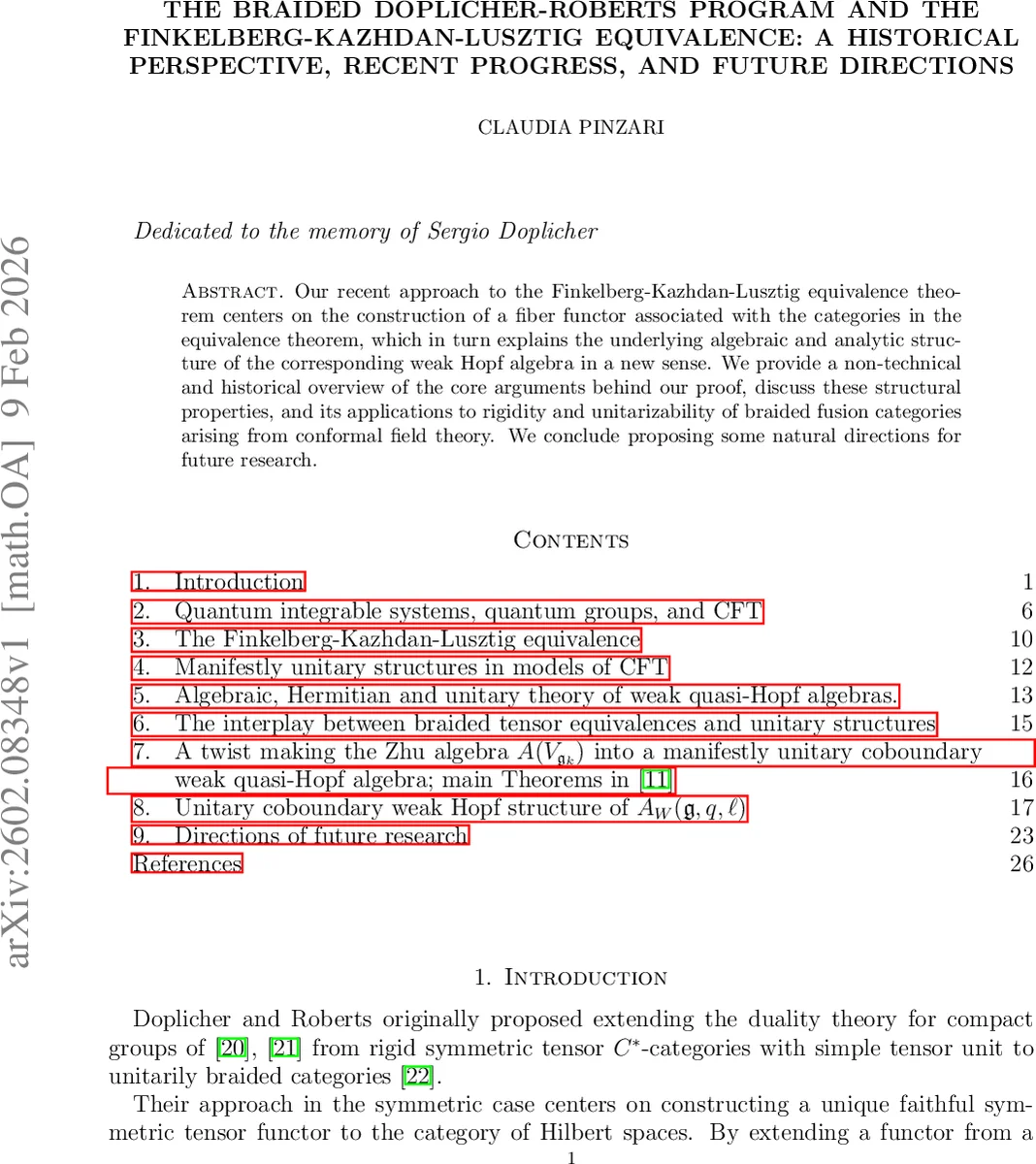
Our recent approach to the Finkelberg-Kazhdan-Lusztig equivalence theorem centers on the construction of a fiber functor associated with the categories in the equivalence theorem, which in turn explains the underlying algebraic and analytic structure of the corresponding weak Hopf algebra in a new sense. We provide a non-technical and historical overview of the core arguments behind our proof, discuss these structural properties, and its applications to rigidity and unitarizability of braided fusion categories arising from conformal field theory. We conclude proposing some natural directions for future research.
💡 Research Summary
This paper revisits the Doplicher‑Roberts (DR) reconstruction program and extends it to the braided setting, thereby providing a new perspective on the Finkelberg‑Kazhdan‑Lusztig (FKL) equivalence. The original DR theorem reconstructs a compact group from a symmetric rigid C*‑tensor category by means of a unique symmetric fiber functor. In the braided case, the lack of a genuine symmetry makes such a construction non‑trivial. The authors propose the “braided Doplicher‑Roberts program” in which the key ingredients are weak Hopf C*‑algebras, weak quasi‑Hopf C*‑algebras, and Drinfeld’s coboundary structures derived from the universal R‑matrix of Drinfeld‑Jimbo quantum groups.
The paper is organized as follows. After a historical overview of the DR theorem and its applications in algebraic quantum field theory (AQFT), the authors discuss the emergence of quantum groups from integrable models, Baxter’s R‑matrix, and the Yang‑Baxter equation. They emphasize that the universal R‑matrix supplies a braided symmetry which can be turned into a coboundary structure—an analogue of a symmetric functor that works for braided categories.
The technical core consists of two constructions. First, for each simple Lie algebra 𝔤, a root of unity q and an integer ℓ, the authors define a weak Hopf C*‑algebra (A_W(\mathfrak g,q,\ell)). Second, they associate to an affine vertex operator algebra (VOA) (V_{\mathfrak g,k}) its Zhu algebra (A(V_{\mathfrak g,k})). Both algebras carry natural coboundary structures and admit faithful fiber functors into Hilbert spaces. By applying a Drinfeld twist they identify the representation category of (A_W(\mathfrak g,q,\ell)) with the quantum group fusion category (\mathcal C(\mathfrak g,q,\ell)) and simultaneously with the braided tensor category (\operatorname{Rep}(V_{\mathfrak g,k})) of affine VOA modules. This yields a concrete, unitary, rigid braided tensor equivalence between the two sides of the FKL theorem.
A crucial insight is the “braid‑generated” property: for Lie types A, C and G₂ the braid group acting on tensor powers of the fundamental representation generates the full centralizer algebras (Hecke, BMW, etc.). This property allows the authors to bypass the intricate geometric arguments traditionally used in the proof of the FKL equivalence. By showing that the weak Hopf algebra’s coboundary structure respects the braid action, they obtain a direct proof of the equivalence for these types. For the exceptional types E and F the braid‑generated property is not yet known, so the full equivalence remains open.
The paper also revisits earlier examples such as the Mack‑Schomerus construction for the critical Ising model (the truncated (\mathfrak{sl}_2) fusion rules at the fourth root of unity) and generalizes them to (\mathfrak{sl}_N) and to all classical Lie types. The authors demonstrate that the weak Hopf algebras arising in these models are precisely the quantum gauge groups expected from the braided DR program.
Finally, the authors outline several future research directions: (i) establishing the braid‑generated property for the remaining exceptional types; (ii) extending the coboundary weak quasi‑Hopf framework to more general quantum gauge groups, with an eye toward low‑dimensional AQFT; (iii) proving a full braided tensor equivalence between conformal nets and VOA module categories, building on Gui’s isomorphism; and (iv) developing an ergodic action theory for weak Hopf C*‑algebras that would accommodate non‑singly generated rigid braided categories, thereby providing a universal quantum gauge group for AQFT.
In summary, the paper successfully generalizes the Doplicher‑Roberts reconstruction to braided tensor categories, constructs explicit weak Hopf and weak quasi‑Hopf algebras equipped with unitary coboundary structures, and uses these tools to give a new, more algebraic proof of the Finkelberg‑Kazhdan‑Lusztig equivalence for a large class of Lie types. This work bridges quantum group theory, vertex operator algebras, and algebraic quantum field theory, and opens several promising avenues for further exploration.
Comments & Academic Discussion
Loading comments...
Leave a Comment