A criterion for a Hurewicz cofibration to be a Quillen cofibration
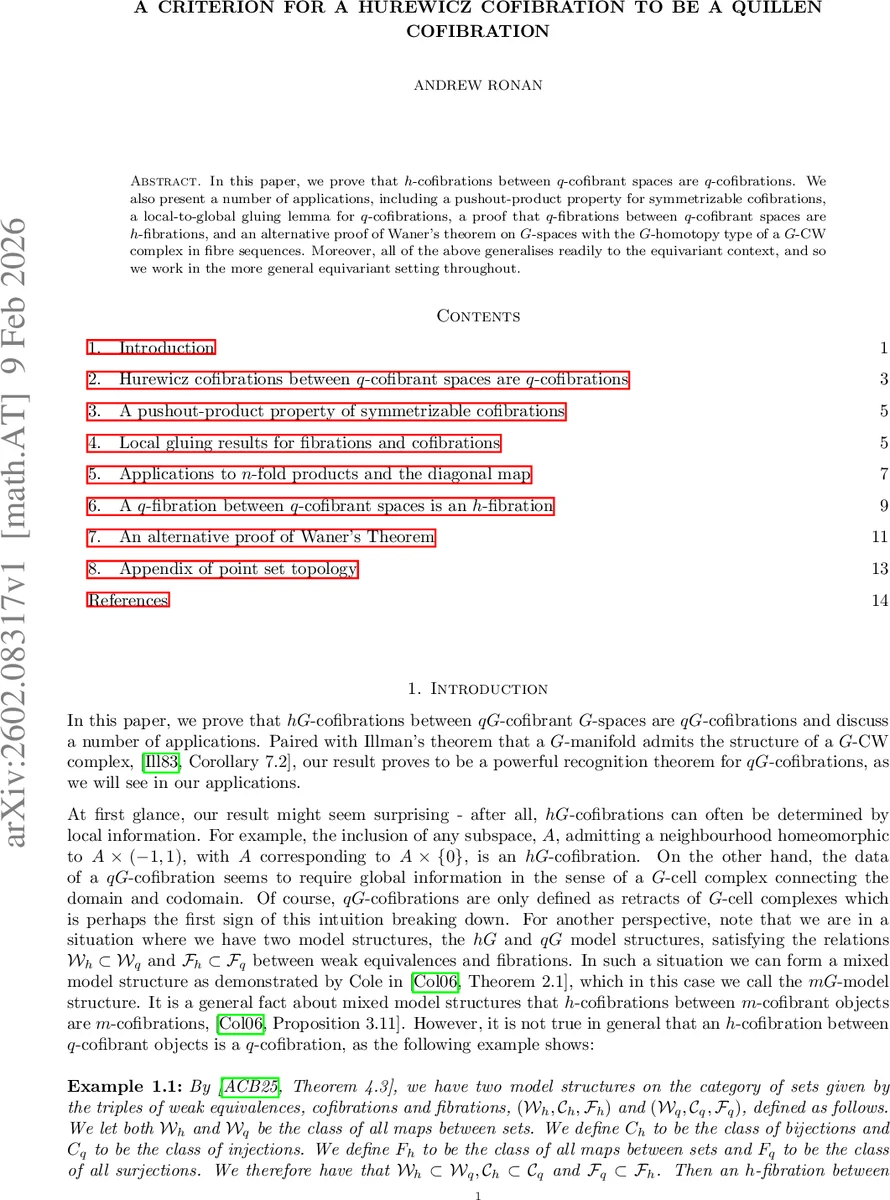
In this paper, we prove that $h$-cofibrations between $q$-cofibrant spaces are $q$-cofibrations. We also present a number of applications, including a pushout-product property for symmetrizable cofibrations, a local-to-global gluing lemma for $q$-cofibrations, a proof that $q$-fibrations between $q$-cofibrant spaces are $h$-fibrations, and an alternative proof of Waner’s theorem on $G$-spaces with the $G$-homotopy type of a $G$-CW complex in fibre sequences. Moreover, all of the above generalises readily to the equivariant context, and so we work in the more general equivariant setting throughout.
💡 Research Summary
The paper establishes a fundamental bridge between two classical notions of cofibration in homotopy theory: Hurewicz (or h‑) cofibrations and Quillen (or q‑) cofibrations, within the setting of equivariant topology. The main theorem states that any h‑cofibration between q‑cofibrant G‑spaces is automatically a q‑cofibration. The proof proceeds by first recalling Cole’s mixed model structure (the “m‑model”) which interpolates between the Hurewicz and Quillen model structures. In this mixed setting, h‑cofibrations between m‑cofibrant objects are m‑cofibrations. The authors then show that, when the target is q‑cofibrant, the mixed cofibration coincides with a q‑cofibration. The technical heart lies in Lemma 2.1, which provides a homotopy‑extension argument for maps satisfying a relative lifting property with respect to a certain cylinder inclusion; this lemma is used repeatedly to replace homotopy‑relative lifts by genuine lifts, thereby enabling the retract argument that characterises cofibrations in a model category.
Having secured this core result (Theorem 2.6), the authors develop several significant applications:
-
Symmetrizable cofibrations and pushout‑product – They define a symmetrizable (acyclic) cofibration as a map whose iterated pushout‑products, modulo the symmetric group action, remain (acyclic) cofibrations. Theorem 3.3 shows that if (j) is a symmetrizable cofibration in a closed symmetric monoidal model category and (i) is a q‑cofibration of spaces, then the pushout‑product (j;\square;i) is again symmetrizable, and it is acyclic whenever either factor is acyclic. The proof exploits the monoidal structure, the fact that the tensor product preserves colimits, and the equivariant left‑lifting‑property for each isotropy subgroup in the chosen family (\mathcal C).
-
Local‑to‑global gluing for cofibrations and fibrations – Using a Zorn‑type argument (Lemma 4.2), the paper proves that if a map is a C‑cofibration (or C‑fibration) on each member of a numerable G‑open cover of the codomain, then it is a C‑cofibration (or C‑fibration) globally (Theorems 4.4 and 4.5). This mirrors classical results of Dold for Hurewicz (co)fibrations but now works in the equivariant q‑model context.
-
Diagonal maps and n‑fold products – Theorem 5.1 establishes that for a q‑cofibrant G‑space (X), the diagonal map (\Delta\colon X\to X^{n}) is a ((G\times\Sigma_{n}))-q‑cofibration. This is obtained by iterating the symmetrizable pushout‑product result and yields an equivariant analogue of a classical result of Dold–Eilenberg.
-
From q‑fibrations to h‑fibrations – Theorem 6.1 shows that a C‑fibration between C‑cofibrant objects is automatically an h‑fibration, provided the family (\mathcal C) is closed under conjugacy and intersections. This reverses the main theorem and recovers known non‑equivariant results (Cauty, Steinberger–West) while extending them to the equivariant setting.
-
Waner’s theorem and its converse – Finally, Theorem 7.1 gives a slick proof of Waner’s theorem on G‑spaces having the G‑homotopy type of a G‑CW complex in fibre sequences, and also its converse. The argument combines the local‑to‑global gluing machinery with the main h‑to‑q result, showing that if (p\colon E\to B) is an h‑fibration and (B) is m(\mathcal C)-cofibrant, then each fibre over a point with isotropy (H) is m((H\cap\mathcal C))-cofibrant.
Throughout, the paper works in the more general (\mathcal C)-model structure on G‑spaces (as in
Comments & Academic Discussion
Loading comments...
Leave a Comment