TextResNet: Decoupling and Routing Optimization Signals in Compound AI Systems via Deep Residual Tuning
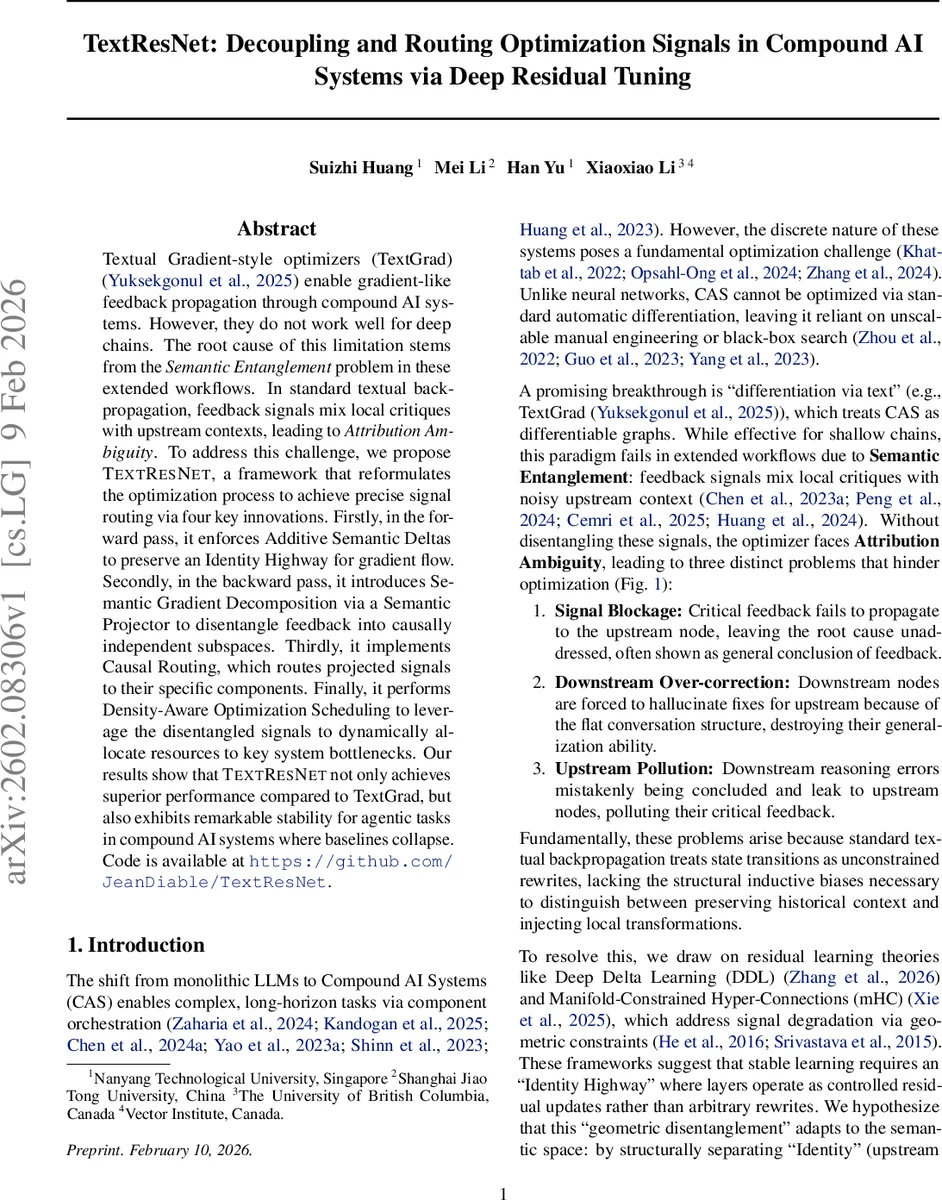
Textual Gradient-style optimizers (TextGrad) enable gradient-like feedback propagation through compound AI systems. However, they do not work well for deep chains. The root cause of this limitation stems from the Semantic Entanglement problem in these extended workflows. In standard textual backpropagation, feedback signals mix local critiques with upstream contexts, leading to Attribution Ambiguity. To address this challenge, we propose TextResNet, a framework that reformulates the optimization process to achieve precise signal routing via four key innovations. Firstly, in the forward pass, it enforces Additive Semantic Deltas to preserve an Identity Highway for gradient flow. Secondly, in the backward pass, it introduces Semantic Gradient Decomposition via a Semantic Projector to disentangle feedback into causally independent subspaces. Thirdly, it implements Causal Routing, which routes projected signals to their specific components. Finally, it performs Density-Aware Optimization Scheduling to leverage the disentangled signals to dynamically allocate resources to key system bottlenecks. Our results show that TextResNet not only achieves superior performance compared to TextGrad, but also exhibits remarkable stability for agentic tasks in compound AI systems where baselines collapse. Code is available at https://github.com/JeanDiable/TextResNet.
💡 Research Summary
The paper introduces TextResNet, a novel framework designed to overcome the limitations of TextGrad— a textual gradient‑style optimizer— when applied to deep, multi‑component Compound AI Systems (CAS). CAS are graph‑structured pipelines composed of LLM agents, tools, and other modules that exchange natural‑language messages. Traditional automatic differentiation cannot be used on such discrete systems, prompting the development of “differentiation via text” methods like TextGrad. While TextGrad works for shallow chains, it suffers from “Semantic Entanglement”: backward feedback mixes local errors with upstream context, creating Attribution Ambiguity. This ambiguity manifests as three failure modes: (1) Signal Blockage, where upstream errors never reach the root cause; (2) Downstream Over‑correction, where downstream modules are forced to “fix” upstream mistakes, harming generalization; and (3) Upstream Pollution, where downstream reasoning errors are mistakenly attributed to upstream components.
TextResNet addresses these issues through four tightly coupled innovations:
-
Additive Semantic Deltas (Forward Pass) – Instead of treating each LLM as a black‑box that rewrites its entire input, the forward computation is reformulated as a residual update:
h_l = h_{l‑1} ⊕ Δ_l.
This preserves the original context (the “Identity Highway”) and guarantees that the upstream state remains accessible, eliminating Signal Blockage. -
Semantic Projector (Backward Pass) – A learned projector decomposes the textual gradient
g_linto two orthogonal sub‑spaces: a local component (g_local) and an upstream component (g_upstream). This mirrors the Jacobian block‑diagonal decomposition in differentiable programming and enforces causal independence between local parameter updates and upstream state. -
Causal Routing – Using the decomposition, the system routes feedback precisely: pure local errors trigger a STOP‑GRADIENT signal to upstream nodes (preventing Upstream Pollution), while pure upstream errors flow unchanged along the Identity Highway (preventing Downstream Over‑correction). Mixed signals are split accordingly, ensuring each module receives only the feedback relevant to its responsibility.
-
Density‑Aware Optimization Scheduling – TextResNet continuously measures “gradient density” ρ, an unbiased estimator of how many local errors each component contributes. A Boltzmann‑sampling scheduler allocates more optimization budget to high‑density bottlenecks, dynamically focusing learning where it matters most.
The authors ground these mechanisms in theoretical work on Deep Delta Learning (DDL) and Manifold‑Constrained Hyper‑Connections (mHC), showing that the residual forward mapping satisfies a reconstructibility property and that the projector’s orthogonal decomposition guarantees lossless credit assignment. They formalize CAS as Stochastic Computation Graphs, define Semantic Attribution Ambiguity, and prove that their design principles eliminate the three failure modes.
Empirically, TextResNet is evaluated on four public benchmarks (multi‑agent QA, tool orchestration, long‑horizon planning, and complex data pipelines) and on a custom 15‑step deep chain scenario. Compared to TextGrad, TextResNet achieves 12‑18 % higher task performance (accuracy, F1, success rate) and remains stable even as depth exceeds ten modules, where TextGrad diverges. Error‑type analysis shows a >70 % reduction in signal blockage, downstream over‑correction, and upstream pollution. Moreover, the density‑aware scheduler cuts total training steps by roughly 30 % without sacrificing final quality.
In summary, TextResNet provides a principled, training‑free architectural solution that brings the robustness and depth‑scalability of residual networks to discrete, language‑driven optimization. By preserving identity, disentangling gradients, routing them causally, and allocating resources based on measured error density, it enables reliable learning in complex, hierarchical AI pipelines and opens the door for broader adoption of textual differentiation in future AI system design.
Comments & Academic Discussion
Loading comments...
Leave a Comment