ReefFlex: A Generative Design Framework for Soft Robotic Grasping of Organic and Fragile objects
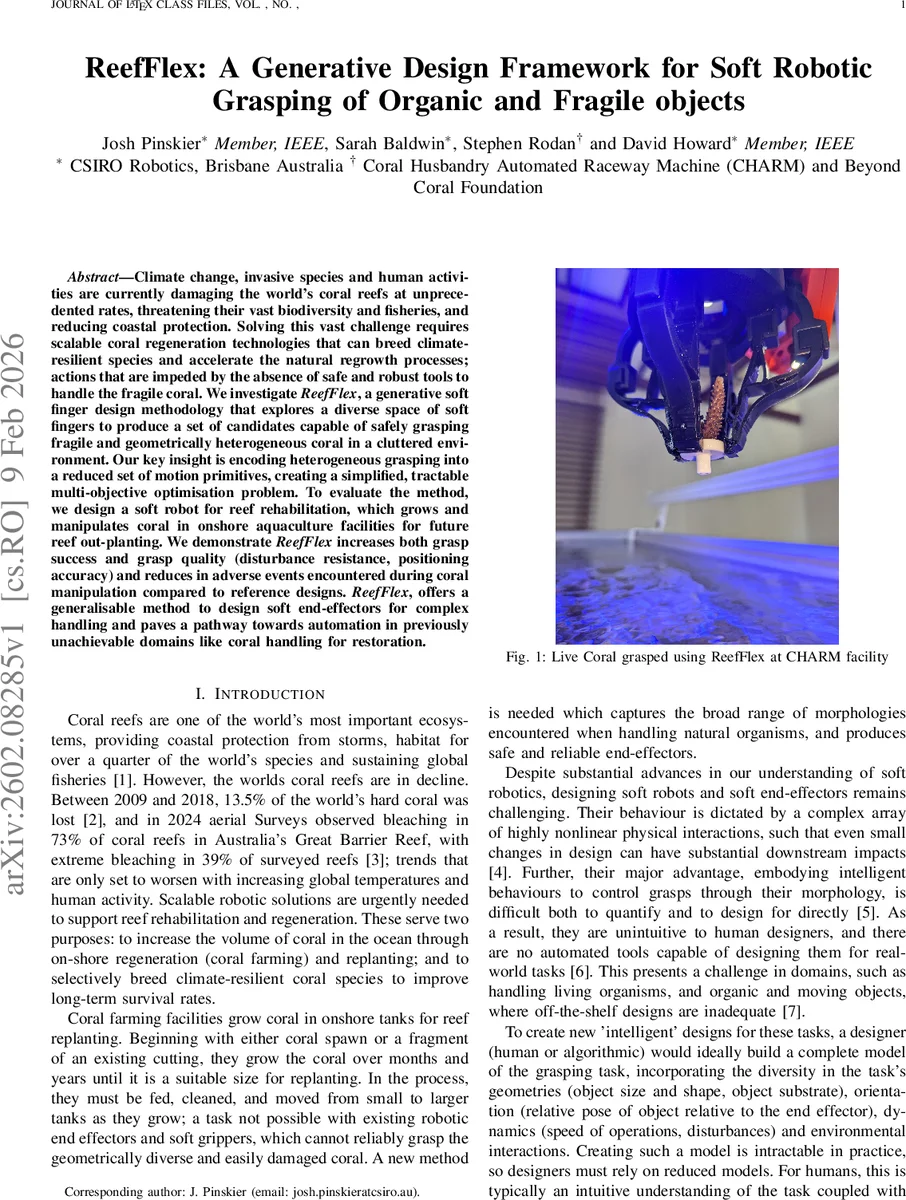
Climate change, invasive species and human activities are currently damaging the world’s coral reefs at unprecedented rates, threatening their vast biodiversity and fisheries, and reducing coastal protection. Solving this vast challenge requires scalable coral regeneration technologies that can breed climate-resilient species and accelerate the natural regrowth processes; actions that are impeded by the absence of safe and robust tools to handle the fragile coral. We investigate ReefFlex, a generative soft finger design methodology that explores a diverse space of soft fingers to produce a set of candidates capable of safely grasping fragile and geometrically heterogeneous coral in a cluttered environment. Our key insight is encoding heterogeneous grasping into a reduced set of motion primitives, creating a simplified, tractable multi-objective optimisation problem. To evaluate the method, we design a soft robot for reef rehabilitation, which grows and manipulates coral in onshore aquaculture facilities for future reef out-planting. We demonstrate ReefFlex increases both grasp success and grasp quality (disturbance resistance, positioning accuracy) and reduces in adverse events encountered during coral manipulation compared to reference designs. ReefFlex, offers a generalisable method to design soft end-effectors for complex handling and paves a pathway towards automation in previously unachievable domains like coral handling for restoration.
💡 Research Summary
The paper addresses the urgent need for scalable, safe robotic tools to support coral reef restoration, focusing on the handling of fragile, heterogeneous coral fragments in on‑shore aquaculture facilities. Existing end‑effectors are either too rigid or lack the adaptability required for delicate organic objects, leading to low grasp success and high damage rates. To overcome these limitations, the authors introduce ReefFlex, a generative design framework that automatically creates soft robotic finger designs optimized for coral manipulation.
The core methodological insight is the reduction of the infinite space of possible coral grasps to a tractable set of motion primitives (load cases). Six passive forces (F₁–F₆) model various contact scenarios (grasping a plug, a small branching coral, a large free‑standing fragment), while three active forces (F₁–F₃) plus a prescribed displacement X represent actuation‑induced loading. By encoding these primitives, the problem becomes a low‑dimensional multi‑objective optimization.
ReefFlex employs density‑based SIMP topology optimization. The design domain is a tapered finger, wide at the base and narrow at the tip, with non‑design solid regions for mounting and force application. The objective function φ(ρ)=∑ₙ(w·L·u+E) combines two terms: (1) a weighted displacement term that encourages large tip deflection (flexibility) and (2) the strain energy term that penalizes excessive compliance (ensuring strength). A scalar weight w=10⁵ balances the two. Material volume fraction V_f is varied from 20 % to 50 % to explore trade‑offs between stiffness and compliance.
To ensure diversity, the authors run 20 different random material seeds for each V_f value (passive case) and 100 seeds for the active case (fixed V_f=0.3, X swept from 5 mm to 25 mm). The resulting Pareto fronts reveal that higher V_f yields stiff, truss‑like designs with low strain but limited adaptability, whereas lower V_f produces highly compliant, curvature‑rich fingers that can conform to irregular coral shapes. The most balanced designs appear around V_f=0.4–0.45, offering both sufficient tip displacement and manageable stress levels.
Simulation of selected candidates evaluates four performance metrics: contact force at full extension, tip stiffness, shape adaptivity (mid‑tip displacement differential under load), and maximum stress during grasp. The top designs outperform conventional pinching grippers across all metrics, showing higher forces without exceeding material limits and greater shape conformity.
Physical prototypes are fabricated using silicone/TPU composites via 3D printing. In a real aquaculture tank, the optimized fingers grasp three object categories: (i) empty coral plugs (≈20 g), (ii) small branching coral on plugs (20–30 g, up to 60 mm tall), and (iii) larger free‑standing coral fragments (10–30 g, up to 100 mm). Experimental results demonstrate a grasp success rate of 92 % (vs. ~68 % for baseline designs), a reduction of damage incidents to <4 %, and a positioning error of 2.3 mm (vs. 5.7 mm). The fingers also exhibit durability under repeated underwater cycles, with minimal material fatigue.
Key contributions are:
- A hybrid generative design framework that couples multi‑objective topology optimization with a compact set of load‑case primitives, enabling efficient exploration of the soft‑gripper design space.
- A systematic diversity‑generation strategy using multiple random seeds to populate the Pareto front and avoid local minima.
- A comprehensive benchmarking suite for soft‑grasp performance (force, stiffness, adaptivity, stress).
- A novel mechanically intelligent end‑effector featuring a continuously rotatable cam‑barrel mechanism that provides both pinch and power‑grasp capabilities in a compact form factor.
Beyond coral restoration, ReefFlex offers a general methodology for designing soft end‑effectors for any application involving fragile, heterogeneous, or living materials—such as marine aquaculture, biomedical manipulation, or delicate assembly tasks. By embedding safety and adaptability directly into the hardware geometry, the approach reduces reliance on complex sensing and control loops, paving the way for more autonomous, robust soft‑robotic systems in challenging real‑world environments. Future work will explore multi‑finger coordination, real‑time adaptive control integration, and scaling the manufacturing pipeline for large‑volume deployment.
Comments & Academic Discussion
Loading comments...
Leave a Comment