Optimal Transmit Beamforming for MIMO ISAC with Unknown Target and User Locations
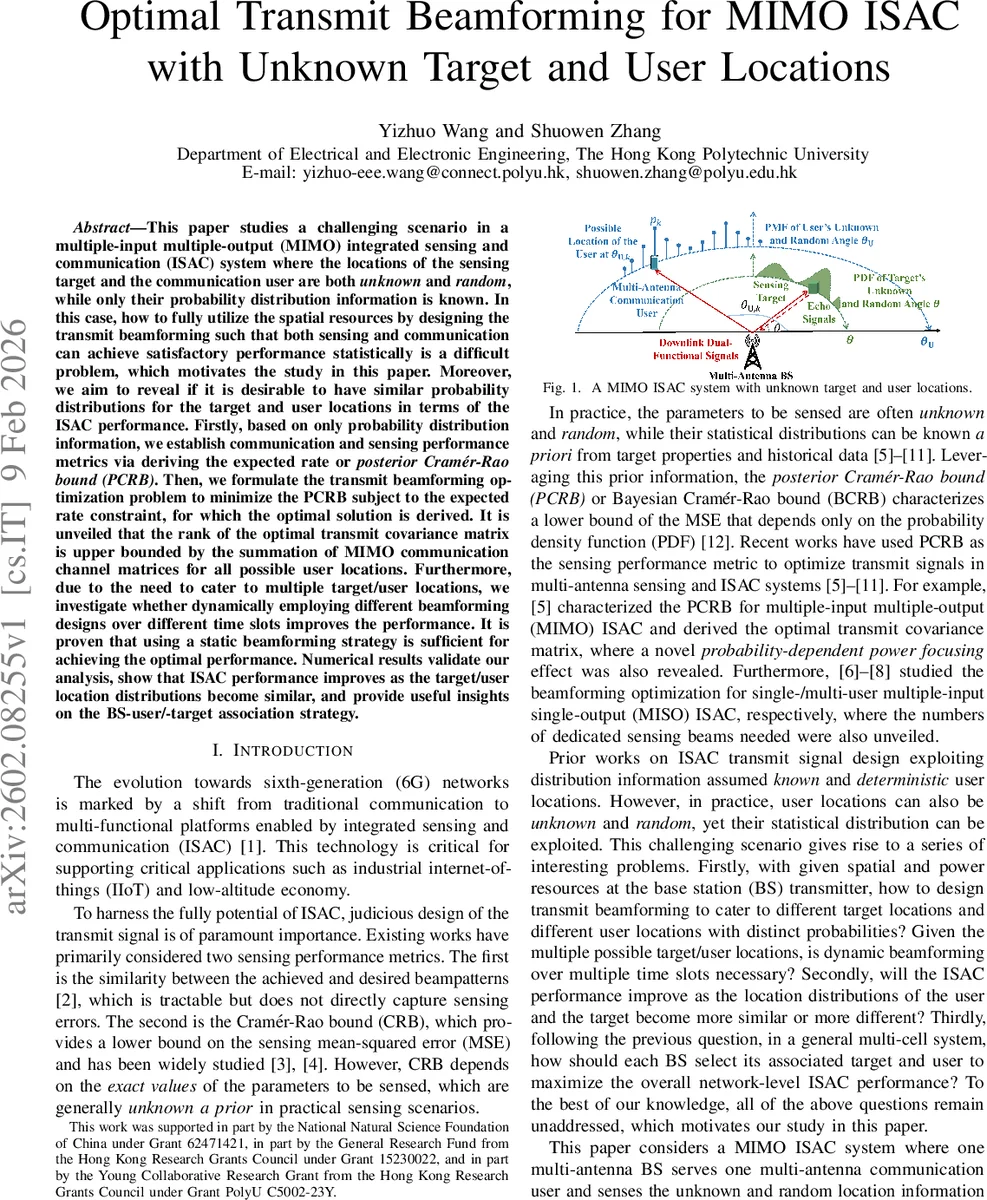
This paper studies a challenging scenario in a multiple-input multiple-output (MIMO) integrated sensing and communication (ISAC) system where the locations of the sensing target and the communication user are both unknown and random, while only their probability distribution information is known. In this case, how to fully utilize the spatial resources by designing the transmit beamforming such that both sensing and communication can achieve satisfactory performance statistically is a difficult problem, which motivates the study in this paper. Moreover, we aim to reveal if it is desirable to have similar probability distributions for the target and user locations in terms of the ISAC performance. Firstly, based on only probability distribution information, we establish communication and sensing performance metrics via deriving the expected rate or posterior Cramér-Rao bound (PCRB). Then, we formulate the transmit beamforming optimization problem to minimize the PCRB subject to the expected rate constraint, for which the optimal solution is derived. It is unveiled that the rank of the optimal transmit covariance matrix is upper bounded by the summation of MIMO communication channel matrices for all possible user locations. Furthermore, due to the need to cater to multiple target/user locations, we investigate whether dynamically employing different beamforming designs over different time slots improves the performance. It is proven that using a static beamforming strategy is sufficient for achieving the optimal performance. Numerical results validate our analysis, show that ISAC performance improves as the target/user location distributions become similar, and provide useful insights on the BS-user/-target association strategy.
💡 Research Summary
This paper tackles a highly realistic yet analytically challenging scenario in multiple‑input multiple‑output (MIMO) integrated sensing and communication (ISAC) systems: both the sensing target and the communication user have unknown, random angular locations, and only their probability distributions are known a priori. The authors first derive statistical performance metrics that depend solely on these distributions. For communication, the expected achievable rate is obtained by averaging the Shannon‑capacity expression over all possible user angles. For sensing, they adopt the posterior Cramér‑Rao bound (PCR‑B) as the metric, which provides a lower bound on the mean‑squared error of the target angle estimate while incorporating prior information about the angle and the unknown reflection coefficient.
The design problem is formulated as a convex optimization: minimize the PCR‑B (equivalently maximize the trace of a positive‑semidefinite matrix A₁ multiplied by the transmit covariance W) subject to (i) an expected‑rate constraint (\bar R) and (ii) a total transmit‑power constraint. Because the objective is linear in W and the constraints are convex, the problem can be solved by standard interior‑point methods, but the authors go further to reveal the structure of the optimal solution using Lagrange duality.
Two cases are examined. When the rate constraint is inactive, the optimal W is rank‑one and aligns with the dominant eigenvector of A₁, i.e., (W^\star = P, q_1 q_1^H). When the rate constraint is active, dual variables β (for the rate) and μ (for power) are introduced, leading to a modified cost matrix Q = μI – βA₁ that must be positive definite (μ must exceed the largest eigenvalue of A₁). By a change of variables, the problem reduces to maximizing a log‑determinant minus a trace term, whose KKT conditions imply that the optimal (\hat W) lies in the column space of a matrix D constructed from the weighted sum of the transformed user channel matrices. Consequently, the rank of the optimal transmit covariance is bounded by the sum of the ranks of all possible user channel matrices: \
Comments & Academic Discussion
Loading comments...
Leave a Comment