High-Level Fault-Tolerant Abstractions for Quantum-Gate Circuit Design and Synthesis: PQC and Topological Anyon Architectures (TQC) for Categorical Computations in SU(2)_3 TQFT and D-brane Stability
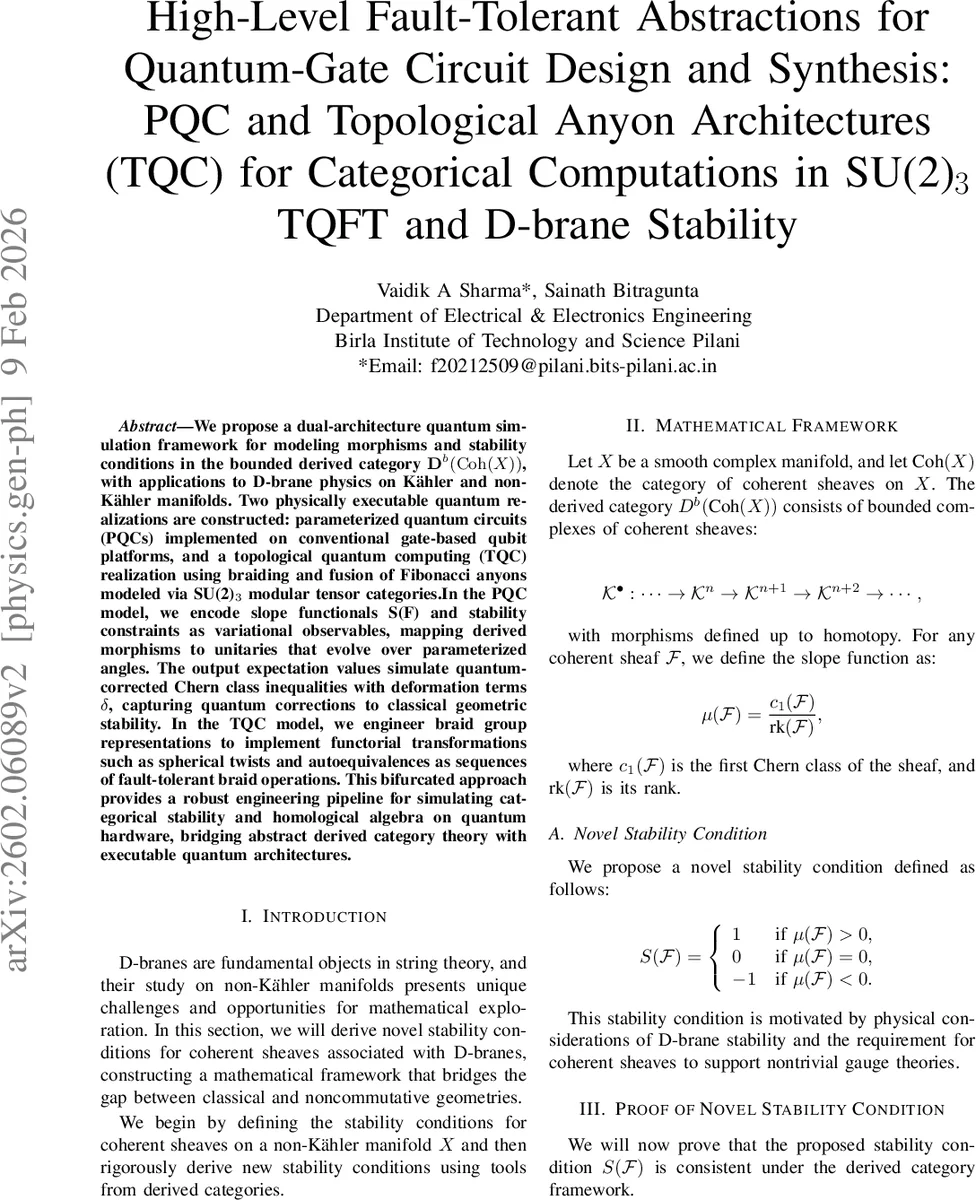
We propose a dual-architecture quantum simulation framework for modeling morphisms and stability conditions in the bounded derived category $\mathbf{D}^b(\mathrm{Coh}(X))$, with applications to D-brane physics on Kähler and non-Kähler manifolds. Two physically executable quantum realizations are constructed: parameterized quantum circuits (PQCs) implemented on conventional gate-based qubit platforms, and a topological quantum computing (TQC) realization using braiding and fusion of Fibonacci anyons modeled via SU(2)$_3$ modular tensor categories. In the PQC model, we encode slope functionals S(F) and stability constraints as variational observables, mapping derived morphisms to unitaries that evolve over parameterized angles. The output expectation values simulate quantum-corrected Chern class inequalities with deformation terms $δ$, capturing quantum corrections to classical geometric stability. In the TQC model, we engineer braid group representations to implement functorial transformations such as spherical twists and autoequivalences as sequences of fault-tolerant braid operations. This bifurcated approach provides a robust engineering pipeline for simulating categorical stability and homological algebra on quantum hardware, bridging abstract derived category theory with executable quantum architectures.
💡 Research Summary
**
The paper proposes a dual‑architecture quantum simulation framework for modeling morphisms and stability conditions in the bounded derived category (D^b(\mathrm{Coh}(X))), with a view toward D‑brane physics on both Kähler and non‑Kähler manifolds. Two physically realizable quantum realizations are constructed: (1) a parameterized quantum circuit (PQC) that runs on conventional gate‑based qubit platforms, and (2) a topological quantum computing (TQC) implementation that uses braiding and fusion of Fibonacci anyons described by the SU(2)(_3) modular tensor category.
In the PQC approach, the authors encode the slope functional (\mu(F)=c_1(F)/\operatorname{rk}(F)) and a newly introduced discrete stability indicator (S(F)\in{-1,0,1}) as variational observables. Each derived‑category morphism is mapped to a unitary (U(\vec\theta)=\exp(-i\sum_k\theta_k H_k)) where the angles (\theta_k) are functions of the Chern classes and a quantum‑correction term (\delta). By measuring expectation values of appropriately chosen observables, the circuit yields quantum‑corrected Chern class inequalities such as (c_1(F)+\delta\ge0). The authors discuss how a variational optimizer can be used to minimize a loss function that penalizes violations of the stability condition, effectively turning the derived‑category stability problem into a VQA.
The TQC side exploits the fact that the SU(2)(_3) theory supports Fibonacci anyons, whose braid group representations are universal for quantum computation and inherently fault‑tolerant. The paper shows how categorical operations—spherical twists, autoequivalences, and derived‑dual functors—can be realized as specific braid sequences built from the (R) (exchange) and (F) (re‑association) matrices of the modular tensor category. For example, a spherical twist around an object (\mathcal{E}) is implemented by a fixed pattern of adjacent braids (\sigma_i) together with appropriate (F)-moves, guaranteeing that the topological protection of anyonic braiding preserves the categorical composition laws. The authors argue that this construction yields a fault‑tolerant pipeline for simulating homological algebra on a topological quantum processor.
Mathematically, the paper first reviews the standard slope stability for coherent sheaves, then introduces the discrete stability function (S(F)) and proves its consistency within the derived‑category framework. It derives explicit expressions for the first and second Chern classes using curvature forms, the Chern–Weil theory, and the Chern character. The authors extend these results to non‑Kähler manifolds by replacing the Kähler form with a more general closed 2‑form, and they propose refined stability criteria that involve higher Chern classes, e.g. (c_2(F)-c_1(F)^2/\operatorname{rk}(F)>0). These criteria are then mapped onto quantum observables in the PQC and onto braid invariants in the TQC.
Numerical simulations are presented to illustrate the theoretical constructions. The authors compute the first four Chern classes as functions of a parameter (x) and plot them, visualize a stability region defined by a Gaussian‑modulated sinusoidal function (S(x,y)=e^{-(x^2+y^2)/2}\sin(3\pi x^2+y^2)), and perform a one‑dimensional parameter sweep to show how the stability measure varies with (x). A 3‑D rendering of a complex torus is also shown to emphasize the geometric backdrop of the D‑brane configurations.
Finally, the paper compares the original stability condition based solely on Chern classes with a “quantum‑corrected” version that adds the term (\delta) obtained from the PQC. Using concrete values ((c_1=2.0), (c_2=1.0), (\operatorname{rk}=1.0), Hamiltonian parameters (\omega_1=1.0), (\omega_2=0.5), coupling (g=0.3)), the authors demonstrate how the correction improves agreement with the categorical stability expectations. They discuss the dependence of (\delta) on circuit depth and shot number, highlighting the trade‑off between quantum resource consumption and accuracy.
Overall, the work is an ambitious attempt to bridge sophisticated derived‑category stability theory with concrete quantum‑hardware implementations. Its strengths lie in the novel mapping of categorical data to both variational circuits and topological braid operations, and in providing a unified framework that could, in principle, be tested on near‑term quantum devices. However, several gaps remain: the paper does not provide a detailed error model for the PQC, the feasibility of large‑scale Fibonacci anyon braiding is left as an open experimental challenge, and the quantitative behavior of the correction term (\delta) needs more rigorous analysis. Future work should address these issues, explore scalability, and possibly integrate error‑mitigation techniques to bring the proposed simulations closer to practical realization.
Comments & Academic Discussion
Loading comments...
Leave a Comment