ReFRAME or Remain: Unsupervised Lexical Semantic Change Detection with Frame Semantics
The majority of contemporary computational methods for lexical semantic change (LSC) detection are based on neural embedding distributional representations. Although these models perform well on LSC benchmarks, their results are often difficult to interpret. We explore an alternative approach that relies solely on frame semantics. We show that this method is effective for detecting semantic change and can even outperform many distributional semantic models. Finally, we present a detailed quantitative and qualitative analysis of its predictions, demonstrating that they are both plausible and highly interpretable
💡 Research Summary
The paper tackles the problem of lexical semantic change (LSC) detection by abandoning the dominant distribution‑based embedding paradigm and instead exploiting Frame Semantics, a linguistically grounded theory that models word meaning through structured background knowledge called frames. The authors hypothesize that a word’s semantic shift is reflected in the changing distribution of frames it participates in, either as the frame trigger (the lexical unit that evokes the frame) or as a frame element (a participant role within the frame).
To test this hypothesis they focus on the English portion of the SemEval 2020 Task 1 dataset, which provides two temporally separated corpora (c. 1810‑1860 and c. 1960‑2010). For each target word they extract all sentences containing its lemma, parse those sentences with a pretrained Frame Semantic Transformer (Chanin 2023) that outputs FrameNet‑style annotations, and collect every frame where the lemma appears as trigger or element. Duplicate counting is avoided at the frame‑instance level, while multiple distinct frames in the same sentence are all retained. Two distribution variants are built: (i) frame‑elements only (FE) and (ii) frame‑triggers plus frame‑elements (FTFE).
The core change metric is Jensen–Shannon Divergence (JSD) between the probability distributions of frames in the two time slices. JSD is bounded between 0 and 1, easy to interpret, and, crucially, decomposable: the contribution of each individual frame to the overall divergence can be inspected, providing a transparent explanation of why a word is deemed to have changed.
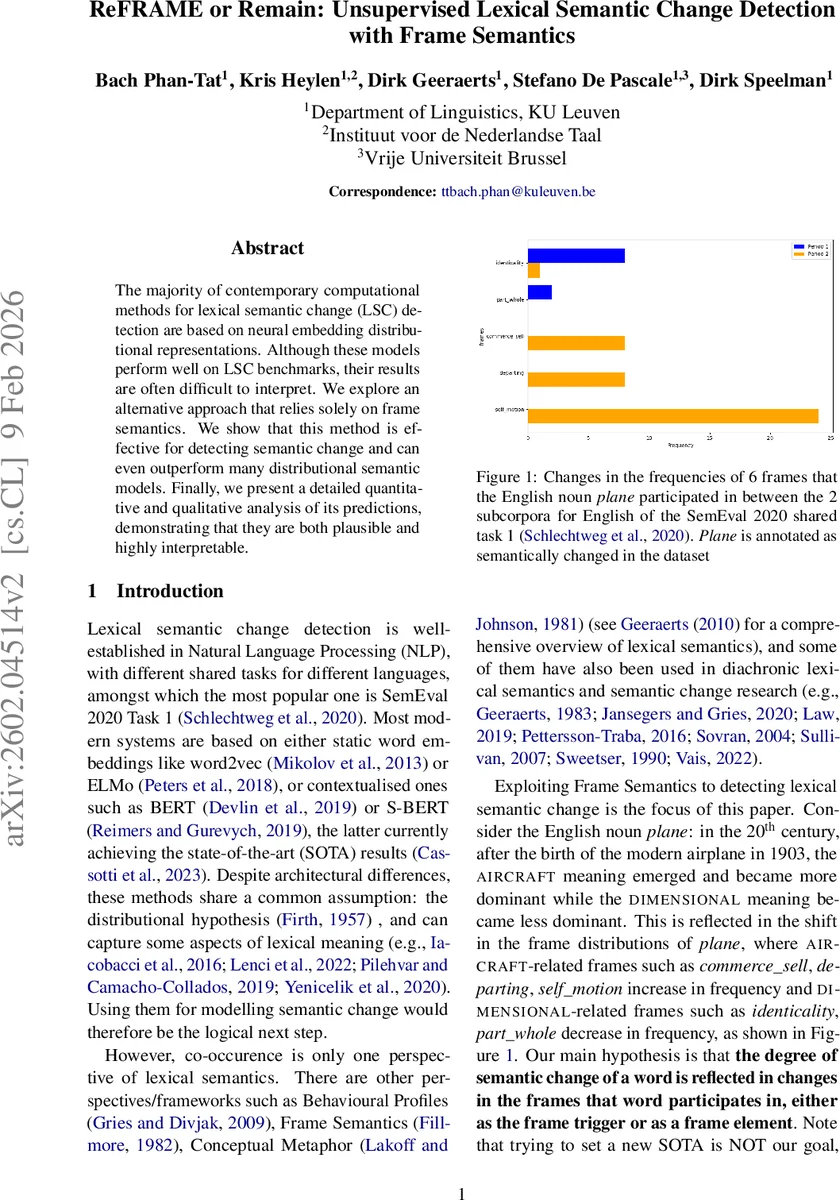
Evaluation follows the two subtasks of SemEval 2020 Task 1. Subtask 1 is a binary classification (changed vs. unchanged) assessed by accuracy; the authors use a simple threshold of JSD ≥ 0.5 to label a word as changed. Subtask 2 is a ranking task, measured by Spearman’s rho between the JSD scores and the gold continuous change scores. The frame‑based approach outperforms many strong baselines, including static embeddings (Word2Vec, FastText), contextual embeddings (ELMo, BERT, S‑BERT), and recent state‑of‑the‑art systems. Moreover, the method’s interpretability is demonstrated through case studies such as the noun “plane”, where the rise of AIR‑CRAFT‑related frames (e.g., commerce_sell, departing) and the decline of DIMENSIONAL frames (e.g., identicality, part_whole) neatly mirror the historical semantic shift from “flat surface” to “aircraft”.
The authors acknowledge several limitations. High‑quality frame parsers are currently available only for English; attempts to use German, Swedish, and Latin resources failed due to poor coverage or restrictive APIs, so the experiments are limited to English. FrameNet itself suffers from incomplete lexical coverage, especially for historical or domain‑specific vocabulary, and building frame‑annotated corpora is labor‑intensive. Nevertheless, the authors argue that frame semantics is theoretically language‑agnostic, and future work could extend the method once reliable multilingual parsers and resources are developed.
In conclusion, the study provides a compelling alternative to embedding‑centric LSC detection: a fully unsupervised, linguistically transparent technique that not only matches or exceeds the performance of state‑of‑the‑art models but also yields fine‑grained, human‑readable explanations of semantic change. This bridges a gap between computational NLP and traditional diachronic linguistics, opening avenues for multilingual extensions, integration with other linguistic cues (e.g., metaphor, lexical relations), and richer, explainable models of language evolution.
Comments & Academic Discussion
Loading comments...
Leave a Comment