Statistical Guarantees for Reasoning Probes on Looped Boolean Circuits
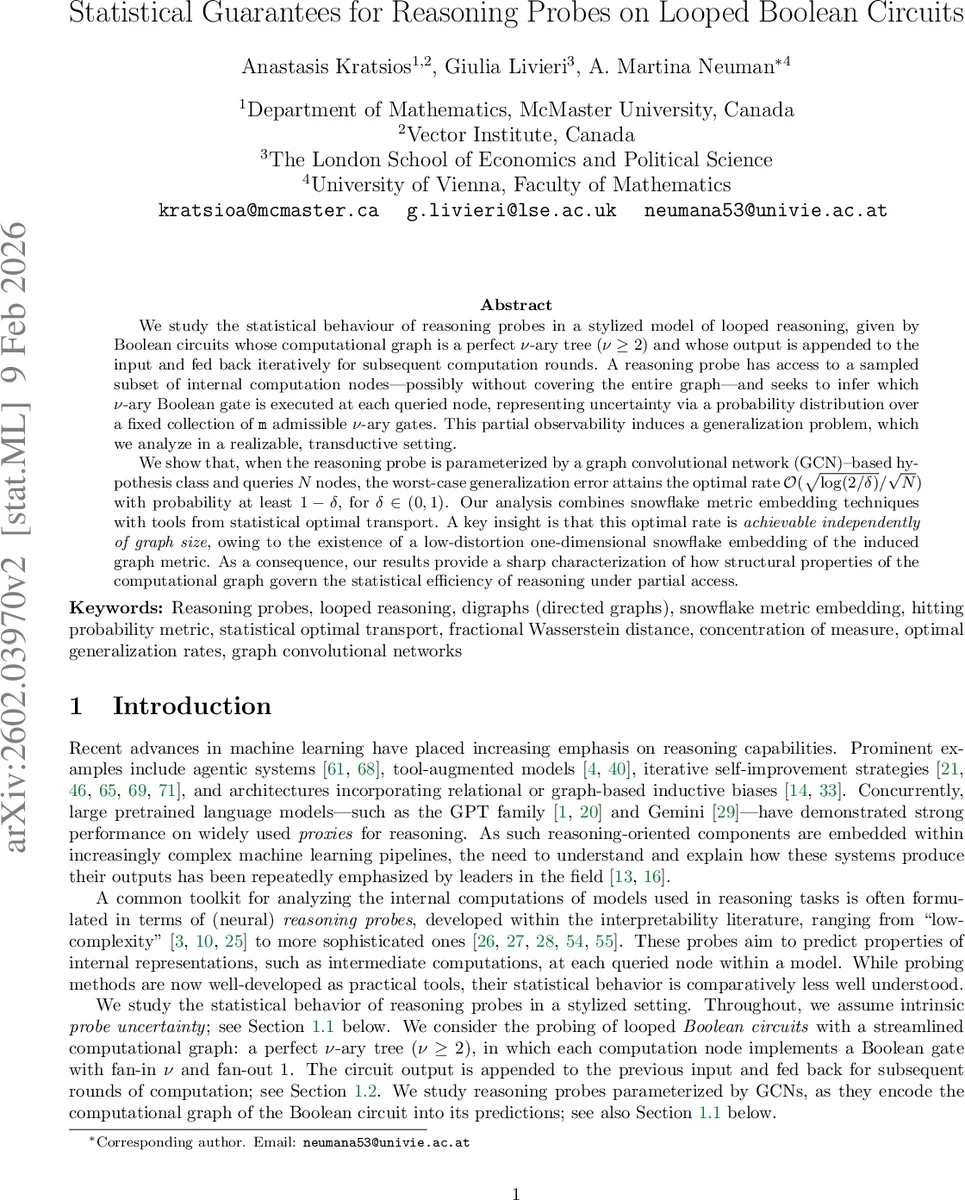
We study the statistical behaviour of reasoning probes in a stylized model of looped reasoning, given by Boolean circuits whose computational graph is a perfect $ν$-ary tree ($ν\ge 2$) and whose output is appended to the input and fed back iteratively for subsequent computation rounds. A reasoning probe has access to a sampled subset of internal computation nodes, possibly without covering the entire graph, and seeks to infer which $ν$-ary Boolean gate is executed at each queried node, representing uncertainty via a probability distribution over a fixed collection of $\mathtt{m}$ admissible $ν$-ary gates. This partial observability induces a generalization problem, which we analyze in a realizable, transductive setting. We show that, when the reasoning probe is parameterized by a graph convolutional network (GCN)-based hypothesis class and queries $N$ nodes, the worst-case generalization error attains the optimal rate $\mathcal{O}(\sqrt{\log(2/δ)}/\sqrt{N})$ with probability at least $1-δ$, for $δ\in (0,1)$. Our analysis combines snowflake metric embedding techniques with tools from statistical optimal transport. A key insight is that this optimal rate is achievable independently of graph size, owing to the existence of a low-distortion one-dimensional snowflake embedding of the induced graph metric. As a consequence, our results provide a sharp characterization of how structural properties of the computational graph govern the statistical efficiency of reasoning under partial access.
💡 Research Summary
The paper introduces a mathematically rigorous framework for “looped reasoning,” a computational paradigm in which the output of a Boolean circuit is repeatedly fed back as input across multiple time steps. The underlying circuit is a perfect ν‑ary tree of height h, where each internal node implements one of m admissible ν‑ary Boolean gates. At each discrete time step the tree’s root output is written to the first cell of a memory tape; the tape is then shifted and its contents become the new inputs for the next iteration. By unrolling this process over time, the authors obtain a strongly connected directed graph G_sc that captures both intra‑round (tree) edges and inter‑round (shift/write) edges.
A “reasoning probe” is defined as a model that, given a sampled subset of N internal nodes, must predict the gate distribution at each queried node. Rather than a single deterministic label, the probe outputs a probability vector in the relative interior Δ°_m of the m‑simplex, representing epistemic uncertainty over the m candidate gates. The simplex is equipped with the Aitchison geometry, which turns Δ°_m into a Hilbert space isometric to ℝ^{m‑1} with the Euclidean norm; this allows the authors to measure prediction error using a true metric rather than a pseudo‑distance.
The learning setting is transductive and realizable: the full graph, the true gate assignments, and the probe’s hypothesis class are all fixed; only a random subset of N nodes is observed. The probe is parameterized by a Graph Convolutional Network (GCN) that operates on the directed graph. Each GCN layer applies a p‑hop graph Laplacian Δ_G^p, a linear weight matrix with bounded operator norm, and a 1‑Lipschitz activation σ. The authors prove that such GCNs are Lipschitz continuous with respect to the hitting‑probability metric d_G defined on the directed graph via the stationary distribution of its associated Markov chain. Specifically, the Lipschitz constant depends only on the maximum out‑degree ν, the number of layers L, and the power p, but not on the total number of vertices |V|.
The technical heart of the paper consists of two novel contributions. First, the authors establish a one‑dimensional snowflake embedding theorem: any finite metric space (V,d) can be embedded into ℝ with distortion O(1) after applying the snowflake transform d^{1/2}. This result is tailored to the hitting‑probability metric of G_sc, which is generally asymmetric and non‑Euclidean. Second, they combine this embedding with the Lipschitz property of GCNs to bound the Rademacher complexity of the hypothesis class in terms of the snowflake‑embedded diameter. Using standard concentration inequalities (McDiarmid’s inequality and a union bound), they derive a high‑probability generalization bound
|R – \hat R| ≤ C·√{log(2/δ)}/√N
that holds with probability at least 1–δ for any δ∈(0,1). Crucially, the constant C is independent of the graph size k = |V_sc|, which for a perfect ν‑ary tree grows exponentially with the height h (k = (ν^{h+1} – ν^h – 1)/(ν–1)). Consequently, even for extremely large looped circuits, the probe’s excess risk decays at the optimal √N rate, matching the minimax lower bound for i.i.d. sampling in Euclidean spaces.
The paper’s contributions are summarized as follows: (1) a precise formalization of looped Boolean circuits as strongly connected digraphs; (2) a definition of reasoning probes that output Aitchison‑geometric probability distributions; (3) a proof that GCNs on such digraphs are Lipschitz with respect to the hitting‑probability metric; (4) a new one‑dimensional snowflake embedding theorem for arbitrary finite metrics; (5) a tight, graph‑size‑independent generalization bound for GCN‑parameterized probes. The authors also discuss secondary implications, such as the potential to extend the analysis to non‑perfect trees, larger gate sets, or alternative graph neural architectures (e.g., GAT, GraphSAGE). While no empirical experiments are presented, the theoretical results provide a solid foundation for designing efficient probing mechanisms in large‑scale, feedback‑driven neural systems such as chain‑of‑thought language models, memory‑augmented networks, and other architectures that exhibit looped computation. Future work is suggested to empirically validate the constants, explore broader circuit topologies, and investigate whether similar metric‑embedding techniques can yield optimal rates for other forms of partial observability in graph‑structured learning problems.
Comments & Academic Discussion
Loading comments...
Leave a Comment