A root finding method with arbitrary order of convergence
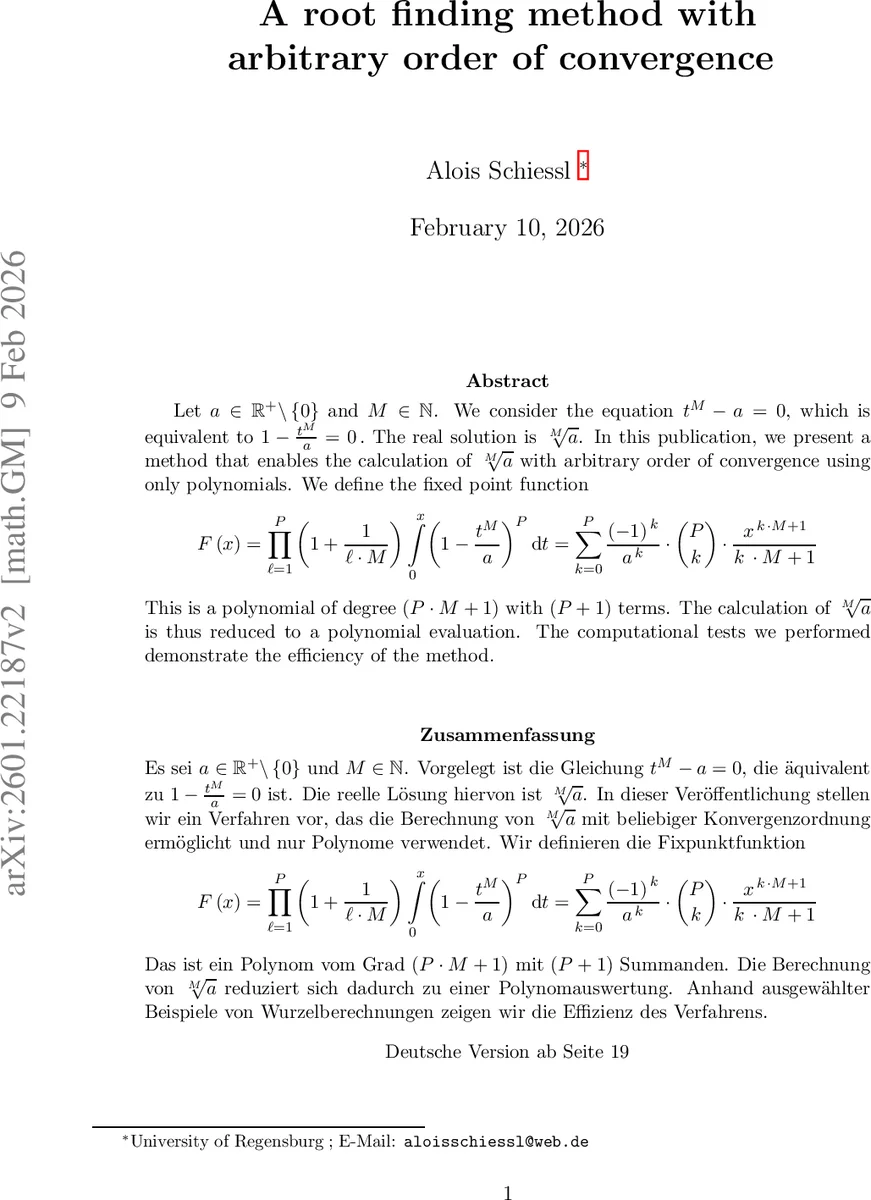
Let $a\in \mathbb{R}^{+}\backslash\left{0\right}$ and $M\in\mathbb{N}$. We consider the equation $t^M-a=0$, which is equivalent to $1-\frac{t^M}{a}=0,.$ The real solution is $\sqrt[M]{a}$. In this publication, we present a method that enables the calculation of $\sqrt[M]{a}$ with arbitrary order of convergence using only polynomials. We define the fixed point function [ F\left(x\right) =\prod_{\ell=1}^{P}\left(1+\frac{1}{\ell\cdot M}\right) \int\limits_{0}^{x}!\left(1-{\frac{{t}^{M}}{a}}\right)^{P}{\rm d}t =\sum\limits_{k=0}^{P}\frac{\left(-1\right)^{,k}}{a^{,k}}\cdot\binom{P}{k}\cdot\frac{x^{,k,\cdot M+1}}{k,\cdot M+1} ] This is a polynomial of degree $\left(P\cdot M+1\right)$ with $\left(P+1\right)$ terms. The calculation of $\sqrt[M]{a}$ is thus reduced to a polynomial evaluation. The computational tests we performed demonstrate the efficiency of the method. – Es sei $a\in \mathbb{R}^{+}\backslash\left{0\right}$ und $M\in\mathbb{N}$. Vorgelegt ist die Gleichung $t^M-a=0$, die äquivalent zu $1-\frac{t^M}{a}=0$ ist. Die reelle Lösung hiervon ist $\sqrt[M]{a}$. In dieser Veröffentlichung stellen wir ein Verfahren vor, das die Berechnung von $\sqrt[M]{a}$ mit beliebiger Konvergenzordnung ermöglicht und nur Polynome verwendet. Wir definieren die Fixpunktfunktion [F\left(x\right) =\prod_{\ell=1}^{P}\left(1+\frac{1}{\ell\cdot M}\right) \int\limits_{0}^{x}!\left(1-{\frac{{t}^{M}}{a}}\right)^{P}{\rm d}t =\sum\limits_{k=0}^{P}\frac{\left(-1\right)^{,k}}{a^{,k}}\cdot\binom{P}{k}\cdot\frac{x^{,k,\cdot M+1}}{k,\cdot M+1} ] Das ist ein Polynom vom Grad $\left(P\cdot M+1\right)$ mit $\left(P+1\right)$ Summanden. Anhand ausgewählter Beispiele von Wurzelberechnungen zeigen wir die Effizienz des Verfahrens.
💡 Research Summary
The paper introduces a novel fixed‑point iteration scheme for computing the real M‑th root of a positive real number a, i.e., the solution of t⁽ᴹ⁾ – a = 0. While the classical Newton method applied to f(t)=tᴹ–a yields quadratic convergence, the author’s approach allows the user to prescribe any natural integer P and obtain convergence of order P + 1, using only polynomial arithmetic.
The core construction starts from the auxiliary function f(t)=1−tᴹ/a. Raising f(t) to the power P and integrating from 0 to x gives
F(x)=∏{ℓ=1}^{P}!\Bigl(1+\frac{1}{ℓM}\Bigr)\int{0}^{x}!\bigl(1-\frac{t^{M}}{a}\bigr)^{P}dt.
By the substitution u=tᴹ/a the integral becomes a beta integral B(1/M, P+1). Using the relationship B(α,β)=Γ(α)Γ(β)/Γ(α+β) and the recurrence Γ(1+z)=zΓ(z), the author evaluates the integral in closed form and shows that
F(a^{1/M}) = a^{1/M},
so a^{1/M} is a fixed point of F. Differentiating F yields
F′(x)=∏_{ℓ=1}^{P}!\Bigl(1+\frac{1}{ℓM}\Bigr)\bigl(1-\frac{x^{M}}{a}\bigr)^{P},
which vanishes at the fixed point. Higher derivatives are obtained by repeatedly applying the Leibniz rule to the product (1−xᴹ/a)^{P}. The author proves that all derivatives up to order P are zero at the fixed point, while the (P+1)‑st derivative equals
F^{(P+1)}(a^{1/M}) = (−1)^{P} M a^{1/M} ∏_{ℓ=1}^{P}(1+ℓM).
Because F′ is continuous and zero at the fixed point, a neighbourhood exists where |F′(x)|<1, satisfying the hypotheses of Banach’s fixed‑point theorem. Consequently, for any initial guess x₀ sufficiently close to a^{1/M}, the iteration
x_{n+1}=F(x_n)
converges to the true root.
The order of convergence follows from the Taylor expansion of F around the fixed point:
F(x)=a^{1/M}+F^{(P+1)}(a^{1/M})/(P+1)!·(x−a^{1/M})^{P+1}+o((x−a^{1/M})^{P+1}).
Thus the error satisfies
e_{n+1}=C·e_n^{P+1}+o(e_n^{P+1}),
with C=F^{(P+1)}(a^{1/M})/(P+1)!. This demonstrates exact (P+1)‑st order convergence.
For practical computation the author expands F(x) into a polynomial
F(x)=∑{k=0}^{P}c_k x^{kM+1}, c_k=∏{ℓ=1}^{P}!\Bigl(1+\frac{1}{ℓM}\Bigr)(−1)^{k}a^{−k}\binom{P}{k}/(kM+1),
which has degree P·M+1 and only P+1 non‑zero terms. The coefficients c_k can be pre‑computed and stored, after which each iteration reduces to a polynomial evaluation. Efficient schemes such as Horner’s method can be employed, giving an O(P) cost per iteration.
The paper provides explicit formulas for P=1,2,3,4, illustrating how the method reproduces the Newton step for P=1 (quadratic convergence) and yields cubic, quartic, and quintic schemes for higher P. Two numerical experiments are reported. The first computes ³√10 with P=1, confirming quadratic convergence: after six iterations the error drops below 10⁻²⁸. The second computes √2 to one million decimal digits using P=3 (fourth‑order convergence). Starting from x₀=1, only nine iterations are required, each quadrupling the number of correct digits, and the final result matches the known high‑precision value.
Overall, the contribution is a flexible, purely polynomial root‑finding algorithm that can achieve arbitrarily high convergence order by choosing P. Its reliance on elementary algebraic operations makes it attractive for high‑precision contexts where division or transcendental functions are costly. The analysis is rigorous, employing classical beta/gamma function identities, Leibniz differentiation, and Banach’s fixed‑point theorem. Potential extensions include applying the same framework to complex roots, other algebraic equations, or integrating the method into arbitrary‑precision libraries.
Comments & Academic Discussion
Loading comments...
Leave a Comment