On curves of degree 10 with 12 triple points
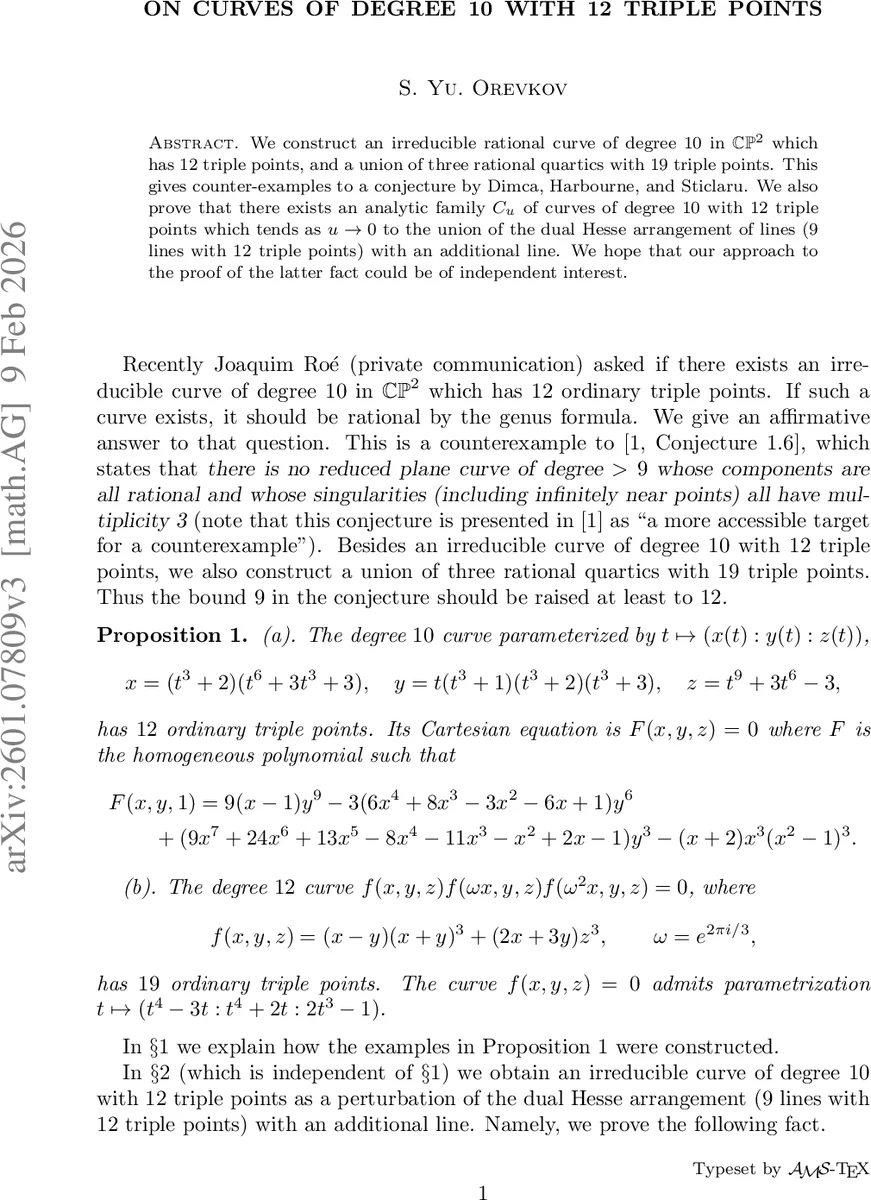
We construct an irreducible rational curve of degree 10 in $CP^2$ which has 12 triple points and a union of three rational quartics with 19 triple points. This gives counter-examples to a conjecture by Dimca, Harbourne, and Sticlaru. We also prove that there exists an analytic family $C_u$ of curves of degree 10 with 12 triple points which tends as $u\to 0$ to the union of the dual Hesse arrangement of lines (9 lines with 12 triple points) with an additional line. We hope that our approach to the proof of the latter fact could be of independent interest.
💡 Research Summary
The paper presents two main contributions concerning plane curves with many ordinary triple points. The first part (Section 1) gives an explicit construction of an irreducible rational curve C of degree 10 in the complex projective plane ℙ² that possesses exactly twelve ordinary triple points. The authors start by looking for a homogeneous polynomial f(x,y,z) of degree 10 that is symmetric in y³, i.e. f(x,y,z)=f₁(x,y³,z). The Newton polygon of f₁ lies inside a trapezoid with vertices (0,0), (10,0), (1,3), (0,3), which suggests working on the weighted projective surface Σ₃ = ℙ²_{1,3,1} (the blow‑up of ℙ² at (0:1:0)). They consider the three‑fold branched covering ρ:(x:y:z)↦(x:y³:z). Under ρ the desired curve C is the pre‑image of a curve C₁⊂Σ₃. C₁ meets the line L₁={y=0} in three points where it has cubic tangency; the remaining nine triple points of C are the pre‑images of three triple points of C₁.
Blowing up those three points on C₁ and then blowing down the strict transforms of the fibers through them transforms Σ₃ into Σ₀=ℙ¹×ℙ¹. On Σ₀ the strict transforms L₂ and C₂ belong respectively to the linear systems |A+3B| and |3A+B|, where A and B are the standard generators of Pic(ℙ¹×ℙ¹). By imposing symmetry with respect to the diagonal, the authors look for C₂ of the form f₂(x,y)=p(y)x+q(y) with degₓf₂=1, deg_yf₂=3. Choosing p(y)=y³−3y²+1 and q(y)=y³−y²+y yields a curve C₂ that is tangent to the line x+y=2a at the diagonal points (a,a) for a=0,±1, giving the required cubic contacts. After reversing the birational transformations and performing a few rescalings, they obtain the parametrization
t ↦ ( (t³+2)(t⁶+3t³+3) : t(t³+1)(t³+2)(t³+3) : t⁹+3t⁶−3 ),
which defines a degree‑10 rational curve with twelve ordinary triple points. This provides a concrete counter‑example to Conjecture 1.6 in Dimca‑Harbourne‑Sticlaru
Comments & Academic Discussion
Loading comments...
Leave a Comment