More Power to the Particles: Analytic Geometry for Partial Optimal Transport-based Fluid simulation
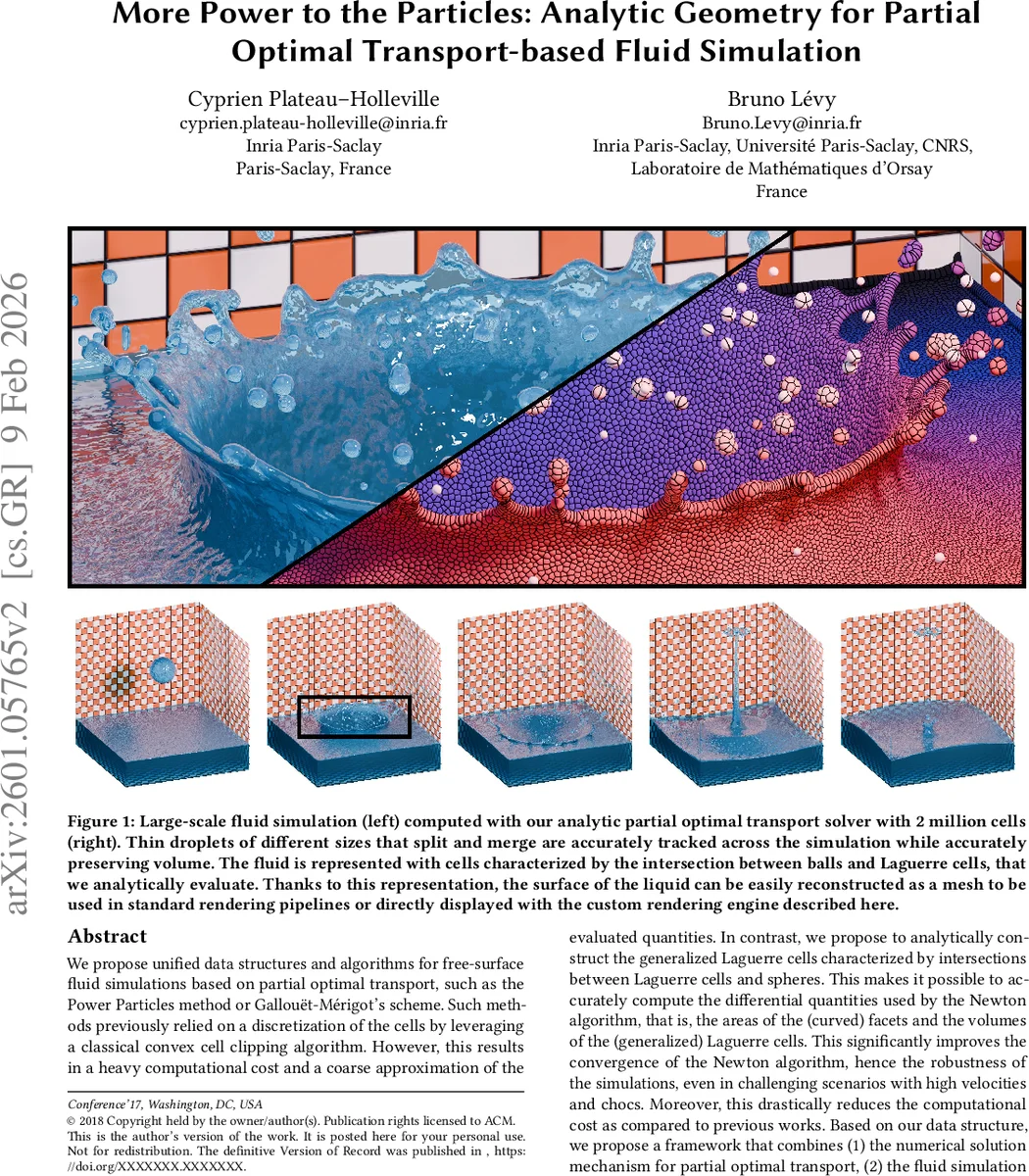
We propose unified data structures and algorithms for free-surface fluid simulations based on partial optimal transport, such as the Power Particles method or Gallouët-Mérigot’s scheme. Such methods previously relied on a discretization of the cells by leveraging a classical convex cell clipping algorithm. However, this results in a heavy computational cost and a coarse approximation of the evaluated quantities. In contrast, we propose to analytically construct the generalized Laguerre cells characterized by intersections between Laguerre cells and spheres. This makes it possible to accurately compute the differential quantities used by the Newton algorithm, that is, the areas of the (curved) facets and the volumes of the (generalized) Laguerre cells. This significantly improves the convergence of the Newton algorithm, hence the robustness of the simulations, even in challenging scenarios with high velocities and chocs. Moreover, this drastically reduces the computational cost as compared to previous works. Based on our data structure, we propose a framework that combines (1) the numerical solution mechanism for partial optimal transport, (2) the fluid simulation scheme and (3) the rendering. The aforementioned three components are implemented on the GPU, providing further speedup and avoiding data transfers. This is made possible by the compactness of our data structure combined with a massively parallel implementation. We report the result of numerical experiments featuring highly detailed, large-scale simulations and high variations of physical properties within the same simulation.
💡 Research Summary
The paper introduces a novel analytic‑geometric framework for free‑surface fluid simulation based on partial optimal transport (POT). Existing POT methods such as Power Particles or the Gallouët‑Mérigot scheme represent each fluid element as a Laguerre (Power) cell and enforce a prescribed volume per particle by solving a convex optimization problem for the cell weights. However, they approximate the cells by polygonal clipping, which is computationally expensive and yields coarse estimates of cell facets and volumes. Consequently, the Newton solver that adjusts the weights suffers from poor convergence, especially in high‑velocity or high‑tension scenarios.
The authors propose to replace the polygonal representation with generalized Laguerre cells, defined as the intersection of a classical Laguerre cell with a sphere (or a set of spheres). This analytic description enables exact closed‑form formulas for the surface area of curved facets and for the volume of each cell. By differentiating these formulas, the gradient and Hessian required by the Newton method are obtained with machine‑level precision, eliminating the need for numerical integration or sampling. The resulting Newton iterations converge in fewer steps and are far more robust to large deformations.
A compact data structure stores, for each particle, only its position, weight, and sphere radius. All geometric quantities are computed independently per cell, making the algorithm embarrassingly parallel. The authors implement the entire pipeline on the GPU: (1) assembly of the Hessian matrix, (2) solution of the linear system using a preconditioned conjugate‑gradient solver, (3) Newton update, (4) fluid advection, pressure projection, surface tension, and (5) rendering of the free surface directly from the sphere‑Laguerre intersections. Because no intermediate CPU‑GPU transfers are required, the implementation scales to millions of cells while maintaining interactive frame rates.
Experimental results demonstrate that the analytic approach reduces the total runtime by a factor of 2–3 compared with the best prior polygon‑clipping POT implementations, while decreasing the number of Newton iterations by roughly 30 %. Volume‑conservation errors stay below 10⁻⁴ even in challenging cases involving splashing droplets, high viscosity contrasts, and strong surface tension. The method also produces a high‑quality surface mesh without any post‑processing, enabling immediate use in standard rendering pipelines.
The paper’s contributions can be summarized as follows: (i) a rigorous analytic model for generalized Laguerre cells, (ii) a high‑precision, fast Newton solver for the POT weight optimization, (iii) a memory‑efficient, fully GPU‑based implementation that integrates fluid dynamics and rendering, and (iv) extensive validation showing superior accuracy, robustness, and performance. Limitations include the current assumption of a single sphere per cell, which may restrict representation of highly irregular free‑surface geometries, and the fixed sphere radius strategy, which could be extended to adaptive radii in future work. Overall, the work provides a significant step toward real‑time, large‑scale, physically accurate fluid simulation using optimal‑transport theory.
Comments & Academic Discussion
Loading comments...
Leave a Comment