New criteria for the rectifiability of Radon measures in terms of Riesz transforms
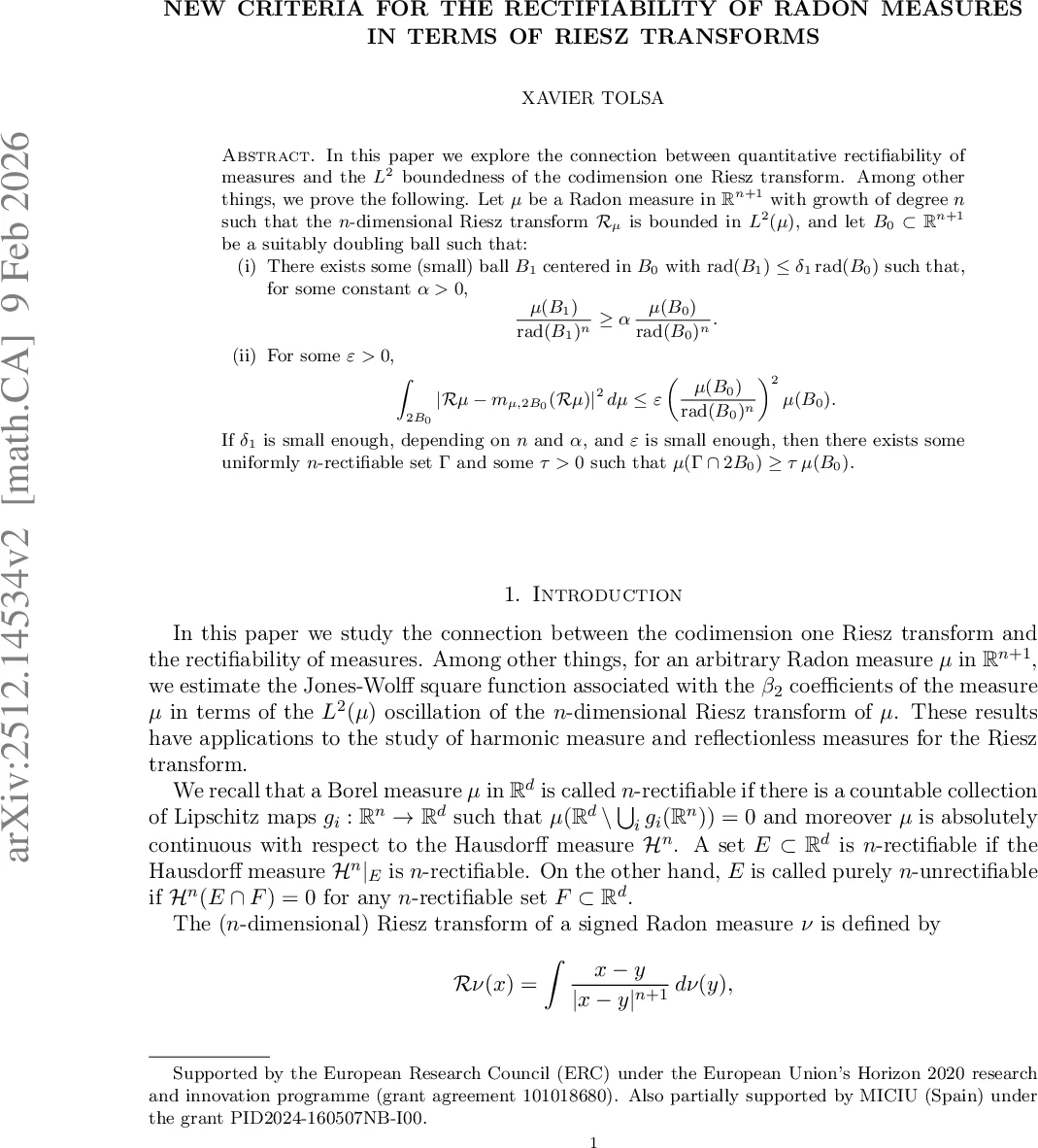
In this paper we explore the connection between quantitative rectifiability of measures and the $L^2$ boundedness of the codimension one Riesz transform. Among other things, we prove the following. Let $μ$ be a Radon measure in $\mathbb R^{n+1}$ with growth of degree $n$ such that the $n$-dimensional Riesz transform $R_μ$ is bounded in $L^2(μ)$, and let $B_0\subset\mathbb R^{n+1}$ be a suitably doubling ball such that: (i) There exists some (small) ball $B_1$ centered in $B_0$ with $r(B_1)\leq δ_1 r(B_0)$ such that, for some constant $α>0$, $$\frac{μ(B_1)}{r(B_1)^n}\geq α,\frac{μ(B_0)}{r(B_0)^n}.$$ (ii) For some $ε>0$, $$\int_{2B_0} |Rμ- m_{μ,2B_0}(Rμ)|^2,dμ\leq ε,\bigg(\frac{μ(B_0)}{r(B_0)^n}\bigg)^2,μ(B_0).$$ If $δ_1$ is small enough, depending on $n$ and $α$, and $ε$ is small enough, then there exists a uniformly $n$-rectifiable set $Γ$ and some $τ>0$ such that $μ(Γ\cap B_0) \geqτ,μ(B_0).$
💡 Research Summary
The paper investigates the relationship between quantitative rectifiability of Radon measures and the $L^2$–boundedness of the codimension‑one Riesz transform. The authors work in $\mathbb R^{n+1}$ with a Radon measure $\mu$ that satisfies an $n$‑dimensional growth condition (i.e., $\mu(B(x,r))\le C r^{n}$ for all balls). The central object is the $n$‑dimensional Riesz transform \
Comments & Academic Discussion
Loading comments...
Leave a Comment