Cardinality of the sets of dimension functions in ordered structures
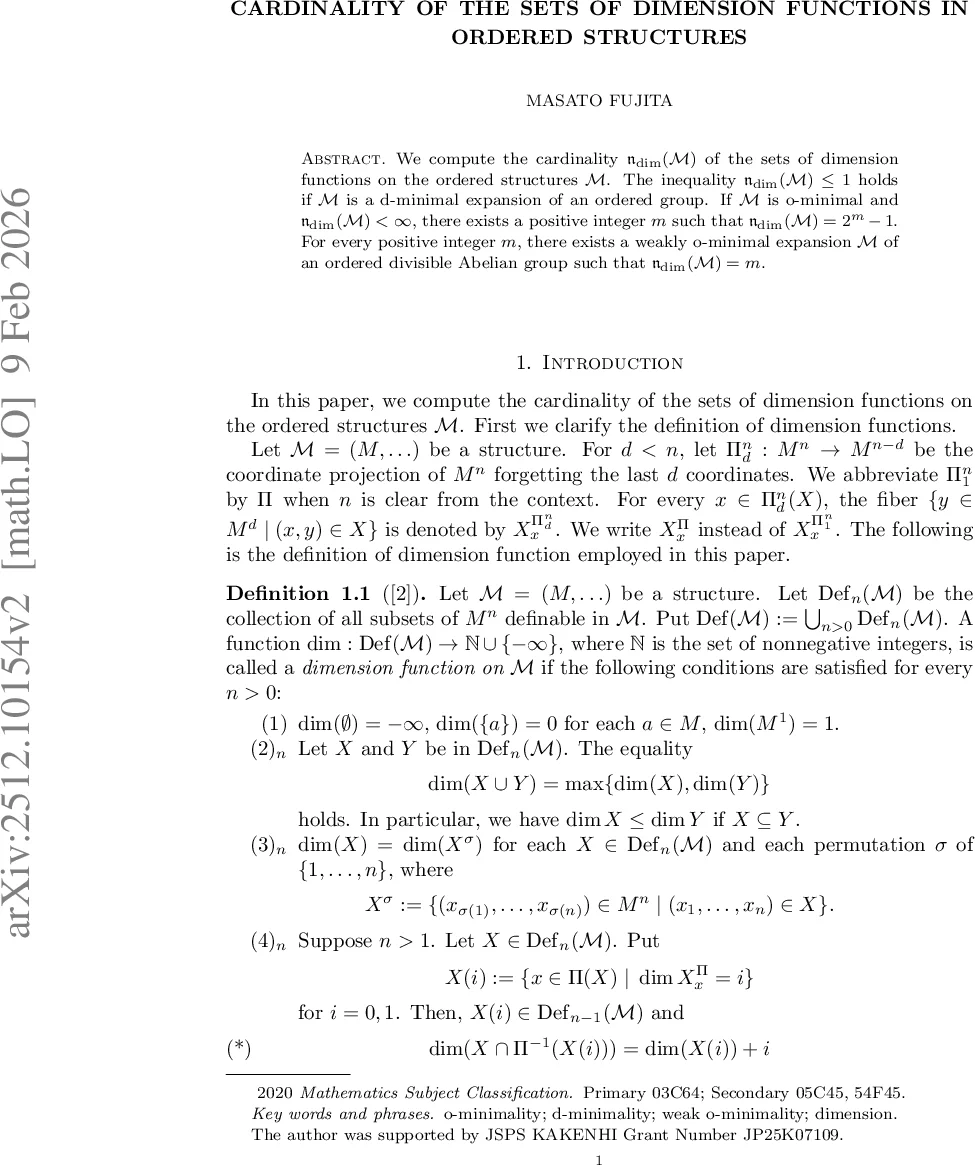
We compute the cardinality $\mathfrak n_{\dim}(\mathcal M)$ of the sets of dimension functions on the ordered structures $\mathcal M$. The inequality $\mathfrak n_{\dim}(\mathcal M) \leq 1$ holds if $\mathcal M$ is a d-minimal expansion of an ordered group. If $\mathcal M$ is o-minimal and $\mathfrak n_{\dim}(\mathcal M)<\infty$, there exists a positive integer $m$ such that $\mathfrak n_{\dim}(\mathcal M)=2^m-1$. For every positive integer $m$, there exists a weakly o-minimal expansion $\mathcal M$ of an ordered divisible Abelian group such that $\mathfrak n_{\dim}(\mathcal M)=m$.
💡 Research Summary
The paper investigates the cardinality 𝔫_dim(𝔐) of the set DIM(𝔐) of all dimension functions on a given ordered structure 𝔐. A dimension function is a map dim:Def(𝔐)→ℕ∪{−∞} satisfying four axioms: (1) base values (∅↦−∞, singletons↦0, the whole universe↦1), (2) the dimension of a union is the maximum of the dimensions, (3) invariance under any permutation of coordinates, and (4) an “addition property” that relates the dimension of a set X⊆Mⁿ to the dimensions of its fibers under coordinate projections. This definition captures the usual topological dimension in o‑minimal settings, Morley rank in strongly minimal structures, and the valuation‑theoretic dimension in Henselian fields.
The first technical contribution is the introduction of a weaker notion of dimension function (Definition 2.2). The weak version requires only the permutation invariance for 2‑tuples (condition 3′) and a simplified addition property (4′) that deals only with fibers of dimension 0 or 1. Lemma 2.3 shows that (4′) together with the lower‑dimensional axioms forces the full union axiom (2) for all n. Lemma 2.4 proves a higher‑dimensional analogue (property (5)ₙ) by induction on n and the number of projected coordinates d. Proposition 2.5 then establishes the equivalence: every weak dimension function is in fact a full dimension function. This equivalence greatly simplifies later arguments, because one can verify the easier (4′) instead of the full (4).
Section 3 applies these tools to various classes of ordered structures.
-
Non‑ordered minimal structures. For a strongly minimal structure 𝔐, the Morley rank provides a unique dimension function (Proposition 3.1), so 𝔫_dim(𝔐)=1.
-
Upper bounds for ordered structures. Lemma 3.2 and Corollary 3.3 show that a dimension function is completely determined by its values on bounded definable subsets of M, and that any bounded definable set must have dimension 0 or 1. Using this, Theorem 3.10 proves 𝔫_dim(𝔐)≤1 for any d‑minimal expansion of an ordered group and for any weakly o‑minimal expansion of an ordered field. The proof hinges on the observation that if every bounded definable set has dimension 0, then the whole universe would have dimension 0, contradicting axiom (1).
-
Exact values in o‑minimal structures. Theorem 3.23 shows that if an o‑minimal structure has finitely many dimension functions, then the number must be of the form 2^m−1 for some positive integer m. The argument proceeds by analyzing how a dimension function can assign values to definable sets of increasing dimension; each step essentially doubles the number of possible distinct functions, leading to the binary‑tree pattern reflected in 2^m−1. Proposition 3.25 constructs, for each m, an o‑minimal theory T such that every model of T has exactly 2^m−1 dimension functions.
-
Arbitrary finite cardinalities in weakly o‑minimal expansions. Theorem 3.26 demonstrates that for any integer m>1 there exists a weakly o‑minimal expansion of an ordered divisible abelian group with 𝔫_dim(𝔐)=m. The construction adds definable discrete sets and intervals in a controlled way so that the addition property forces exactly m different possible dimension assignments.
-
Extreme cases. Proposition 3.24 shows that for a pure dense linear order without endpoints (a model of DLO) the number of dimension functions equals the cardinality of the underlying set, i.e., 𝔫_dim(𝔐)=|M|. This reflects the maximal freedom when no additional algebraic or topological structure restricts the dimension theory.
Overall, the paper provides a clear taxonomy: in highly tame settings (d‑minimal, weakly o‑minimal) the dimension theory is essentially unique (≤1), in the classical o‑minimal world the finite possibilities are tightly constrained to the binary pattern 2^m−1, while in the most unrestricted ordered settings the number of dimension functions can be as large as the universe itself. The introduction of weak dimension functions and the systematic use of the addition property are the key technical innovations that enable these results.
Comments & Academic Discussion
Loading comments...
Leave a Comment