ExoJAX Retrievals of VLT/CRIRES Spectra of Luhman 16AB: C/O Ratios and Systematic Uncertainties
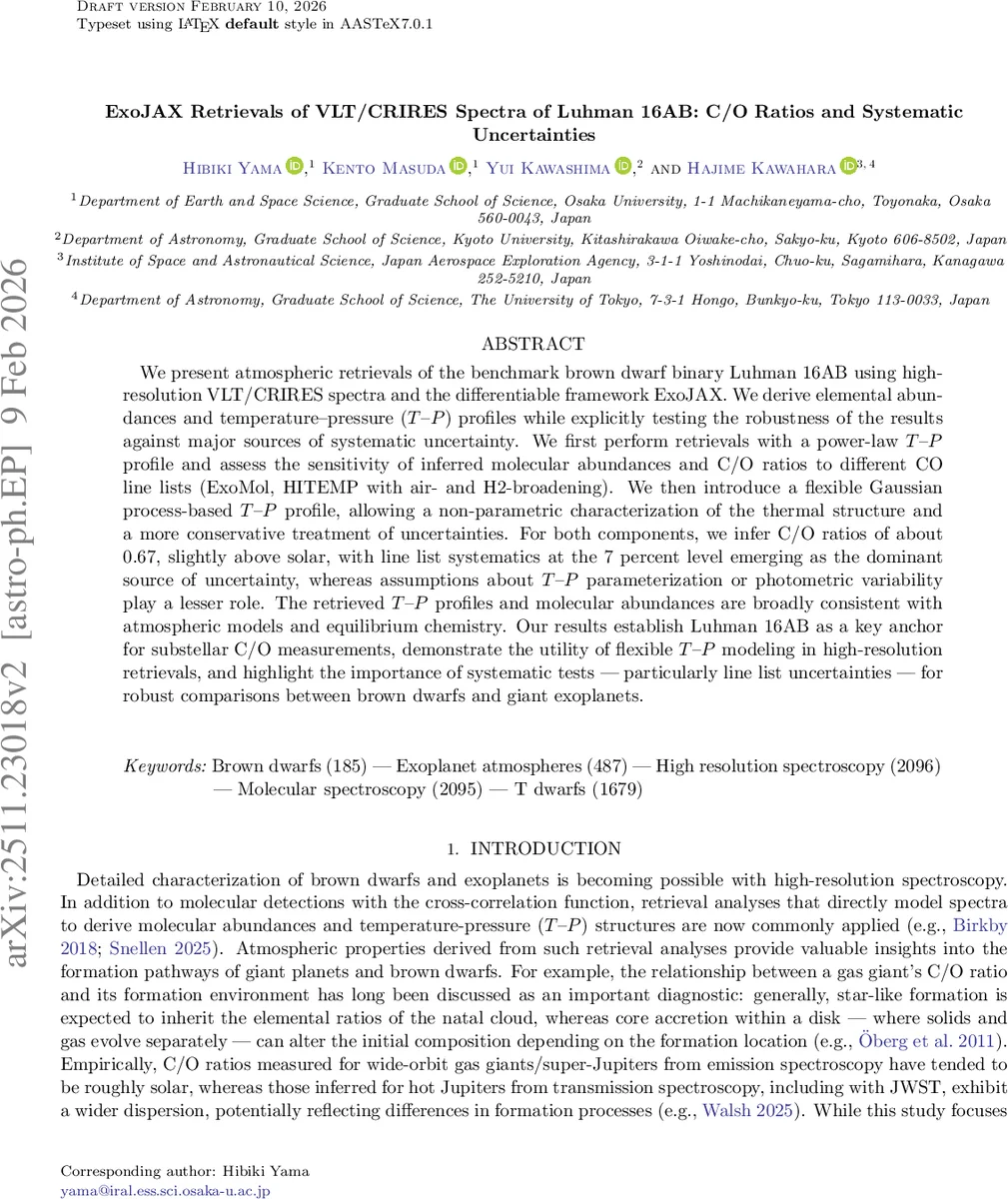
We present atmospheric retrievals of the benchmark brown dwarf binary Luhman 16AB using high-resolution VLT/CRIRES spectra and the differentiable framework ExoJAX. We derive elemental abundances and temperature-pressure ($T$-$P$) profiles while explicitly testing the robustness of the results against major sources of systematic uncertainty. We first perform retrievals with a power-law $T$-$P$ profile and assess the sensitivity of inferred molecular abundances and C/O ratios to different CO line lists (ExoMol, HITEMP with air- and H2-broadening). We then introduce a flexible Gaussian process-based $T$-$P$ profile, allowing a non-parametric characterization of the thermal structure and a more conservative treatment of uncertainties. For both components, we infer C/O ratios of about 0.67, slightly above solar, with line list systematics at the 7 percent level emerging as the dominant source of uncertainty, whereas assumptions about $T$-$P$ parameterization or photometric variability play a lesser role. The retrieved $T$-$P$ profiles and molecular abundances are broadly consistent with atmospheric models and equilibrium chemistry. Our results establish Luhman 16AB as a key anchor for substellar C/O measurements, demonstrate the utility of flexible $T$-$P$ modeling in high-resolution retrievals, and highlight the importance of systematic tests – particularly line list uncertainties – for robust comparisons between brown dwarfs and giant exoplanets.
💡 Research Summary
This paper presents a comprehensive atmospheric retrieval analysis of the benchmark brown‑dwarf binary Luhman 16AB using high‑resolution (R ≈ 10⁵) VLT/CRIRES K‑band spectra (2.288–2.345 µm) with signal‑to‑noise around 180. The authors employ the differentiable ExoJAX framework, which couples a line‑by‑line radiative‑transfer solver with automatic differentiation, enabling gradient‑based inference on GPUs. They model the atmosphere with 101 logarithmically spaced pressure layers from 10⁻⁴ to 10² bar and include four trace gases—CO, H₂O, CH₄, and HF—with uniform volume mixing ratios (VMRs). The bulk composition is set to a solar H₂/He mass ratio (0.74:0.25), converted to volume ratios using molecular masses, ensuring mass conservation across all species.
A key strength of the work is the explicit treatment of systematic uncertainties. The authors explore two distinct temperature–pressure (T‑P) parameterizations: (1) a simple power‑law profile, T(P)=T₀·(P/1 bar)^α, with T₀ and α as free parameters; and (2) a flexible Gaussian‑process (GP) based non‑parametric T‑P model that treats the power‑law as a mean function and adds a GP with an RBF kernel (amplitude a_T, length scale τ_T) to capture deviations. This dual approach allows them to assess how rigid versus flexible thermal structures propagate into retrieved abundances.
Surface gravity (log g) is constrained by external dynamical masses (33.5 M_J for component A, 28.6 M_J for B), an age estimate of 510 ± 95 Myr, and the Baraffe et al. (2003) evolutionary models. The resulting priors are Normal(log g_A = 4.93 ± 0.09, log g_B = 4.86 ± 0.09), truncated at three sigma. Rotational broadening (V sin i) and limb‑darkening (quadratic law with parameters q₁, q₂) are also inferred, ensuring that line shapes are modeled accurately.
The retrieval includes a sophisticated treatment of correlated noise via a Gaussian‑process likelihood. The covariance matrix combines the per‑pixel measurement errors with an RBF kernel K_ij = a_GP exp
Comments & Academic Discussion
Loading comments...
Leave a Comment