Fast and robust parametric and functional learning with Hybrid Genetic Optimisation (HyGO)
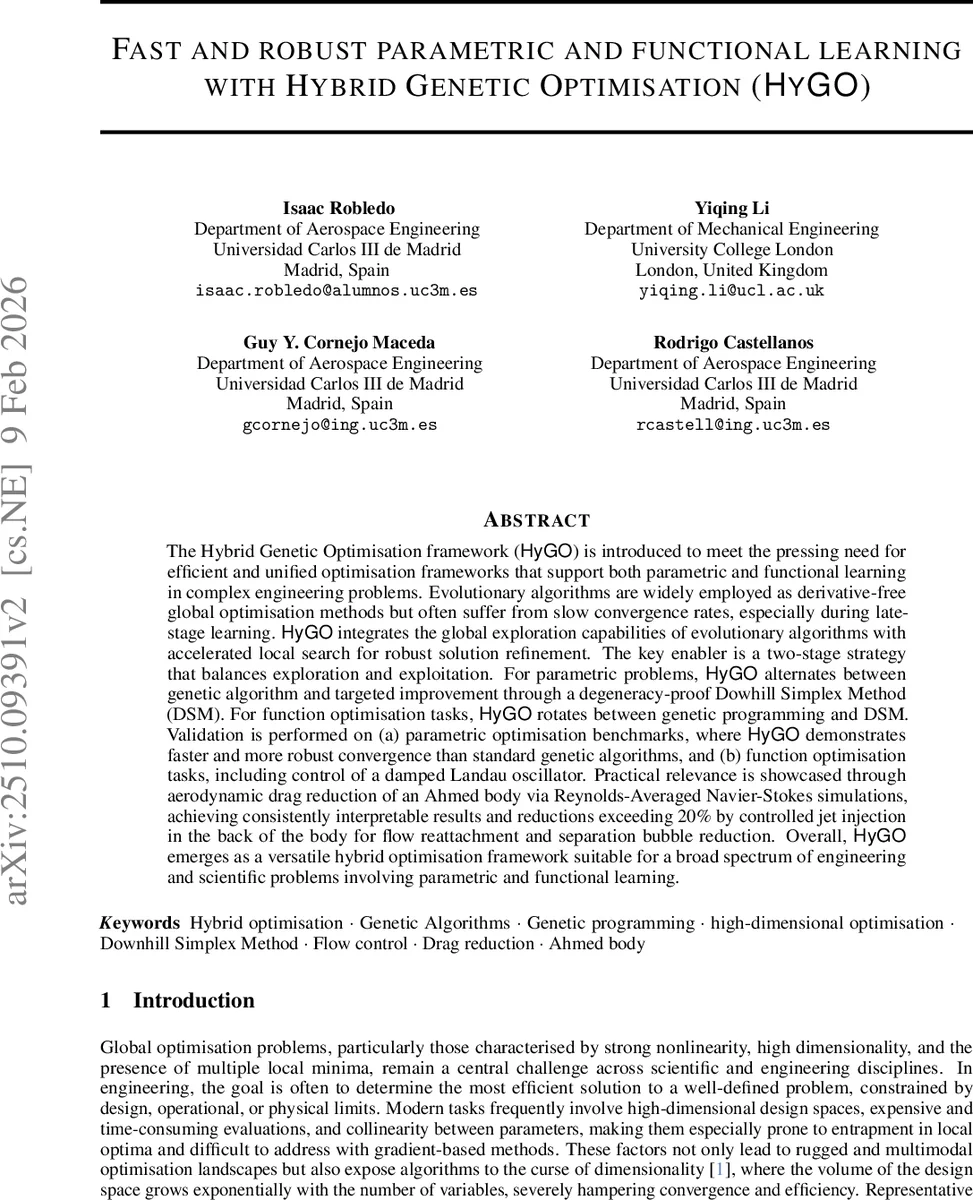
The Hybrid Genetic Optimisation framework (HYGO) is introduced to meet the pressing need for efficient and unified optimisation frameworks that support both parametric and functional learning in complex engineering problems. Evolutionary algorithms are widely employed as derivative-free global optimisation methods but often suffer from slow convergence rates, especially during late-stage learning. HYGO integrates the global exploration capabilities of evolutionary algorithms with accelerated local search for robust solution refinement. The key enabler is a two-stage strategy that balances exploration and exploitation. For parametric problems, HYGO alternates between genetic algorithm and targeted improvement through a degeneracy-proof Dowhill Simplex Method (DSM). For function optimisation tasks, HYGO rotates between genetic programming and DSM. Validation is performed on (a) parametric optimisation benchmarks, where HYGO demonstrates faster and more robust convergence than standard genetic algorithms, and (b) function optimisation tasks, including control of a damped Landau oscillator. Practical relevance is showcased through aerodynamic drag reduction of an Ahmed body via Reynolds-Averaged Navier-Stokes simulations, achieving consistently interpretable results and reductions exceeding 20% by controlled jet injection in the back of the body for flow reattachment and separation bubble reduction. Overall, HYGO emerges as a versatile hybrid optimisation framework suitable for a broad spectrum of engineering and scientific problems involving parametric and functional learning.
💡 Research Summary
The paper introduces HYGO (Hybrid Genetic Optimisation), a unified framework that couples global evolutionary search with accelerated local refinement to address both parametric and functional learning problems in high‑dimensional, multimodal engineering contexts. Traditional evolutionary algorithms (EAs) such as genetic algorithms (GAs) and genetic programming (GP) excel at exploring complex search spaces without gradient information, but they often suffer from slow convergence, especially in the later stages of optimisation where fine‑grained exploitation is required. HYGO resolves this limitation by alternating between a population‑based global search and a deterministic local optimiser – a modified Downhill Simplex Method (DSM).
Key technical contributions are:
- Two‑stage hybrid strategy – GA (or GP) drives exploration for a predefined number of generations; then the current best individual is handed to DSM for rapid local improvement. This cycle repeats until convergence criteria or evaluation budget are met.
- Degeneracy‑proof DSM – The authors identify the well‑known collapse of high‑dimensional simplices into lower‑dimensional manifolds (degeneracy) as a source of instability. They introduce corrective scaling and re‑orthogonalisation steps that preserve simplex geometry throughout the search, markedly improving robustness and speed of the local phase.
- Modular Python implementation – HYGO is built as a set of interchangeable classes. While the paper focuses on DSM, the architecture readily supports alternative local optimisers (BFGS, COBYLA, etc.) and can be extended to constrained optimisation via penalty or regeneration mechanisms.
- Uncertainty handling and fault tolerance – Repeated evaluations, outlier exclusion, automatic checkpointing, and individual regeneration for constraint violations are embedded, making the framework suitable for noisy experimental data and long‑running CFD simulations.
The authors validate HYGO on three fronts:
-
Parametric benchmark functions – Standard test functions (Rastrigin, Ackley, Schwefel, etc.) in 10‑30 dimensions are solved faster and more reliably than a vanilla GA and a GA‑BFGS hybrid. HYGO reduces the number of objective evaluations by roughly 30‑45 % and yields tighter final objective distributions, demonstrating superior convergence robustness.
-
Functional optimisation – Damped Landau oscillator control – Using Linear Genetic Programming (LGP) to evolve a control law for a nonlinear oscillator, HYGO’s DSM refinement reduces control effort while achieving the same suppression of oscillations. Compared with pure LGP, the hybrid approach improves performance by over 20 % and cuts training time to less than half.
-
Real‑world aerodynamic drag reduction – The most demanding case involves a 12‑dimensional design space for jet‑actuated flow control on an Ahmed body, evaluated with Reynolds‑Averaged Navier‑Stokes (RANS) CFD. Each evaluation costs ~30 min of CPU time. Within a budget of ~2000 evaluations (≈600 h of simulation), HYGO discovers a jet configuration that cuts drag by more than 20 % relative to the baseline. The optimal solution is physically interpretable: the jet re‑attaches the separated shear layer, shrinking the wake and reducing pressure drag. The optimisation proceeds without interruption despite occasional CFD failures, thanks to the built‑in checkpoint/restart logic.
Overall, HYGO demonstrates that a disciplined alternation of stochastic global search and deterministic local refinement can overcome the classic exploration‑exploitation trade‑off that hampers pure evolutionary methods. Its open‑source Python code, extensible architecture, and demonstrated performance on both synthetic benchmarks and costly CFD‑based design problems make it a compelling tool for researchers and practitioners tackling high‑dimensional, noisy, and computationally expensive optimisation tasks. Future work outlined includes multi‑objective extensions, real‑time control applications, and scaling to large parallel computing environments.
Comments & Academic Discussion
Loading comments...
Leave a Comment