A note on internality of certain differential systems
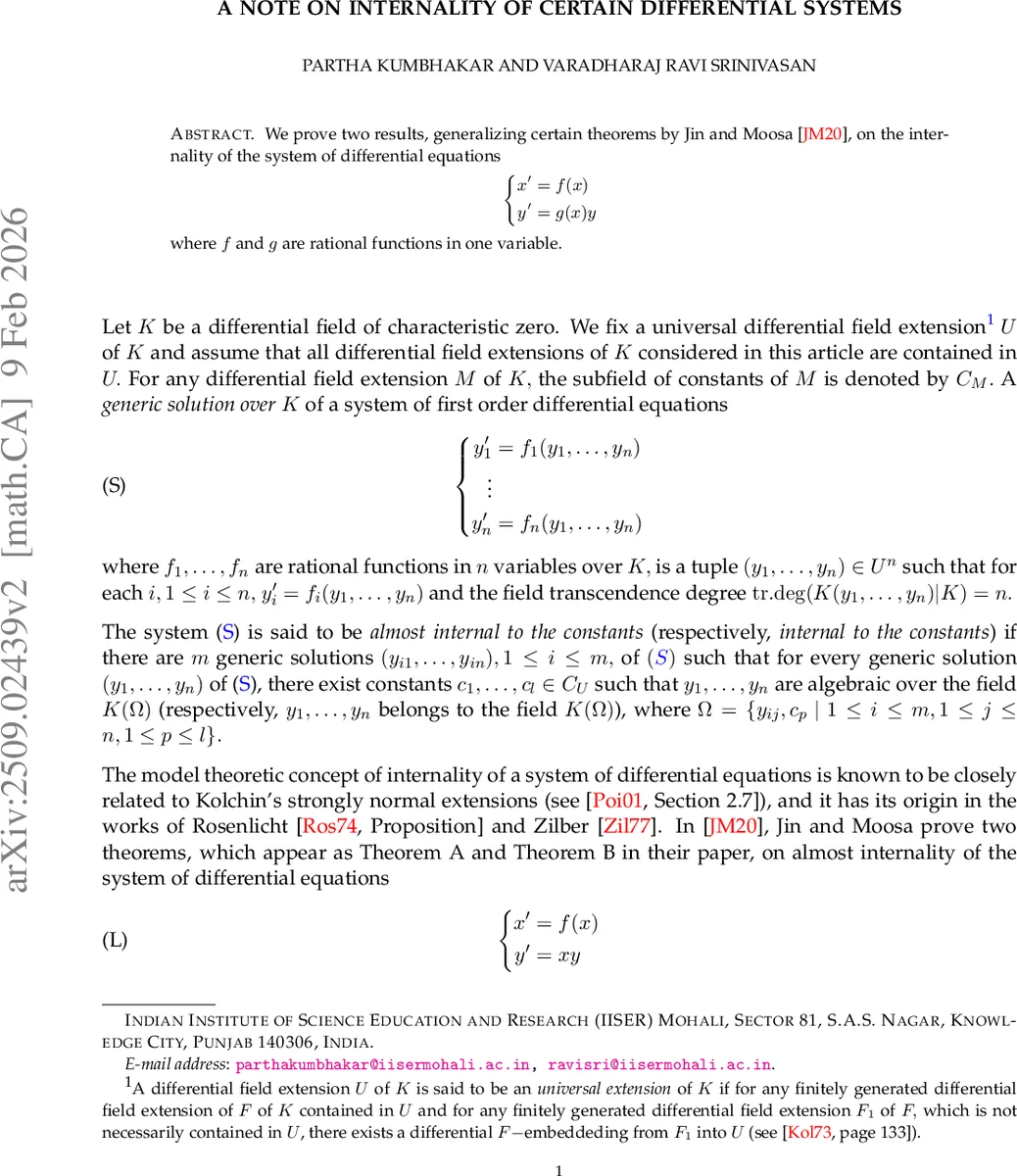
We prove two results, generalizing certain theorems by Jin and Moosa, on the internality of the system of differential equations \begin{equation*} \begin{aligned} x’ &= f(x)\ y’ &= g(x)y,\ \end{aligned} \end{equation*}where $f$ and $g$ are rational functions in one variable.
💡 Research Summary
The paper investigates the internality and almost‑internality of first‑order differential systems of the form
(L) x′ = f(x), y′ = g(x) y
where f and g are rational functions in one variable over a differential field K of characteristic zero. Internality, a model‑theoretic notion, corresponds to Kolchin’s strongly normal extensions and captures when the solution set of a differential equation can be described using only constants of the ambient differential field.
The authors first establish a structural lemma (Proposition 1): if a two‑dimensional system is almost internal to the constants, then after adjoining a suitable finite‑generated differential extension M of K, the field M(x, y) contains two M‑algebraically independent constants. Moreover, any intermediate differential field of transcendence degree one over M contributes exactly one new constant. This result supplies a key tool for later arguments.
Theorem 2 gives a complete classification of when the scalar equation x′ = f(x) is internal to the constants. By exploiting the almost‑internality hypothesis, the authors show that f must be a quadratic polynomial:
f(x) = a₂ x² + a₁ x + a₀, a₀, a₁, a₂ ∈ K, a₂ ≠ 0.
The proof proceeds by passing to an algebraic extension \tilde M where \tilde M(x) = \tilde M(c) for a single constant c, then writing c as a Möbius transform of x and differentiating. The converse direction is demonstrated by constructing explicit constants from four generic solutions, following a classical argument of Nagloo.
Theorem 4 addresses the full two‑dimensional system (L) under the additional assumption that the scalar equation x′ = f(x) is already internal. Using Proposition 1, the authors locate a constant in M(x, y) that is not in M(x), which forces the existence of an element z with z′ = n z for some positive integer n. Comparing coefficients in the differential equation yields the relation (p − q) a₂ = n, where p and q are the degrees of the numerator and denominator of a rational expression for z. Consequently a₂ must be a non‑zero rational number. The converse is constructive: when f(x) = a₂ x² + a₁ x + a₀ with a₂ ∈ ℚ{0}, the authors introduce an auxiliary variable v satisfying v^{m₂} = y − m₁ (with a₂ = m₁/m₂) and build two independent generic solutions (x₁, y₁), (x₂, y₂) together with two constants c₁, c₂. They then show that any generic solution (x, y) is algebraic over the field generated by these four functions and the two constants, establishing almost‑internality.
Theorem 5 treats the special case where the constant field C is algebraically closed and carries the trivial derivation. It provides necessary and sufficient conditions for the system
(A) x′ = f(x), y′ = g(x) y
to be almost internal to C. Condition (i) requires that the reciprocal of f be a logarithmic derivative of some rational function u ∈ C(x) (or, up to a non‑zero scalar c, the product u·∂u/∂x). Condition (ii) demands that a linear combination b + m g(x) f(x) be a logarithmic derivative of another rational function v ∈ C(x), where m ∈ ℤ and b ∈ C. The proof again uses Proposition 1 to guarantee two independent constants in a suitable extension, then invokes Rosenlicht’s result on the existence of u with u′ = 1 or u′ = c u. The authors further apply Picard‑Vessiot theory and the Kolchin‑Ostrowski theorem to relate g and f via logarithmic derivatives, handling separately the cases C(F) = C and C(F) ≠ C. The converse direction constructs the required constants explicitly from the given u and v, showing that any generic solution is algebraic over a field generated by two generic solutions and the constants.
Finally, the paper notes that when g(x) = x, Theorem 5 recovers Jin‑Moosa’s Theorem B, and it comments on connections with recent work on non‑orthogonality and relative internality.
Overall, the article extends the internality theory of differential equations by providing a full algebraic description of when the planar system (L) is almost internal to the constants, linking this property tightly to the quadratic nature of f and to explicit logarithmic‑derivative conditions on f and g. The results blend differential algebra, model theory, and differential Galois theory, offering new tools for classifying differential systems whose solution spaces are governed by constant parameters.
Comments & Academic Discussion
Loading comments...
Leave a Comment