Triply Robust Panel Estimators
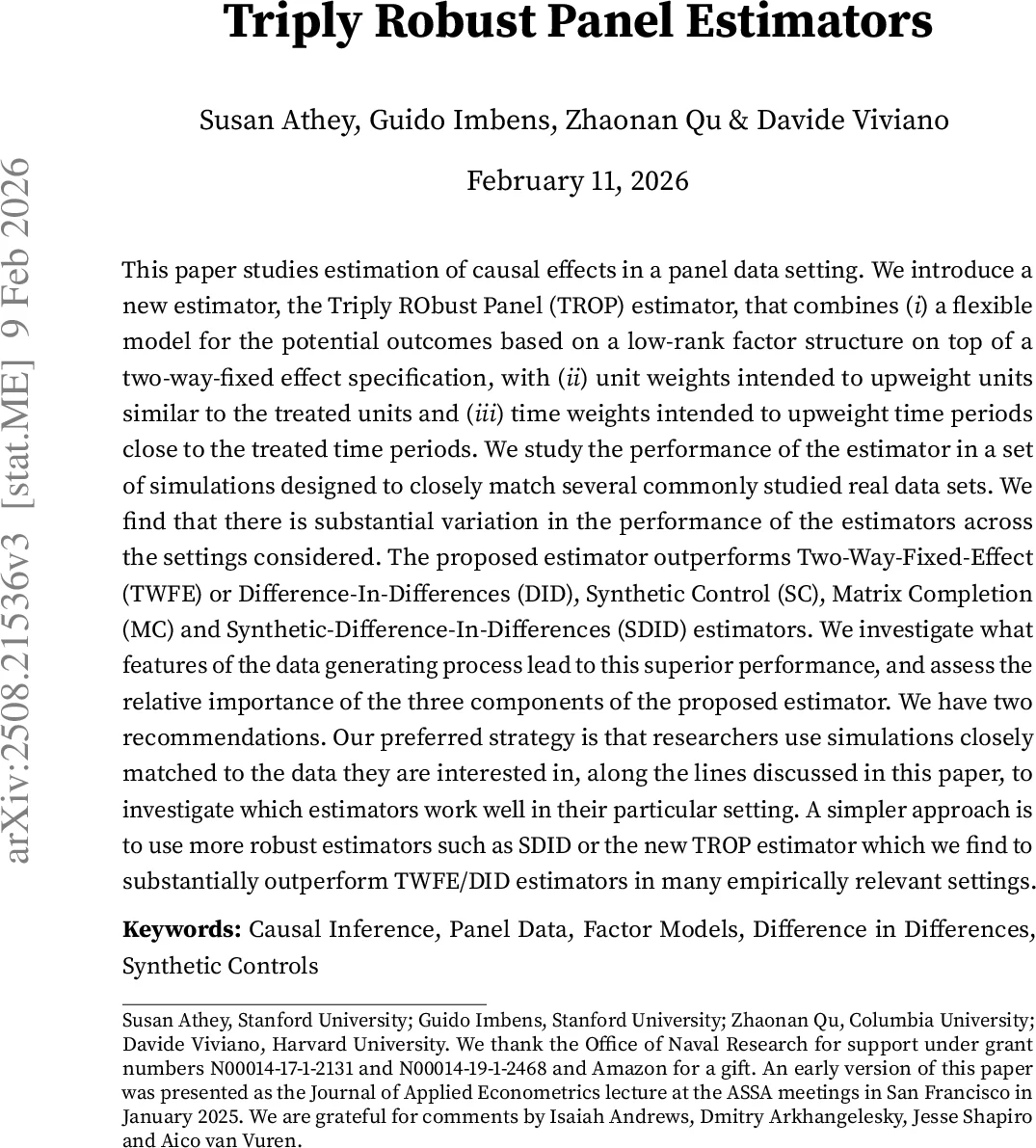
This paper studies estimation of causal effects in a panel data setting. We introduce a new estimator, the Triply RObust Panel (TROP) estimator, that combines (i) a flexible model for the potential outcomes based on a low-rank factor structure on top of a two-way-fixed effect specification, with (ii) unit weights intended to upweight units similar to the treated units and (iii) time weights intended to upweight time periods close to the treated time periods. We study the performance of the estimator in a set of simulations designed to closely match several commonly studied real data sets. We find that there is substantial variation in the performance of the estimators across the settings considered. The proposed estimator outperforms two-way-fixed-effect/difference-in-differences, synthetic control, matrix completion and synthetic-difference-in-differences estimators. We investigate what features of the data generating process lead to this performance, and assess the relative importance of the three components of the proposed estimator. We have two recommendations. Our preferred strategy is that researchers use simulations closely matched to the data they are interested in, along the lines discussed in this paper, to investigate which estimators work well in their particular setting. A simpler approach is to use more robust estimators such as synthetic difference-in-differences or the new triply robust panel estimator which we find to substantially outperform two-way fixed effect estimators in many empirically relevant settings.
💡 Research Summary
This paper introduces the Triply Robust Panel (TROP) estimator for causal inference in panel data. The authors combine three components: (i) a flexible outcome model based on a low‑rank factor structure (plus unit and time fixed effects), (ii) unit weights that give more influence to control units whose pre‑treatment trajectories resemble the treated units, and (iii) time weights that place greater emphasis on periods close to the treatment dates. The estimator is “triply robust” in the sense that the bias is the product of three imbalance terms—unit, time, and model misspecification—so that if any one component is correctly specified, the overall estimator is asymptotically unbiased. Theoretical results (Theorem 5) formalize this property and show that TROP nests DID/TWFE, Matrix Completion, Synthetic Control, and SDID as special cases.
To evaluate performance, the authors conduct 21 semi‑synthetic simulation studies calibrated to real datasets (CPS, PWT, German reunification, Basque, smoking, and Boatri data). In each design, treatment effects are set to zero, outcomes are generated from a rank‑4 factor model, and ten treated units and ten treated periods are randomly selected. Across 1,000 replications per design, TROP achieves the lowest root‑mean‑squared error (RMSE) in 20 of the 21 settings; in the remaining case it is only 24 % worse than the best competitor (Synthetic Control). The gains are especially pronounced when time weights and the regression adjustment are used together; unit weights provide additional improvement in some cases but are less critical.
The paper also investigates drivers of performance. It finds that interactive fixed effects (i.e., low‑rank factors) are common in the applications and that TROP’s ability to model them reduces bias relative to DID, which is sensitive to violations of parallel trends. When the number of treated units or periods is small, other methods become more competitive, but the inclusion of time weights consistently helps.
Finally, the authors discuss extensions to multiple treated units, covariates, and dynamic effects, providing algorithms for inference and establishing asymptotic normality. They recommend that researchers first run simulations tailored to their own data to select an estimator, and as a simpler alternative adopt robust methods such as SDID or the newly proposed TROP, which consistently outperform traditional TWFE/DID in a wide range of empirically relevant scenarios.
Comments & Academic Discussion
Loading comments...
Leave a Comment