Minimal Theory of Strange Carriers
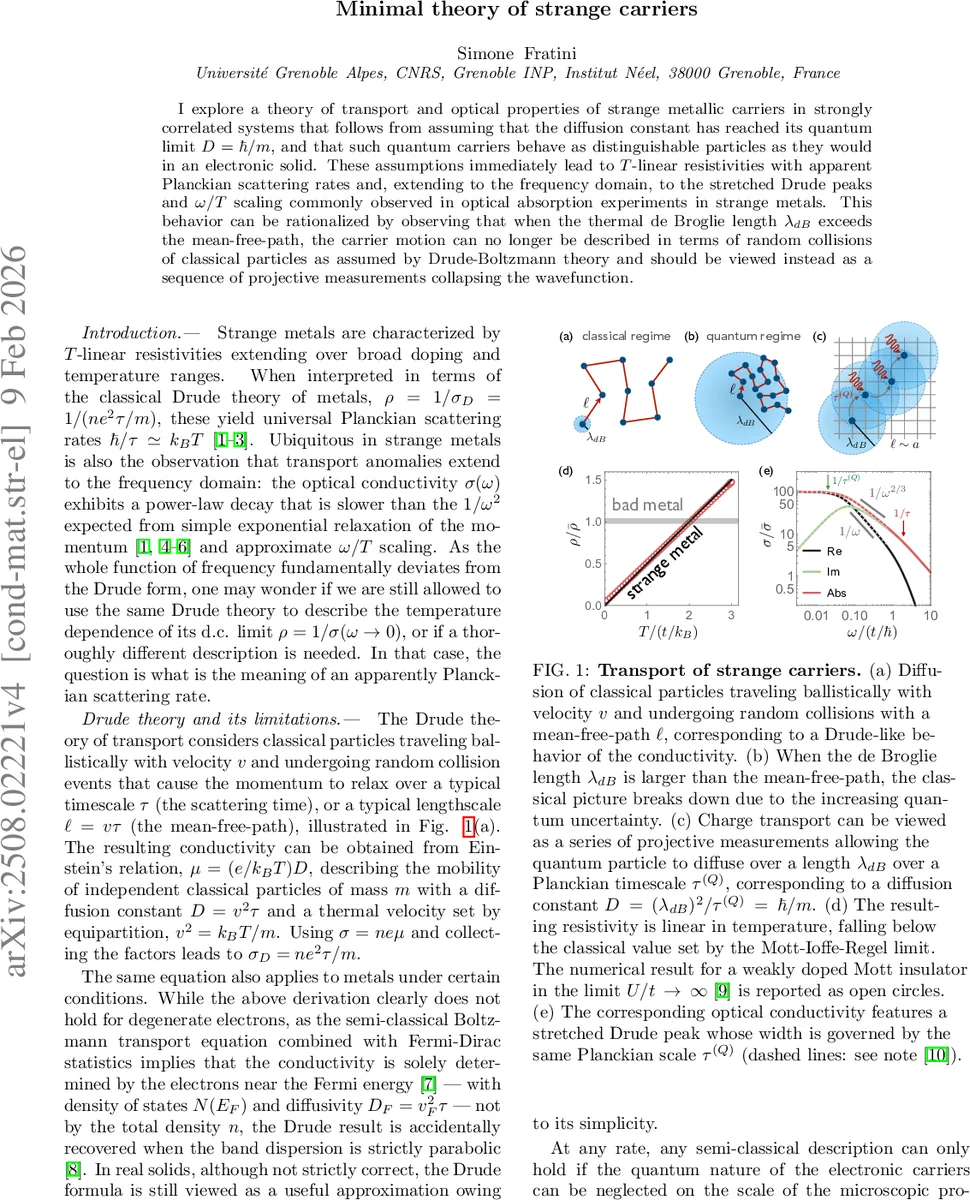
I explore a theory of transport and optical properties of strange metallic carriers in strongly correlated systems that follows from assuming that the diffusion constant has reached its quantum limit $D=\hbar/m$, and that such quantum carriers behave as distinguishable particles as they would in an electronic solid. These assumptions immediately lead to $T$-linear resistivities with apparent Planckian scattering rates and, extending to the frequency domain, to the stretched Drude peaks and $ω/T$ scaling commonly observed in optical absorption experiments in strange metals. This behavior can be rationalized by observing that when the thermal de Broglie length $λ_{dB}$ exceeds the mean-free-path, the carrier motion can no longer be described in terms of random collisions of classical particles as assumed by Drude-Boltzmann theory and should be viewed instead as a sequence of projective measurements collapsing the wavefunction.
💡 Research Summary
The paper puts forward a minimalist theory for the transport and optical anomalies of strange metals, based on two elementary assumptions. First, the charge carriers reach the quantum limit of diffusion, D = ℏ/m, where ℏ is the reduced Planck constant and m the effective mass. Second, these carriers can be treated as distinguishable particles, allowing the Einstein relation µ = (e/kBT) D to be applied unchanged. From these premises the author derives a temperature‑linear resistivity ρ ∝ T with an apparent Planckian scattering time τ_Q = ℏ/kBT, reproducing the ubiquitous “Planckian” behavior observed in cuprates, twisted bilayer graphene and other strongly correlated systems.
Using the Kubo formula for the optical conductivity and inserting the quantum diffusion constant, the author obtains a “quantum Drude” expression:
Re σ(ω) = σ_Q ·
Comments & Academic Discussion
Loading comments...
Leave a Comment