A Survey of Behavior Foundation Model: Next-Generation Whole-Body Control System of Humanoid Robots
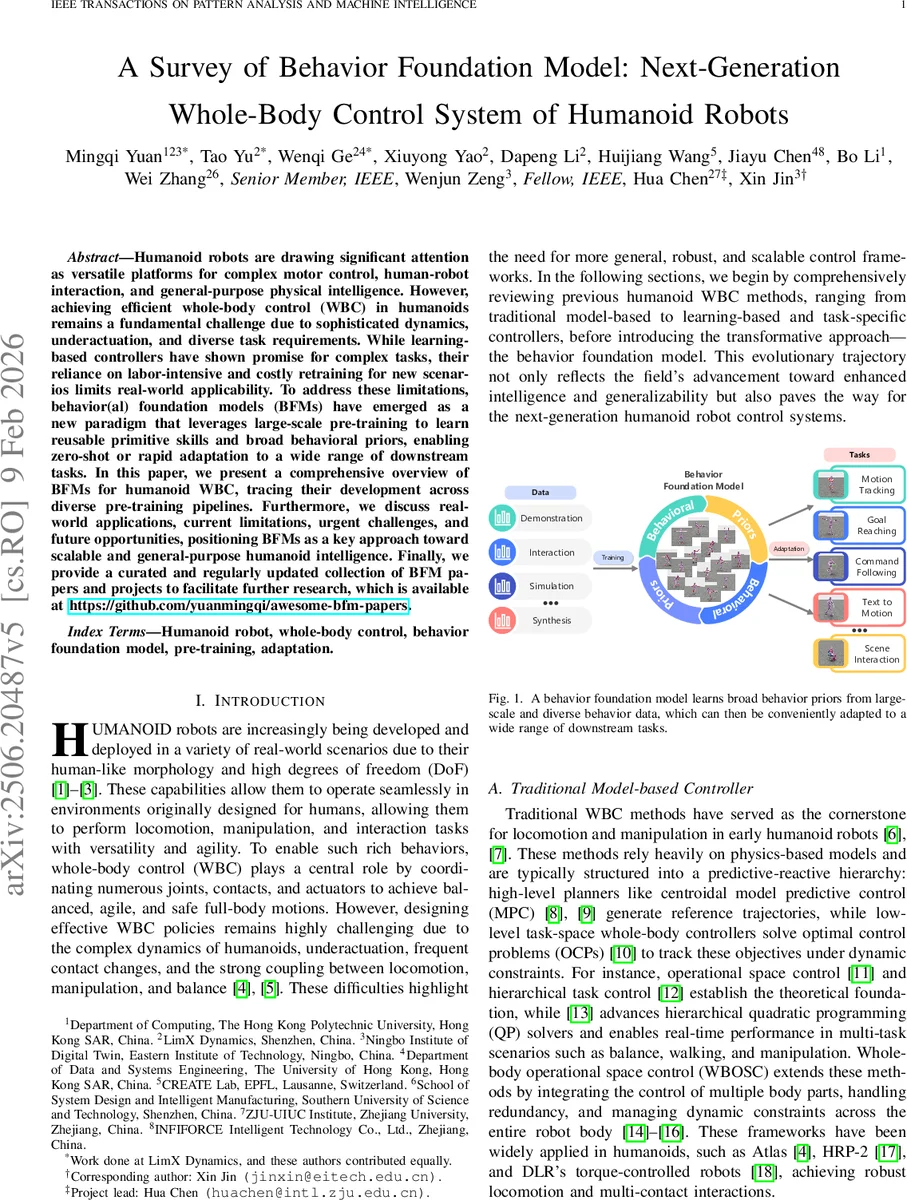
Humanoid robots are drawing significant attention as versatile platforms for complex motor control, human-robot interaction, and general-purpose physical intelligence. However, achieving efficient whole-body control (WBC) in humanoids remains a fundamental challenge due to sophisticated dynamics, underactuation, and diverse task requirements. While learning-based controllers have shown promise for complex tasks, their reliance on labor-intensive and costly retraining for new scenarios limits real-world applicability. To address these limitations, behavior(al) foundation models (BFMs) have emerged as a new paradigm that leverages large-scale pre-training to learn reusable primitive skills and broad behavioral priors, enabling zero-shot or rapid adaptation to a wide range of downstream tasks. In this paper, we present a comprehensive overview of BFMs for humanoid WBC, tracing their development across diverse pre-training pipelines. Furthermore, we discuss real-world applications, current limitations, urgent challenges, and future opportunities, positioning BFMs as a key approach toward scalable and general-purpose humanoid intelligence. Finally, we provide a curated and regularly updated collection of BFM papers and projects to facilitate more subsequent research, which is available at https://github.com/yuanmingqi/awesome-bfm-papers.
💡 Research Summary
This survey paper provides a comprehensive overview of Behavior Foundation Models (BFMs) as the next‑generation paradigm for whole‑body control (WBC) of humanoid robots. The authors begin by reviewing the evolution of humanoid WBC methods. Traditional model‑based approaches—such as centroidal model predictive control (MPC), whole‑body operational space control (WBOSC), and hierarchical quadratic programming (QP) solvers—rely on accurate physics models and a predictive‑reactive hierarchy. While these methods deliver mathematically sound solutions, they suffer from high computational load, labor‑intensive gain tuning, limited robustness to rapid contact changes, and difficulty handling highly dynamic motions (e.g., backflips) or unexpected disturbances.
The paper then surveys learning‑based controllers that emerged to address some of these shortcomings. Reinforcement learning (RL) frameworks such as DeepMimic, Adversarial Motion Priors (AMP), and HoST have demonstrated the ability to acquire complex locomotion and manipulation skills through simulated interaction or human demonstration. Imitation‑learning (IL) systems like ExBody decouple upper‑body style generation from lower‑body stability, mitigating morphological mismatches between humans and robots. Despite impressive results, these methods are hampered by sample inefficiency (often requiring millions of simulated steps), sensitivity to reward shaping, a persistent simulation‑to‑real (Sim2Real) gap, and poor cross‑task generalization; new tasks typically demand extensive retraining.
Behavior Foundation Models are introduced as a unifying solution that leverages large‑scale pre‑training on diverse behavior data to learn reusable primitive skills and broad behavioral priors. The authors define BFMs as a specialized class of foundation models—analogous to GPT‑4, CLIP, or SAM—but trained on dynamic action sequences rather than static images or text. BFMs aim to encode a comprehensive spectrum of motions (locomotion, manipulation, interaction) so that a single model can be adapted to many downstream tasks with little or no additional learning.
The survey categorizes BFM pre‑training pipelines into three major streams:
- Goal‑conditioned learning – uses extrinsic reward functions together with large human‑demonstration datasets to train policies that directly map states and goals to actions.
- Intrinsic‑reward self‑supervision – generates internal rewards (e.g., curiosity, energy efficiency) to drive exploration and learn useful representations without external labels.
- Forward‑backward representation learning (FEN/BEN) – learns forward and backward state‑action embeddings from reward‑free transition data; at test time a specific reward can be combined with these embeddings to infer a policy.
Adaptation strategies for BFMs are also detailed:
- Full fine‑tuning (FFT) of all parameters.
- Low‑rank adaptation (LoRA) and other parameter‑efficient methods.
- Latent‑space adaptation, where a task vector in a learned latent space is modified to steer behavior.
- Hierarchical control, wherein a high‑level planner (e.g., a large language model or diffusion model) generates sub‑goals or motion primitives that the BFM executes as a low‑level controller.
These mechanisms enable zero‑shot or rapid adaptation to new tasks, environments, or hardware configurations, dramatically reducing the need for costly retraining.
The authors critically examine current limitations. Large‑scale, high‑quality behavior datasets are still scarce, and aligning human demonstrations with robot dynamics remains challenging due to morphological differences. Pre‑trained priors may not respect physical constraints such as joint limits or torque bounds, raising safety concerns during zero‑shot deployment. The Sim2Real gap persists because many BFMs are still trained primarily in simulation; domain‑adaptation techniques are required to bridge this gap. Moreover, most existing BFMs focus on single‑modality inputs, whereas real‑world humanoid tasks often demand multimodal perception (vision, language, tactile) and long‑horizon reasoning.
Future research directions are organized into four layers:
- Data Layer – creation of open, standardized behavior repositories, joint human‑robot data collection pipelines, and benchmark environments.
- Model Layer – development of massive self‑supervised pre‑training, multimodal encoder‑decoder architectures, and hybrid loss functions that embed physical constraints.
- Adaptation Layer – meta‑learning and prompt‑based rapid fine‑tuning, online adaptation with safety verification, and human‑in‑the‑loop feedback mechanisms.
- Ethics & Safety Layer – analysis of bias in behavior priors, real‑time safety monitoring, accountability frameworks, and regulatory guidelines for deploying autonomous humanoids.
By integrating these layers, BFMs could evolve from research prototypes to robust, general‑purpose controllers that endow humanoid robots with versatile, adaptable, and safe whole‑body behaviors across diverse real‑world applications. The paper concludes that BFMs represent a promising pathway toward scalable, general‑purpose humanoid intelligence, provided that the community addresses data scarcity, safety, Sim2Real transfer, and ethical considerations.
Comments & Academic Discussion
Loading comments...
Leave a Comment