Spacetime quantum mechanics for bosonic and fermionic systems
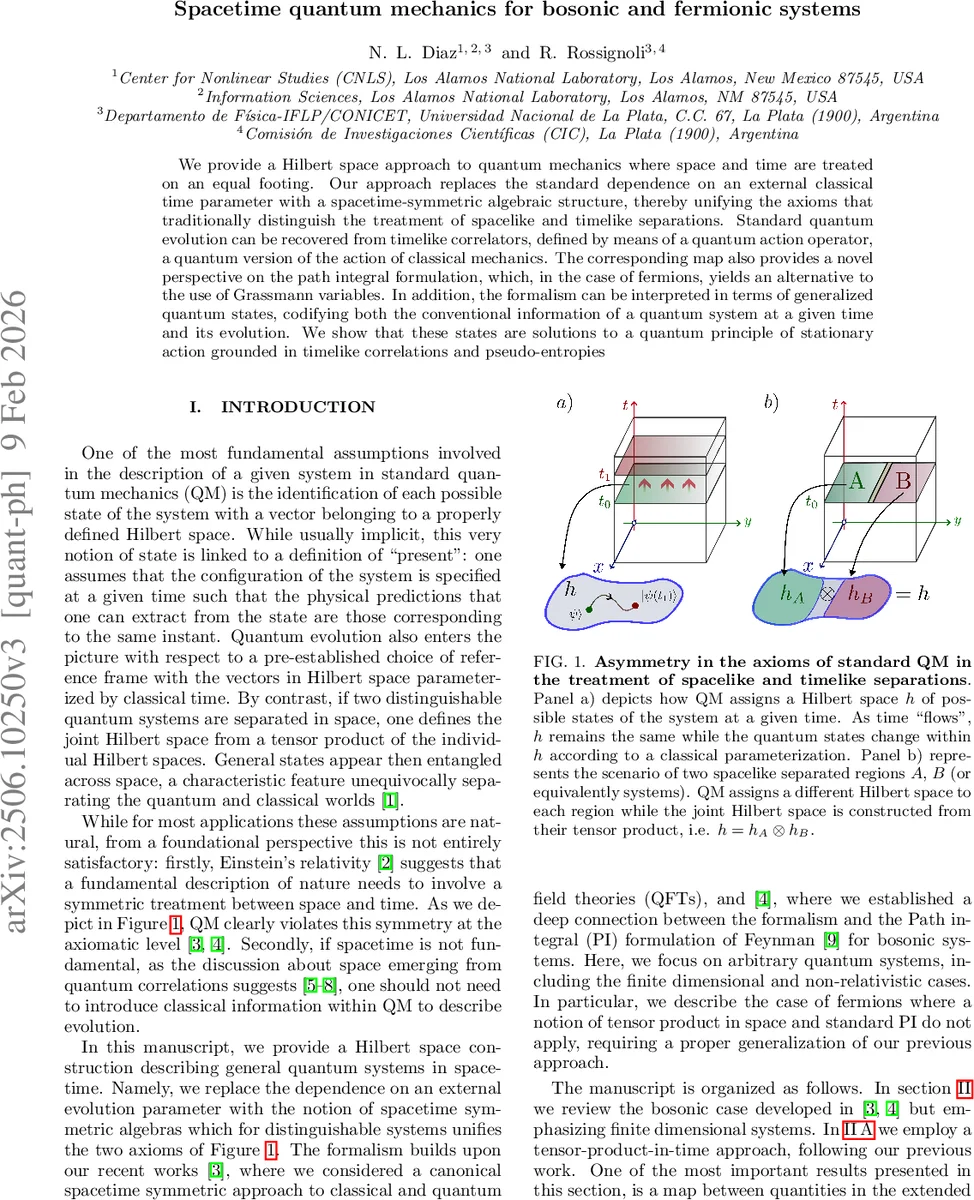
We provide a Hilbert space approach to quantum mechanics where space and time are treated on an equal footing. Our approach replaces the standard dependence on an external classical time parameter with a spacetime-symmetric algebraic structure, thereby unifying the axioms that traditionally distinguish the treatment of spacelike and timelike separations. Standard quantum evolution can be recovered from timelike correlators, defined by means of a quantum action operator, a quantum version of the action of classical mechanics. The corresponding map also provides a novel perspective on the path integral formulation, which, in the case of fermions, yields an alternative to the use of Grassmann variables. In addition, the formalism can be interpreted in terms of generalized quantum states, codifying both the conventional information of a quantum system at a given time and its evolution. We show that these states are solutions to a quantum principle of stationary action grounded in timelike correlations and pseudo-entropies
💡 Research Summary
The paper proposes a fully spacetime‑symmetric formulation of quantum mechanics that eliminates the need for an external classical time parameter. The authors begin by constructing an extended Hilbert space H = ⊗{t=1}^N h from N copies of a d‑dimensional Hilbert space h, interpreting the copy index t as a discrete time slice. A unitary time‑translation operator e^{iεP} is introduced, and Lemma 1 shows that traces over H can be mapped exactly onto ordinary traces over h. Building on this, a quantum action operator S is defined as e^{iS}=e^{iεP}⊗{t=0}^{N-1}e^{-iεH_t}, where H_t is the Hamiltonian acting on slice t. Lemma 2 demonstrates that for any set of operators A(t) the trace Tr
Comments & Academic Discussion
Loading comments...
Leave a Comment