Robust Aggregation of Preferences
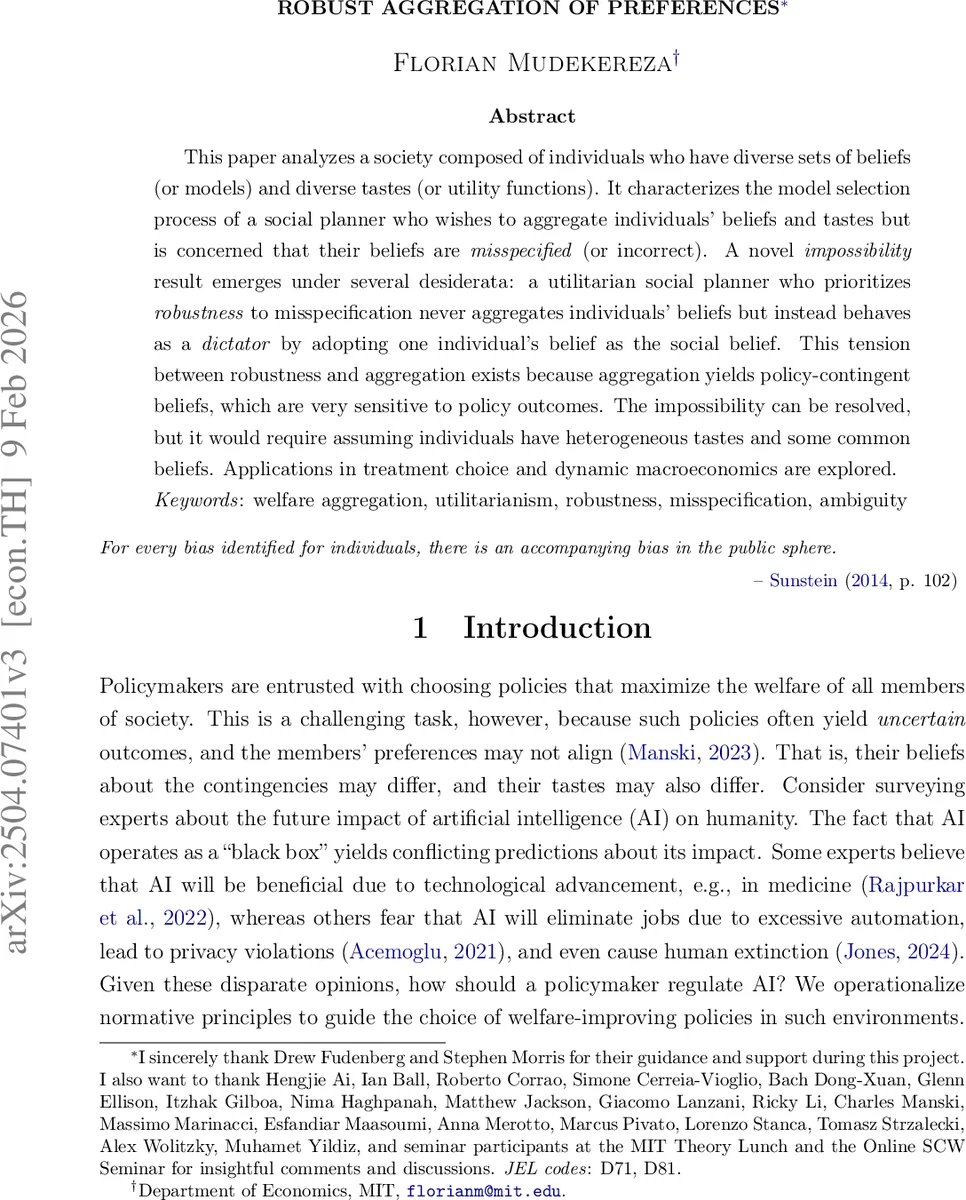
This paper analyzes a society composed of individuals who have diverse sets of beliefs (or models) and diverse tastes (or utility functions). It characterizes the model selection process of a social planner who wishes to aggregate individuals’ beliefs and tastes but is concerned that their beliefs are misspecified (or incorrect). A novel impossibility result emerges under several desiderata: a utilitarian social planner who prioritizes robustness to misspecification never aggregates individuals’ beliefs but instead behaves as a dictator by adopting one individual’s belief as the social belief. This tension between robustness and aggregation exists because aggregation yields policy-contingent beliefs, which are very sensitive to policy outcomes. The impossibility can be resolved, but it would require assuming individuals have heterogeneous tastes and some common beliefs. Applications in treatment choice and dynamic macroeconomics are explored.
💡 Research Summary
The paper investigates a social planning problem in which a society consists of individuals who hold heterogeneous beliefs (or models) and heterogeneous tastes (utility functions). The planner wishes to aggregate both beliefs and tastes into a social preference, but is concerned that the individuals’ beliefs may be misspecified. To capture this concern, the author adopts a robust‑control welfare criterion and imposes three desiderata that a “robust‑utilitarian” planner should satisfy.
Desiderata
- Welfare Dominance – The planner selects a set of beliefs that maximizes welfare uniformly across every policy that all individuals unanimously agree upon.
- Maximum Ambiguity – Following Brunnermeier et al. (2014), the planner is allowed to choose any belief in the full convex hull of individual beliefs.
- Robust‑Control Axiomatization – The welfare functional is strictly convex in beliefs, differs from a Bayesian planner’s criterion, and satisfies the axioms underlying Hansen‑Sargent’s multiplier approach.
Impossibility Results
Propositions 1‑3 show that under each of the three desiderata a robust planner must pick a singleton belief set: the social belief collapses to the belief of a single individual. In other words, a planner who wishes to hedge against misspecification inevitably behaves as a “probability dictator,” ignoring the rest of the belief distribution. The intuition is that aggregating beliefs creates policy‑contingent beliefs that are extremely sensitive to outcomes; robustness forces the planner to eliminate this sensitivity by fixing a single belief.
Resolving the Impossibility
The paper demonstrates that the impossibility can be avoided if three additional structural conditions hold:
- Heterogeneous Tastes – Individuals have distinct utility functions, allowing the social utility to be expressed as a linear combination of them.
- Some Common Beliefs – There exists a non‑empty intersection of the individuals’ belief sets.
- Bregman‑Ball Beliefs – Each individual’s belief set is a Bregman ball (e.g., an entropy ball) centred at a “reference model.”
Under these assumptions, Corollary 1 proves that the intersection of the Bregman balls can be reduced to a singleton, which becomes the unique social belief. The social belief is then a convex combination of the reference models, and the social utility reduces to a standard SEU representation. Thus, robustness and belief aggregation become compatible when the geometry of belief sets is suitably restricted.
Policy‑Contingent Beliefs
Theorem 2 shows that if the planner must use the entire intersection of belief sets, the resulting social belief is a convex combination of reference models whose weights depend on the policy being evaluated. This captures the idea that more risky or high‑stakes policies require a more conservative (central) belief, while low‑risk policies allow the planner to rely more on diverse opinions. Corollary 2 establishes that this policy dependence disappears only when the belief set is a singleton – precisely the situation identified by the impossibility results.
Applications
- Treatment Choice: In a public‑health setting, a robust planner justifies diversifying treatment allocations across sub‑populations. The model yields new comparative statics linking the degree of belief misspecification to the optimal share of each treatment.
- Dynamic Macro‑Economics: The framework is applied to the AI & Bansal (2018) representative‑agent model. By adopting a robust social planner, the aggregate behavior coincides with that of a representative agent, addressing the classic critique that individual maximizers do not aggregate to a collective maximizer.
Conclusion
The paper uncovers a fundamental tension between robustness to belief misspecification and the desire to aggregate beliefs. Without additional structure, a robust utilitarian planner must act as a belief dictator. By imposing heterogeneous tastes, a modest amount of common belief, and a Bregman‑ball geometry on belief sets, the planner can achieve both robustness and genuine belief aggregation. The results have broad implications for policy design, macro‑economic modeling, and welfare analysis in environments where expert opinions are diverse and potentially misspecified.
Comments & Academic Discussion
Loading comments...
Leave a Comment