Superconducting Spin-Singlet QuBit in a Triangulene Spin Chain
Chains of triangular nanographene (triangulene), recently identified as realizing the valence-bond solid phase of a spin-1 chain, offer a promising platform for quantum information processing. We propose a spin-singlet qubit based on these chains grown on a superconducting substrate. Using the numerical renormalization group (NRG), we identify a manifold consisting of the two lowest-lying, spin-singlet states isolated from doublet states of opposite fermion parity, which undergo an avoided crossing. A qubit utilizing these states is thus protected from random Zeeman and/or spin-orbit coupling. Despite the unavoidable effect of quasiparticle poisoning on qubit performance, the isolation of the singlet states offers additional protection. In addition, we introduce a mesoscopic device architecture, based on a triple quantum dot coupled to a superconducting junction, that quantum simulates the spin chain and enables control and readout of the qubit. An effective two-level description of the device is validated using time-dependent NRG.
💡 Research Summary
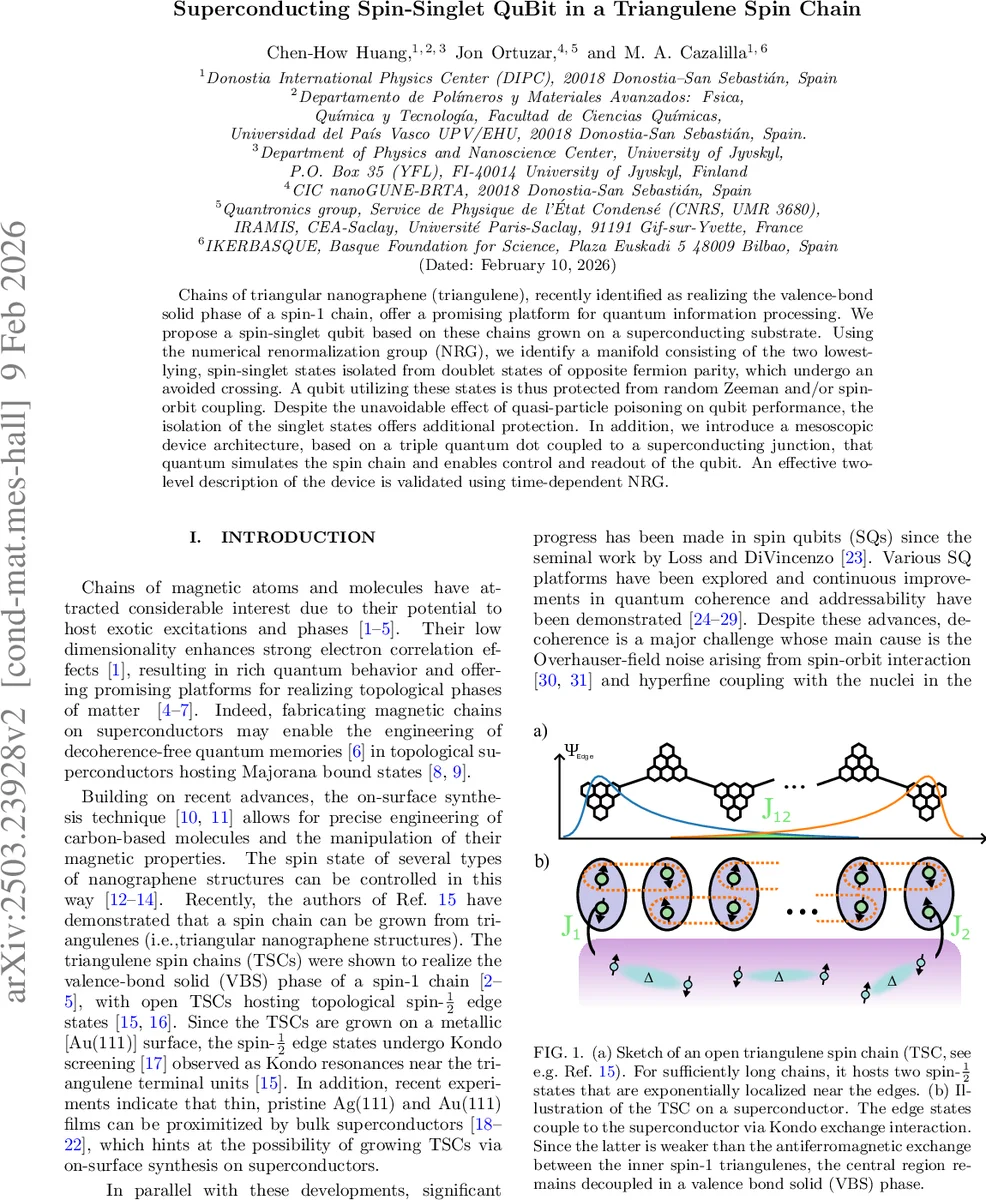
The authors present a novel superconducting spin‑singlet qubit architecture based on chains of triangular nanographene (triangulene) molecules, which have been experimentally shown to realize the valence‑bond‑solid (VBS) phase of a spin‑1 chain. In the VBS phase, each chain hosts two spin‑½ edge states that are weakly coupled through an antiferromagnetic Heisenberg exchange (J_ex) while simultaneously interacting with a superconducting substrate via Kondo exchange (J_K). By modeling the system as two Kondo impurities coupled to a superconducting bath, the authors employ the Numerical Renormalization Group (NRG) to compute the low‑energy spectrum. They discover that, as the ratio J_K/J_ex is tuned, the two lowest‑lying spin‑singlet states undergo an avoided crossing, forming an isolated manifold separated from higher‑energy doublet states of opposite fermion parity. This isolation protects the logical |0⟩ and |1⟩ states from random Zeeman fields and spin‑orbit noise, because any perturbation that flips a single spin would require a change in fermion parity and is thus energetically forbidden.
Quasiparticle poisoning—inevitable in any superconductor—remains the primary decoherence channel. The NRG analysis quantifies its impact and shows that when the singlet manifold is sufficiently gapped from the doublet continuum, the poisoning rate is strongly suppressed. The minimum singlet‑singlet gap Δ_gap can be controlled by electrostatic scattering potentials (V_1, V_2) or, in a device context, by the tunneling amplitude or phase bias of a superconducting junction.
To move beyond the impracticality of scanning‑tunneling‑microscope (STM) manipulation of individual molecules, the paper proposes a mesoscopic implementation using a triple quantum dot (TQD) coupled to a superconducting junction. Each dot mimics one of the edge spins, and the central dot’s tunnel coupling serves as a tunable knob for J_K and J_ex. Time‑dependent NRG simulations demonstrate that voltage pulses applied to the TQD induce coherent Rabi oscillations between the two singlet states, validating an effective two‑level Hamiltonian. Moreover, the device allows for fast, non‑invasive readout via the Josephson current, offering a realistic pathway to initialize, control, and measure the qubit with existing cryogenic electronics.
The work highlights four key insights: (1) the intrinsic energy separation provided by the VBS phase, (2) protection offered by the superconducting gap and fermion‑parity conservation, (3) the ability to engineer the avoided crossing through exchange‑ratio tuning, and (4) the feasibility of a scalable, electrically controllable platform via the TQD simulator. While quasiparticle poisoning remains a challenge, the proposed architecture promises a spin‑singlet qubit that is markedly more resilient to magnetic and spin‑orbit noise than conventional spin‑qubits, and it bridges molecular nanomagnetism with mesoscopic quantum‑electronic engineering, opening a viable route toward robust quantum information processing.
Comments & Academic Discussion
Loading comments...
Leave a Comment