Isoperimetric inequality for nearly spherical domains in the Bergman ball
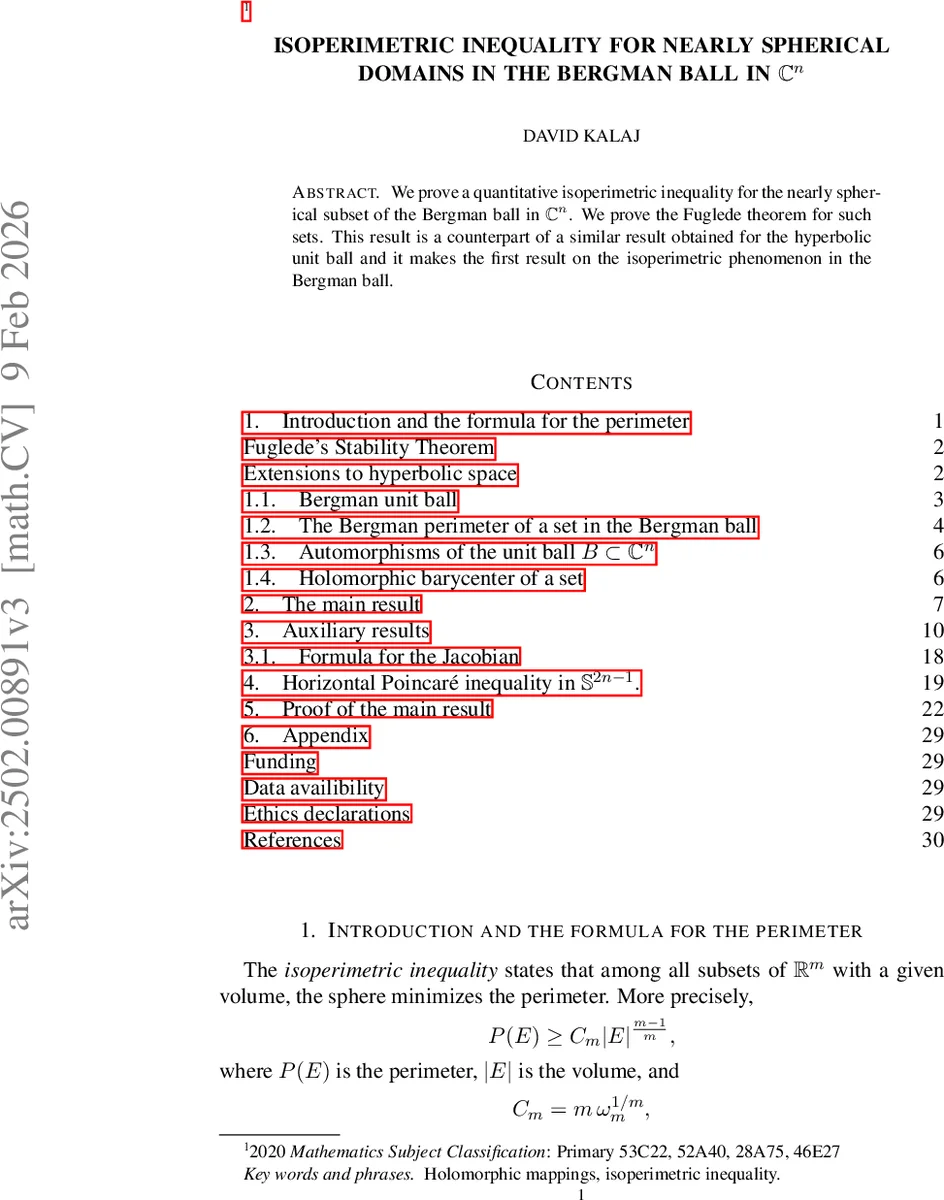
We prove a quantitative isoperimetric inequality for the nearly spherical subset of the Bergman ball in $\mathbb{C}^n$. We prove the Fuglede theorem for such sets. This result is a counterpart of a similar result obtained for the hyperbolic unit ball and it makes the first result on the isoperimetric phenomenon in the Bergman ball.
💡 Research Summary
The paper “Isoperimetric inequality for nearly spherical domains in the Bergman ball” establishes a quantitative isoperimetric inequality and a Fuglede‑type stability theorem for subsets of the complex unit ball equipped with the Bergman metric. After a brief historical overview of the classical Euclidean isoperimetric inequality, Fuglede’s stability result, and their extensions to hyperbolic space, the authors turn to the Bergman ball (B^{n}={z\in\mathbb C^{n}:|z|<1}).
First, the Bergman kernel (K(z,w)=\frac{1}{(1-\langle z,w\rangle)^{n+1}}) yields the metric tensor (g_{i\bar j}(z)=\frac{(1-|z|^{2})\delta_{ij}+z_i\bar z_j}{(1-|z|^{2})^{2}}). The associated volume form is (\mathrm d\mu(z)=(1-|z|^{2})^{-n-1}\mathrm dV(z)). Using a smooth defining function (U) for a level set (M={U=c}), the authors compute the Bergman normal (\nabla_{b}U) and derive a perimeter formula \
Comments & Academic Discussion
Loading comments...
Leave a Comment