Berry phase in axion physics, SM global structure, and generalized symmetries
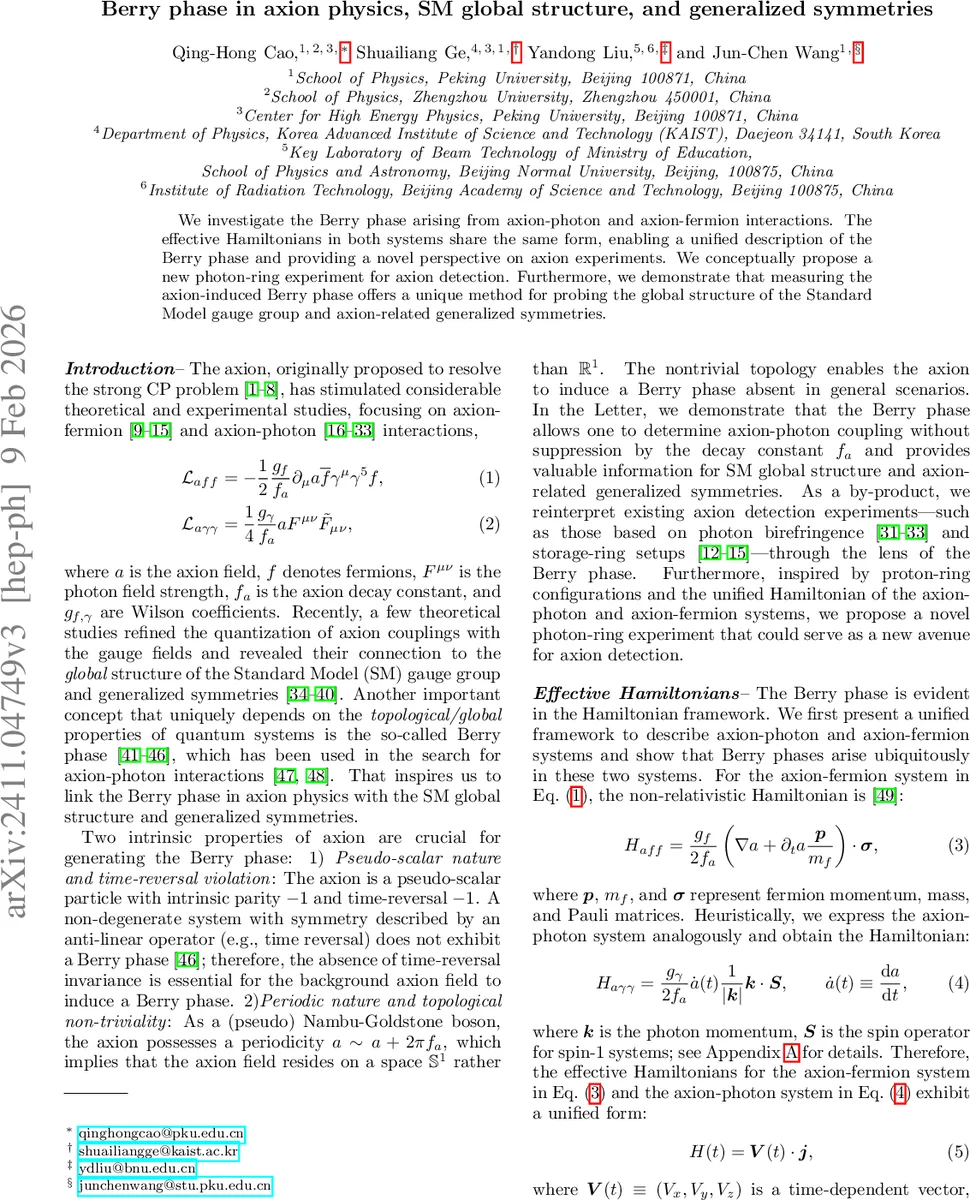
We investigate the Berry phase arising from axion-photon and axion-fermion interactions. The effective Hamiltonians in both systems share the same form, enabling a unified description of the Berry phase and providing a novel perspective on axion experiments. We conceptually propose a new photon-ring experiment for axion detection. Furthermore, we demonstrate that measuring the axion-induced Berry phase offers a unique method for probing the global structure of the Standard Model gauge group and axion-related generalized symmetries.
💡 Research Summary
The authors investigate the geometric (Berry) phase that arises when an axion background couples to photons or fermions. Starting from the standard interaction Lagrangians L_af = –½ g_f f a ∂μ a \bar f γ^μ γ_5 f and L_aγγ = ¼ g_γ a F{μν}\tilde F^{μν}, they derive non‑relativistic Hamiltonians for the two systems. The axion‑fermion Hamiltonian contains a term proportional to ∇a·σ and a term proportional to \dot a p/m_f·σ, while the axion‑photon Hamiltonian can be written as H_aγ = (g_γ/2f_a)\dot a(t) (k̂·S). Both Hamiltonians share the unified structure H(t)=V(t)·j, where V(t) is a time‑dependent vector determined by the axion field and j is the appropriate spin operator (Pauli matrices for spin‑½, spin‑1 matrices for photons).
Two distinct scenarios for the Berry phase are explored:
- Time‑varying magnitude of V(t) – This corresponds to a periodic axion background where \dot a(t) changes in time but the direction of V(t) remains fixed (e.g., photons propagating along the +z axis). By employing the operator decomposition U(t)=Z(t) e^{iMt} for a periodic Hamiltonian, the authors obtain the Berry phase α_Berry = ±(g_γ/2f_a)
Comments & Academic Discussion
Loading comments...
Leave a Comment