The Dold-Kan theorem for paracyclic modules
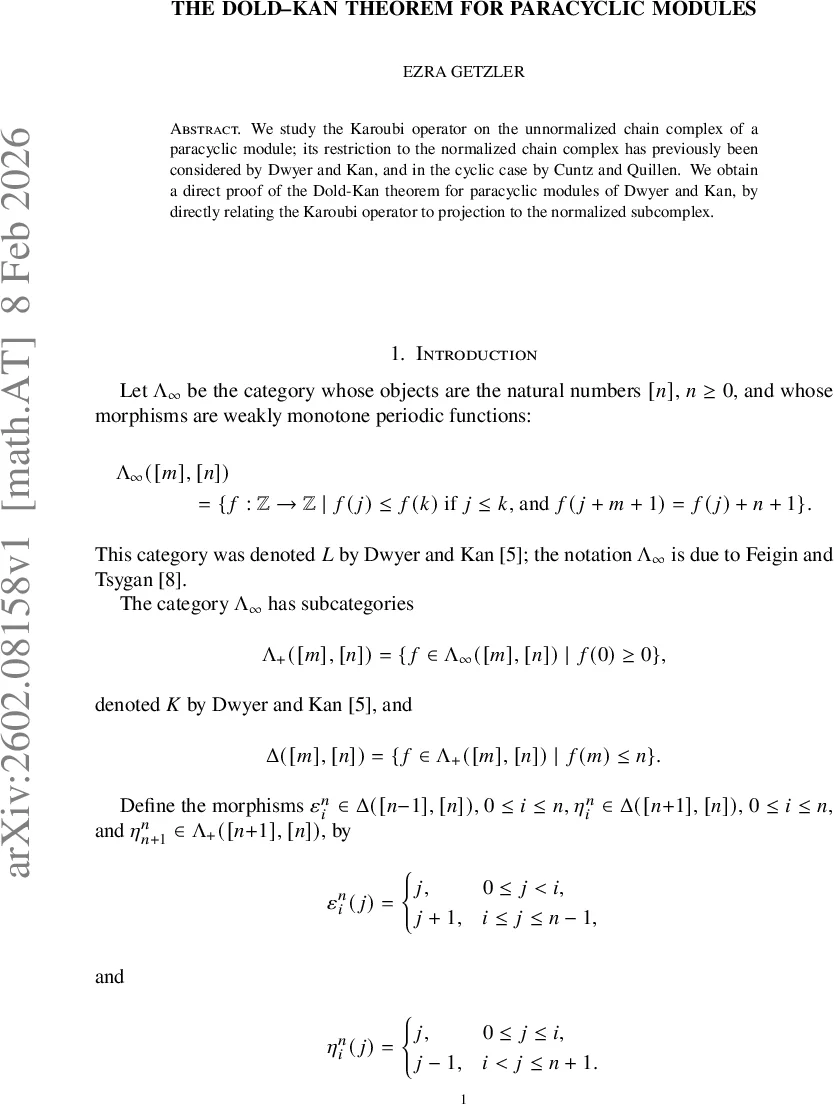
We study the Karoubi operator on the unnormalized chain complex of a paracyclic module; its restriction to the normalized chain complex has previously been considered by Dwyer and Kan, and in the cyclic case by Cuntz and Quillen. We obtain a direct proof of the Dold-Kan theorem for paracyclic modules of Dwyer and Kan, by directly relating the Karoubi operator to projection to the normalized subcomplex.
💡 Research Summary
The paper presents a new, direct proof of the Dold‑Kan theorem for paracyclic modules, originally due to Dwyer and Kan, by focusing on the Karoubi operator and its relationship to the projection onto the normalized subcomplex. The authors begin by recalling the category Λ∞ of “weakly monotone periodic” functions, together with its subcategories Λ⁺ (the duplicial category) and Δ (the simplicial category). A paracyclic module M· is a presheaf on Λ∞, a duplicial module on Λ⁺, and a simplicial module on Δ. The standard face, degeneracy, and cyclic operators εₙᵢ, ηₙᵢ, and τₙ are introduced, satisfying the usual simplicial relations.
The classical Dold‑Puppe idempotents pₙ, which project onto the normalized chains Nₙ(M) while killing degeneracies Dₙ(M), are revisited. Assuming the ambient pre‑additive category A is weakly idempotent complete, the authors show that each pₙ splits, yielding a direct sum decomposition Mₙ = Nₙ(M) ⊕ Dₙ(M). This decomposition underlies the Dold‑Kan decomposition: every element of Mₙ can be uniquely expressed as a sum of iterated degeneracies applied to a normalized element.
The core of the paper is the definition of the Karoubi operator κₙ on a duplicial module: \
Comments & Academic Discussion
Loading comments...
Leave a Comment