Spinor Double-Quantum Excitation in the Solution NMR of Near-Equivalent Spin-1/2 Pairs
A family of double-quantum excitation schemes is described for the solution nuclear magnetic resonance (NMR) of near-equivalent spin-1/2 pairs. These new methods exploit the spinor behaviour of 2-level systems, whose signature is the change of sign of a quantum state upon a $2π$ rotation. The spinor behaviour is used to manipulate the phases of single-quantum coherences, in order to prepare a double-quantum precursor state which is rapidly converted into double-quantum coherence by a straightforward $π/2$ rotation. One set of spinor-based methods exploits symmetry-based pulse sequences, while the other set exploits SLIC (spin-lock-induced crossing), in which the nutation frequency under a resonant radiofrequency field is matched to the spin-spin coupling. A variant of SLIC is introduced which is well-compensated for deviations in the radiofrequency field amplitude. The methods are demonstrated by performing double-quantum-filtered $^{19}$F NMR on a molecular system containing a pair of diastereotopic $^{19}$F nuclei. The new methods are compared with existing techniques.
💡 Research Summary
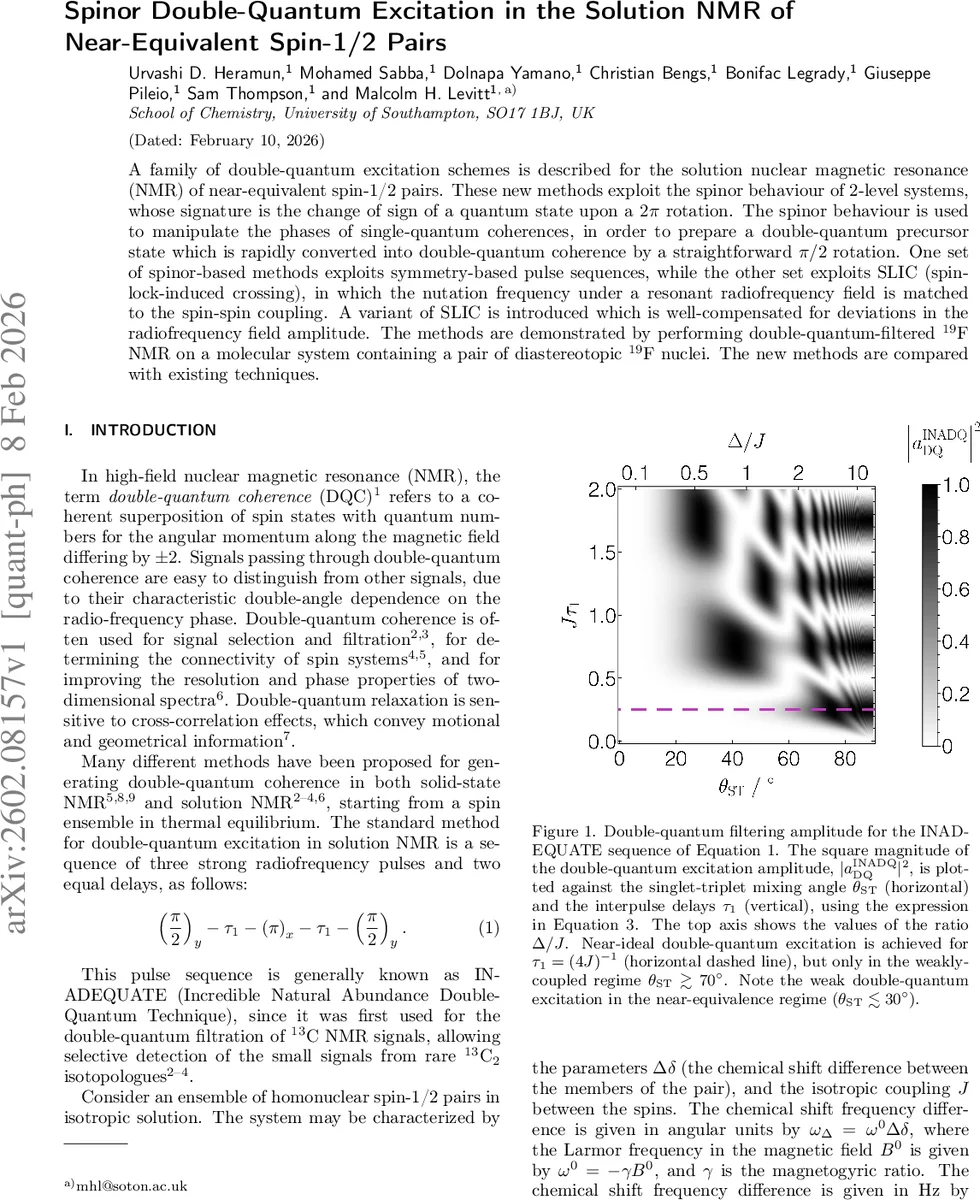
The paper introduces a new family of double‑quantum (DQ) excitation schemes specifically designed for solution‑state NMR of near‑equivalent spin‑½ pairs, i.e., systems in which the chemical‑shift difference Δ is comparable to or smaller than the scalar coupling J (mixing angle θ_ST ≲ 30°). Traditional DQ excitation methods such as INADEQUATE work well only in the weak‑coupling regime (θ_ST ≳ 70°) and become inefficient for near‑equivalent spins because the required interpulse delays become impractically long and relaxation losses dominate. Geometric DQ (GeoDQ) can recover efficiency by exploiting a Berry‑type phase in the zero‑quantum subspace, but it demands precise knowledge of Δ and J and a labor‑intensive optimisation procedure.
The authors propose to exploit the spinor property of a two‑level quantum system: a 2π rotation restores the original state with a sign change. By engineering pulse sequences that enact a 2π rotation in a selected two‑level subspace of the four‑level spin‑½ pair, they can deliberately introduce a π phase shift into the single‑quantum (SQ) coherences. This phase shift converts a SQ coherence into a “double‑quantum precursor” that is instantly transformed into true DQ coherence by a subsequent 90° pulse. Two concrete implementations are described.
-
PulsePol / Symmetry‑Based Implementation (R₄₁₃)
PulsePol, originally developed for electron‑nuclear polarization transfer in NV‑centers, consists of four π pulses with carefully chosen phases (Φ_A, Φ_B, Φ_rec). In the language of symmetry‑based recoupling, this sequence generates a 2π rotation (operator C₁₂) in the {|S₀⟩,|T₊₁⟩} subspace. Because C₁₂ carries the spinor sign (−1), the SQ coherence acquires the required π phase. A final 90° pulse then converts the precursor into DQ coherence. Theoretical analysis yields an excitation amplitude a_DQ given by Eq. 70, which approaches unity even for θ_ST ≈ 20°. The total sequence length T is modest (a few milliseconds for typical J ≈ 250 Hz), keeping relaxation losses low. -
SLIC‑Based Implementation
Spin‑Lock‑Induced Crossing (SLIC) applies a resonant RF field whose nutation frequency ω_nut matches the scalar coupling J, creating a crossing between the singlet and triplet manifolds. In the standard SLIC protocol an initial 90° pulse with a 90° phase offset is required; the authors show that for DQ generation the initial 90° pulse can be omitted and the SLIC block can be placed directly after the equilibrium magnetization. The SLIC block is followed by a 90° pulse sharing the same phase as the spin‑lock field, which directly converts the generated coherence into DQ. However, conventional SLIC is highly sensitive to RF amplitude errors.To overcome this, a compensated SLIC (cSLIC) variant is introduced. cSLIC consists of two consecutive spin‑lock periods with different amplitudes (γB₁ and 2γB₁). The first period creates the desired crossing, while the second corrects the phase error introduced by any deviation in the actual RF amplitude. Analytical treatment (Eq. 104) shows that the DQ excitation amplitude becomes largely independent of modest RF mis‑calibration (±5 %). The overall duration remains comparable to standard SLIC.
Theoretical Framework
The authors rewrite the rotating‑frame Hamiltonian in terms of single‑transition operators I_rs^μ, separating the sum (Σ) and difference (Δ) Zeeman terms and the J‑coupling term. By applying rotation operators R_rs^μ(β) they express the effect of each pulse on the four‑level system. The 2π rotation operator C_rs = R_rs^μ(2π) is shown to be –1 in the rotated subspace plus identity on the orthogonal subspace (Eq. 15), embodying the spinor sign change. The DQ excitation amplitude a_DQ is defined as ⟨T₊₁|U ρ_eq U†|T₋₁⟩, where U is the total unitary of the pulse sequence. The DQ filtering amplitude a_DQF = |a_DQ|² is the observable after the standard four‑step phase‑cycling detection.
Experimental Validation
A diastereotopic ¹⁹F pair in a small organic molecule is used as a test system (J = 255.94 Hz, Δ = 17.8 Hz). The authors acquire DQ‑filtered spectra for four excitation schemes: INADEQUATE, PulsePol‑DQ, SLIC‑DQ, and cSLIC‑DQ. The INADEQUATE sequence, even at its optimal τ₁ = (4J)⁻¹, yields a DQF of only ~0.12 due to the near‑equivalence. PulsePol‑DQ reaches a DQF of ~0.78 at T ≈ 4 ms, SLIC‑DQ gives ~0.73 at T ≈ 5 ms, and cSLIC‑DQ attains ~0.80 at a similar duration. Simulations that neglect relaxation match the experimental curves closely, confirming the theoretical predictions. Moreover, cSLIC‑DQ maintains >95 % of its efficiency when the RF amplitude is varied by ±5 %, whereas standard SLIC drops by >20 % under the same conditions.
Discussion and Outlook
The work demonstrates that spinor‑based phase engineering provides a robust route to high‑efficiency DQ excitation in the regime where conventional methods fail. Because the technique does not require prior knowledge of Δ and J, it is well suited for unknown or complex mixtures. The short overall sequence length reduces relaxation losses, making the approach applicable to biomolecules with short T₂. Potential extensions include: (i) generating higher‑order multiple‑quantum coherences by chaining spinor rotations, (ii) integrating the method into 2D correlation experiments (e.g., DQ‑COSY, DQ‑HSQC) for improved resolution of overlapped resonances, (iii) exploiting the sign‑change property for quantum‑information‑type gate operations in liquid‑state NMR quantum computing, and (iv) applying the compensated SLIC concept to other spin‑lock based manipulations such as singlet‑state preparation and long‑lived coherence storage.
In summary, the paper provides a clear theoretical foundation, practical pulse‑sequence recipes, and convincing experimental evidence that spinor‑driven double‑quantum excitation is a powerful addition to the NMR toolbox for near‑equivalent spin‑½ pairs.
Comments & Academic Discussion
Loading comments...
Leave a Comment