The Game-Theoretic Katětov Order and Idealised Effective Subtoposes
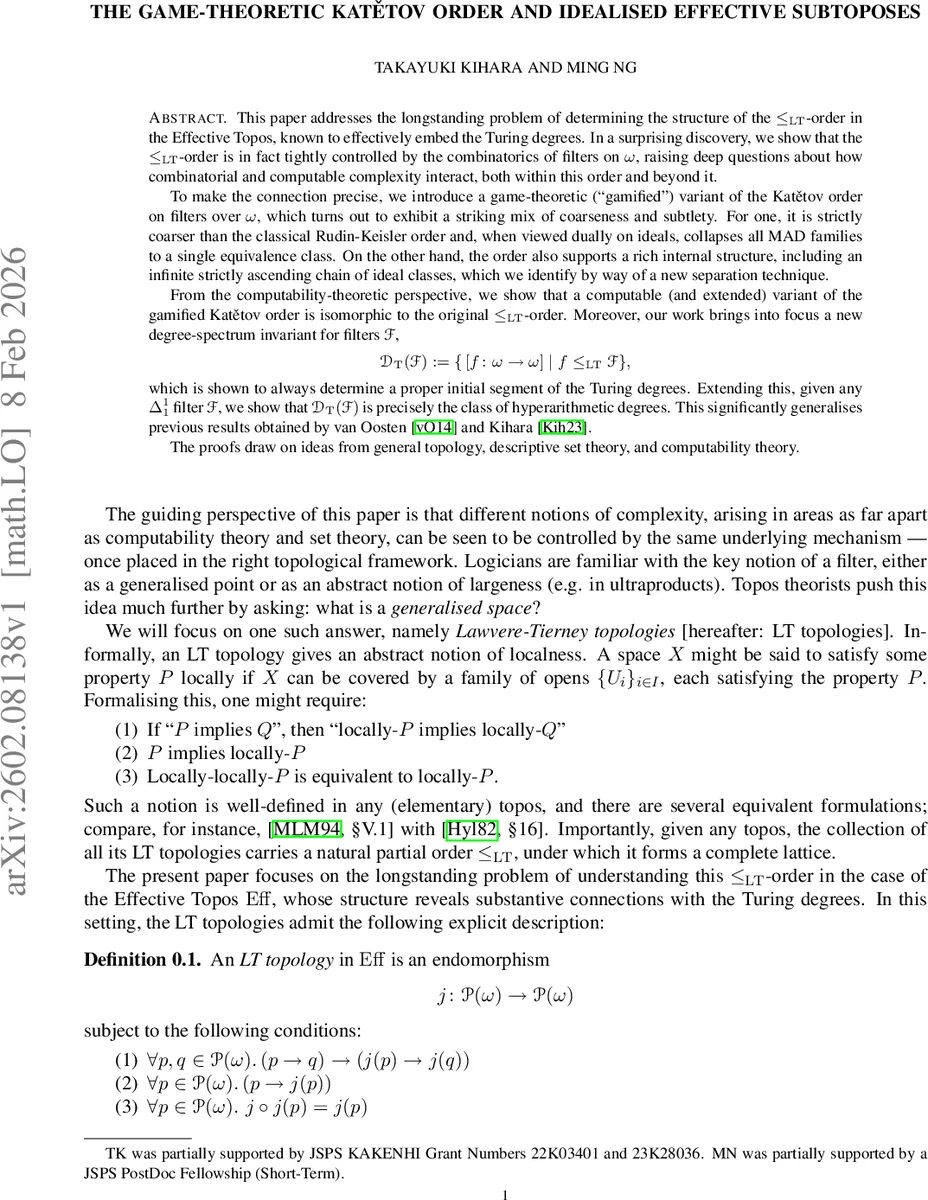
This paper addresses the longstanding problem of determining the structure of the $\leq_{\mathrm{LT}}$-order in the Effective Topos, known to effectively embed the Turing degrees. In a surprising discovery, we show that the $\leq_{\mathrm{LT}}$-order is in fact tightly controlled by the combinatorics of filters on $ω$, raising deep questions about how combinatorial and computable complexity interact, both within this order and beyond it. To make the connection precise, we introduce a game-theoretic (‘‘gamified’’) variant of the Katětov order on filters over $ω$, which turns out to exhibit a striking mix of coarseness and subtlety. For one, it is strictly coarser than the classical Rudin-Keisler order and, when viewed dually on ideals, collapses all MAD families to a single equivalence class. On the other hand, the order also supports a rich internal structure, including an infinite strictly ascending chain of ideal classes, which we identify by way of a new separation technique. From the computability-theoretic perspective, we show that a computable (and extended) variant of the gamified Katětov order is isomorphic to the original $\leq_{\mathrm{LT}}$-order. Moreover, our work brings into focus a new degree-spectrum invariant for filters $\mathcal{F}$, $$\mathcal{D}{\mathrm{T}}(\mathcal{F}):={,[f\colonω\toω] \mid f\leq{\mathrm{LT}} \mathcal{F} },$$ which is shown to always determine a proper initial segment of the Turing degrees. Extending this, given any $Δ^1_1$ filter $\mathcal{F}$, we show that $\mathcal{D}_{\mathrm{T}}(\mathcal{F})$ is precisely the class of hyperarithmetic degrees. This significantly generalises previous results obtained by van Oosten \cite{vO14} and Kihara \cite{Kih23}. The proofs draw on ideas from general topology, descriptive set theory, and computability theory.
💡 Research Summary
The paper tackles the long‑standing problem of describing the ≤ₗₜ‑order on Lawvere‑Tierney (LT) topologies in the Effective Topos (Eff). While it has been known since Hyland that the Turing degrees embed into this order, the internal structure of ≤ₗₜ has remained obscure. The authors introduce a new preorder on upper sets of ω, called the Game‑Theoretic Katětov order (denoted U ≤ₒₗₜ V), and show that this order precisely captures the combinatorial and computational content of ≤ₗₜ.
The construction proceeds by taking the classical Katětov order on filters and closing it under well‑founded iterations of Fubini powers, formalised as δ‑Fubini powers. This yields a strictly coarser relation than both the Rudin‑Keisler (≤_RK) and the ordinary Katětov orders. Crucially, the authors give an explicit two‑player game: Player I chooses a function, Player II chooses a set from V, and the win condition mirrors the inclusion of the image of the function in the filter generated by the chosen set. Existence of a winning strategy for Player I exactly means U ≤ₒₗₜ V.
Three main theorems connect this new order to the Effective Topos. Theorem A proves that the computable version of the Game‑Theoretic Katětov order is isomorphic to the ≤ₗₜ‑order on LT topologies: for any upper sets U, V there is a computable strategy iff the corresponding LT topologies satisfy j_U ≤ₗₜ j_V. Theorem B shows that the Game‑Theoretic Katětov order is incomparable with the Tukey order in ZFC, highlighting that it detects a different aspect of filter cofinality. Theorem C demonstrates that, despite collapsing all MAD families to a single equivalence class, the order still contains an infinite strictly ascending chain of ideals:
Fin < ED Fin
Comments & Academic Discussion
Loading comments...
Leave a Comment