Double Disadvantage: How Gender and Residential Location Shape Hiring Outcomes in Pakistan's IT Sector
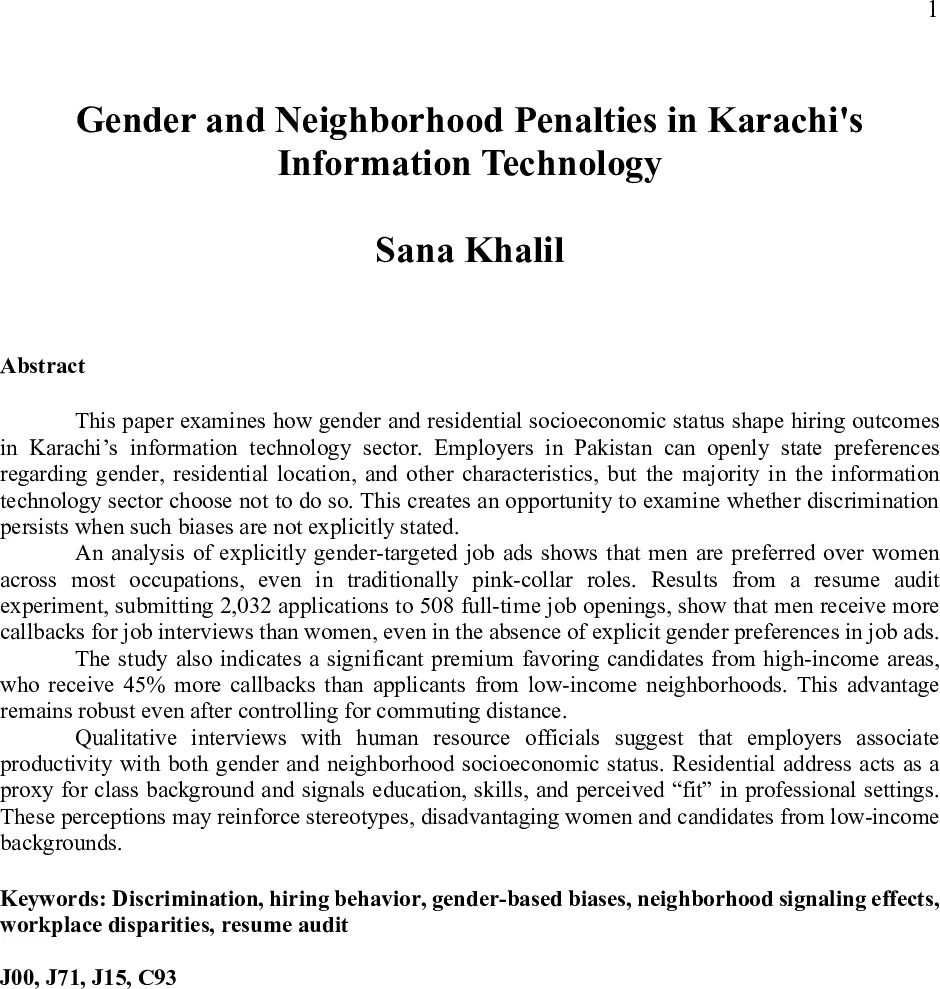
This paper examines how gender and residential socioeconomic status shape hiring outcomes in the information technology sector using a field experiment from the city of Karachi, Pakistan. Employers in Pakistan can openly state preferences regarding gender, residential location, and other characteristics, but the majority in the information technology sector choose not to do so. This creates an opportunity to examine whether discrimination persists when such biases are not explicitly stated. An analysis of explicitly gender-targeted job ads shows that men are preferred over women across most occupations, even in traditionally pink-collar roles. Moreover, results from a resume audit experiment, submitting 2,032 applications to 508 full-time job openings, show that men receive more callbacks for job interviews than women, even in the absence of explicit gender preferences in job ads. The study also indicates a significant premium favoring candidates from high-income areas, who receive 45 percent more callbacks than applicants from low-income neighborhoods. This advantage remains robust even after controlling for commuting distance. Qualitative interviews with human resource officials suggest that employers associate productivity with both gender and neighborhood socioeconomic status. Residential address acts as a proxy for class background and signals education, skills, and perceived “fit” in professional settings. These perceptions may reinforce stereotypes, disadvantaging women and candidates from low-income backgrounds.
💡 Research Summary
This paper investigates how gender and residential socioeconomic status influence hiring outcomes in Karachi’s information‑technology (IT) sector. The author adopts a three‑pronged research design: (1) analysis of explicit gender preferences in job advertisements, (2) a correspondence (resume‑audit) experiment, and (3) qualitative interviews with human‑resource (HR) professionals.
First, job ads posted on Pakistan’s largest online portal (rozee.pk) and major newspapers between August 2018 and March 2019 were coded for gender specifications. Although roughly 80 % of IT postings omitted any gender preference, the ads that did specify a preference overwhelmingly favored men (14 % of ads) over women (6 %). Male preference was observed across most occupations, including traditionally “pink‑collar” fields such as health and medicine, where men were still preferred at a ratio of roughly 21 % to 6 %.
Second, following the Bertrand‑Mullainathan (2004) methodology, the author constructed 2,032 fictitious résumés of software programmers. Real LinkedIn profiles were stripped of identifying information; names were randomly assigned as male or female, and residential addresses were drawn from high‑income neighborhoods (e.g., DHA, Clifton) and low‑income neighborhoods (e.g., Orangi, Lyari). These résumés were randomly submitted to 508 real full‑time IT job openings, and the binary outcome was whether the applicant received an interview invitation. Regression analysis shows that, even when the posting contains no explicit gender bias, male applicants receive about 28 % more callbacks than female applicants. Moreover, candidates from high‑income neighborhoods receive 45 % more callbacks than those from low‑income neighborhoods. These effects remain statistically significant after controlling for commuting distance, education, work experience, and technical skill set, indicating that the residential address functions as a powerful proxy for socioeconomic status independent of actual travel time.
Third, semi‑structured interviews were conducted with 30 HR officials from both IT firms and Sales & Business Development (SBD) firms. IT HR managers emphasized technical competence but admitted that a candidate’s address signals “network strength, education level, punctuality, and overall professionalism.” SBD managers, whose roles involve frequent client interaction, reported stronger gender‑based stereotypes and were more likely to associate low‑income addresses with cultural incompatibility. These qualitative insights corroborate the experimental findings and align with theoretical models of statistical discrimination (Phelps 1972; Hillier 2003) and distance‑based productivity concerns (Phillips 2020; Diaz & Salas 2020).
The study contributes to three strands of literature. It provides the first field experiment on hiring discrimination in Pakistan, a context where explicit discrimination is legally permissible but often unregulated. It triangulates evidence from job‑ad data, audit experiments, and interviews to capture both overt and covert bias. Finally, it extends spatial mismatch and stratification economics by demonstrating that neighborhood signals affect hiring decisions in a high‑skill labor market, even after commuting distance is held constant.
Policy implications include strengthening enforcement of Pakistan’s anti‑discrimination provisions, implementing blind‑recruiting systems that mask names and addresses, and expanding technical training and networking programs for residents of low‑income neighborhoods. Limitations involve the focus on a single sector, omission of informal hiring channels, and lack of longitudinal tracking of actual employment outcomes. Future research should replicate the design across diverse industries and examine long‑term career trajectories to better understand the persistence and economic costs of gender and residential discrimination.
Comments & Academic Discussion
Loading comments...
Leave a Comment