Adjustment of Cluster-Then-Predict Framework for Multiport Scatterer Load Prediction
Predicting interdependent load values in multiport scatterers is challenging due to high dimensionality and complex dependence between impedance and scattering ability, yet this prediction remains crucial for the design of communication and measurement systems. In this paper, we propose a two-stage cluster-then-predict framework for multiple load values prediction task in multiport scatterers. The proposed cluster-then-predict approach effectively captures the underlying functional relation between S-parameters and corresponding load impedances, achieving up to a 46% reduction in Root Mean Square Error (RMSE) compared to the baseline when applied to gradient boosting (GB). This improvement is consistent across various clustering and regression methods. Furthermore, we introduce the Real-world Unified Index (RUI), a metric for quantitative analysis of trade-offs among multiple metrics with conflicting objectives and different scales, suitable for performance assessment in realistic scenarios. Based on RUI, the combination of K-means clustering and k-nearest neighbors (KNN) is identified as the optimal setup for the analyzed multiport scatterer.
💡 Research Summary
The paper addresses the challenging problem of predicting multiple load impedances in multi‑port scatterers, a task that is essential for the design and real‑time control of reconfigurable intelligent surfaces (RIS) and backscatter devices. Conventional AI‑based regression models such as Gradient Boosting (GB) and k‑Nearest Neighbors (KNN) suffer from severe accuracy degradation when the number of loads increases, mainly because the high‑dimensional S‑parameter data exhibit large variance and complex inter‑load dependencies.
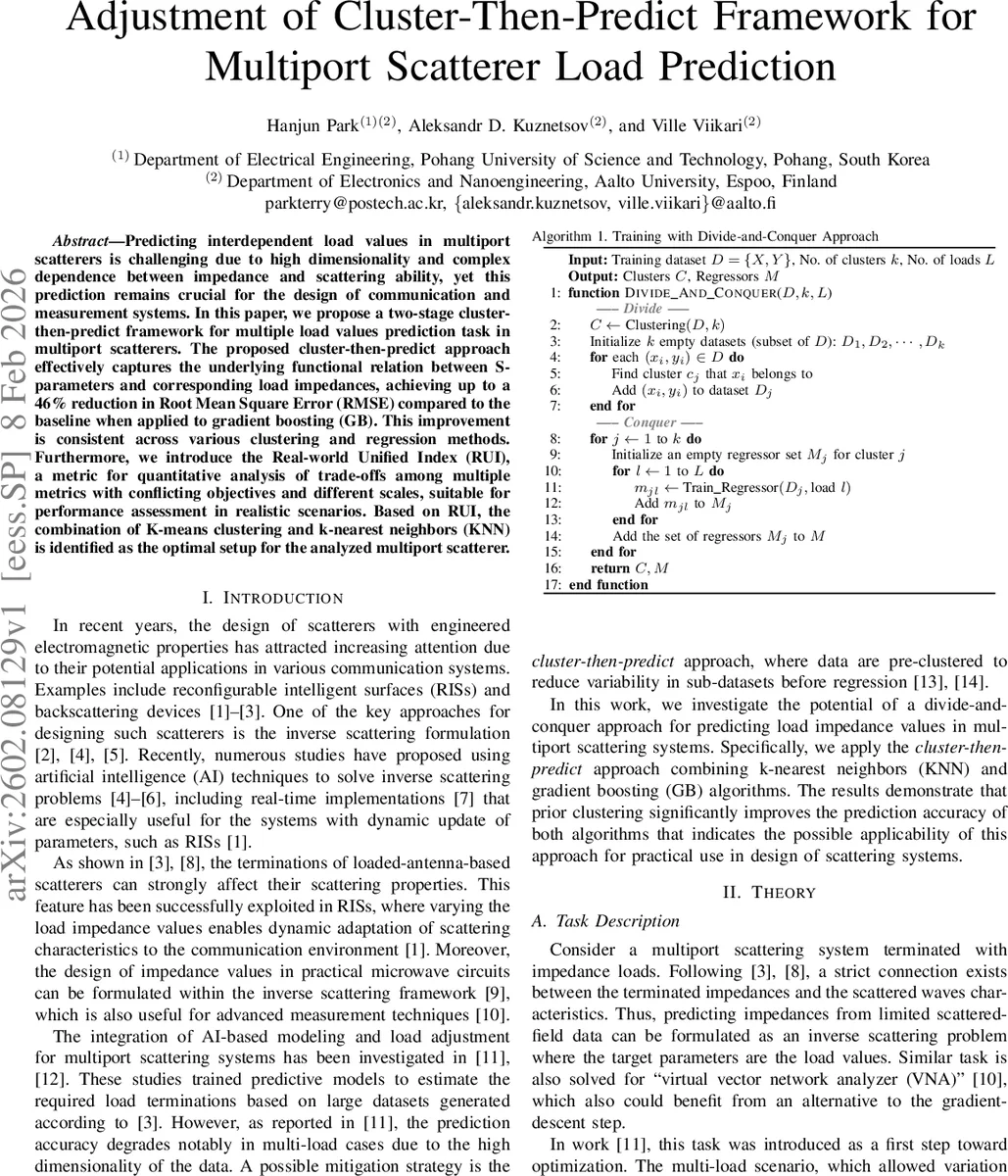
To mitigate these issues, the authors propose a two‑stage “cluster‑then‑predict” framework. In the first stage, the entire training set is partitioned into more homogeneous subsets using either standard K‑means or an Optimal Transport (OT)‑based K‑means algorithm. The clustering quality is assessed with the silhouette score. In the second stage, a separate regression model is trained for each cluster. The regression models examined include a multi‑output Gradient Boosting model (GB), a variant that trains one GB per load (GB′), and K‑Nearest Neighbors (KNN) with various neighbor counts. During inference, a test sample is assigned to the nearest cluster centroid and the corresponding regressor produces the load predictions.
The experimental setup uses a synthetic dataset of one million samples derived from a three‑layer dipole scatterer, with three load impedances and S‑parameters measured in four directions. The data are split 80/20 for training and testing, and all features are normalized using the training statistics. A grid search over the number of clusters (5–200 in steps of 5) is performed, and performance is evaluated with three metrics: Root Mean Square Error (RMSE), silhouette score, and prediction time (including cluster assignment).
Key findings are:
-
Accuracy improvement for GB – When clustering is applied, GB’s RMSE drops from 167.82 Ω (baseline) to 90.11 Ω, a 46 % reduction. The improvement plateaus after a certain number of clusters, indicating an optimal trade‑off between data homogeneity and model complexity.
-
Limited impact on KNN – KNN’s RMSE changes only marginally (≈+0.3 Ω) with clustering, and its prediction time remains essentially constant (~0.04 s), confirming that KNN already captures local structure well and is naturally suited for real‑time operation.
-
Clustering method comparison – Standard K‑means yields higher silhouette scores than OT‑K‑means, though both methods show decreasing scores as the number of clusters grows, suggesting over‑segmentation harms cluster quality.
-
Composite metric (RUI) – To handle conflicting objectives (minimizing error, maximizing cluster quality, minimizing latency), the authors introduce the Real‑world Unified Index (RUI). After normalizing each metric to
Comments & Academic Discussion
Loading comments...
Leave a Comment