On the approximation gain for abc-triples
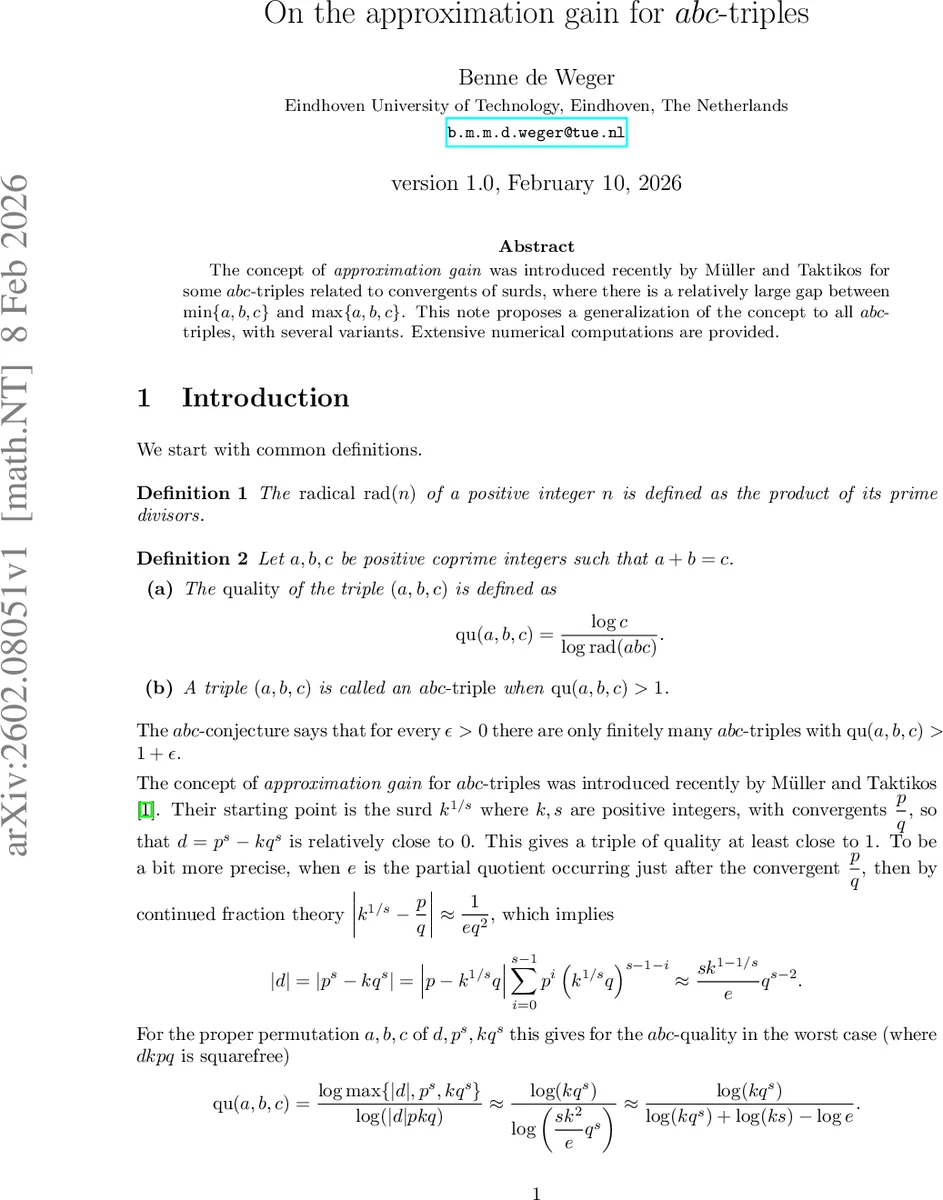
The concept of approximation gain was introduced recently by Müller and Taktikos for some abc-triples related to convergents of surds, where there is a relatively large gap between min{a,b,c} and max{a,b,c}. This note proposes a generalization of the concept to all abc-triples, with several variants. Extensive numerical computations are provided.
💡 Research Summary
**
The paper revisits the notion of “approximation gain” introduced by Müller and Taktikos for certain abc‑triples that arise from convergents of surds, where the smallest element a is much smaller than the middle element b. In those cases the quantity |p·s − k·q·s| is tiny, yielding an abc‑quality close to 1. The author observes that this definition is limited to triples with a pronounced size gap and proposes a comprehensive generalisation that applies to any abc‑triple.
First, the author defines a family of “real enhanced radicals” rrad₍d₎(a,b,c) for any integer degree d ≥ 2. Writing a = β·d·b′ and c = γ·d·c′ with β, γ as large as possible, the enhanced radical is rrad₍d₎ = a^β · b′^γ · c′. Two associated quantities are introduced:
- rag₍d₎ = log c · log rrad₍d₎ (the real approximation gain),
- rpg₍d₎ = log rrad₍d₎ · log rad(abc) (the real power gain).
The author proves that for each triple the supremum of rag₍d₎ over d exists (it is attained when d exceeds the maximal exponent occurring in b or c, at which point rrad₍d₎ = abc) and that the infimum of rpg₍d₎ exists. Moreover, rag₍d₎ ≤ quality qu(a,b,c) ≤ 3·rpg₍d₎, so the two new measures bound the classical abc‑quality from below and above respectively.
A detailed example is given with Reyssat’s record triple (2, 3¹⁰·10⁹, 23⁵). For d = 5 the real approximation gain reaches 1.46283…, while the corresponding power gain is 1.11421…, illustrating that the quality is essentially the product rag·rpg.
Extensive computations are performed on all known abc‑triples below 10¹⁸ (≈14.5 million) and on the 9.3 million triples between 10¹⁸ and 2⁶³ from Bart de Smit’s tables. The top ten rag values are listed; the maximum rag (1.46283…) again belongs to Reyssat’s triple, confirming that the new measure captures the best known “real” approximations. The largest observed rpg (2.94376…) occurs for (2⁴⁹, 7⁷·19³·123 499, 3¹³·5⁵·503²), where rag is modest (0.45020…) but the overall quality is 1.32528….
Recognising that many abc‑triples do not exhibit a large real‑size gap, the author introduces a p‑adic analogue. For a chosen prime p, one writes the selected element (say a) as a = p^α·a′ with α ≥ 1. A “multiple p‑adic enhanced radical” mrad₍a*,d₎ is defined as rad(a*)·β·b′·γ·c′, where a* denotes the chosen element after stripping all p‑powers beyond the first. Corresponding p‑adic gains are
- mag₍a*,d₎ = log c · log mrad₍a*,d₎ (p‑adic approximation gain),
- mpg₍a*,d₎ = log mrad₍a*,d₎ · log rad(abc) (p‑adic power gain).
By allowing different primes simultaneously (e.g., using both 2 and 5), one obtains a “multiple p‑adic approximation gain” that can be larger than any single‑prime version. The author demonstrates the method with three concrete examples:
- A triple where a is huge in the real sense but has a large 2‑adic exponent (α = 19). The real rag is only 0.65708, whereas the 2‑adic mag rises to 1.05580.
- A triple with moderate exponents at 2, 5, 7. Using both 2 and 5 together yields mag ≈ 0.96855, outperforming any single‑prime gain.
- Reyssat’s triple again, now examined for p = 2, 3, 23, 109. For p = 3 and 23 the p‑adic mag equals the abc‑quality (≈1.62991), while for p = 109 it is lower (≈0.80372) because the exponent of 109 is only 1.
The paper also discusses the lattice viewpoint: for a p‑adic integer α and approximation order n, the set of integer pairs (x,y) with |x − yα|ₚ ≤ p^{−n} forms a 2‑dimensional lattice Λₙ(α). Basis reduction on this lattice reproduces the continued‑fraction‑like process and yields the optimal p‑adic approximations (the “partial quotients” become the reduction coefficients).
Finally, the author summarises the theoretical bounds: 1/3 ≤ rag ≤ qu ≤ 3·rpg, and outlines future directions: optimal choice of degree d, deeper analysis of multiple‑prime p‑adic gains, and a rigorous investigation of the relationship between approximation gains and the abc‑conjecture. All data and code are made publicly available on a dedicated website, ensuring reproducibility.
Comments & Academic Discussion
Loading comments...
Leave a Comment