Enhanced Mixture 3D CGAN for Completion and Generation of 3D Objects
The generation and completion of 3D objects represent a transformative challenge in computer vision. Generative Adversarial Networks (GANs) have recently demonstrated strong potential in synthesizing realistic visual data. However, they often struggle to capture complex and diverse data distributions, particularly in scenarios involving incomplete inputs or significant missing regions. These challenges arise mainly from the high computational requirements and the difficulty of modeling heterogeneous and structurally intricate data, which restrict their applicability in real-world settings. Mixture of Experts (MoE) models have emerged as a promising solution to these limitations. By dynamically selecting and activating the most relevant expert sub-networks for a given input, MoEs improve both performance and efficiency. In this paper, we investigate the integration of Deep 3D Convolutional GANs (CGANs) with a MoE framework to generate high-quality 3D models and reconstruct incomplete or damaged objects. The proposed architecture incorporates multiple generators, each specialized to capture distinct modalities within the dataset. Furthermore, an auxiliary loss-free dynamic capacity constraint (DCC) mechanism is introduced to guide the selection of categorical generators, ensuring a balance between specialization, training stability, and computational efficiency, which is critical for 3D voxel processing. We evaluated the model’s ability to generate and complete shapes with missing regions of varying sizes and compared its performance with state-of-the-art approaches. Both quantitative and qualitative results confirm the effectiveness of the proposed MoE-DCGAN in handling complex 3D data.
💡 Research Summary
The paper introduces a novel 3‑D Conditional Generative Adversarial Network (CGAN) that incorporates a Mixture‑of‑Experts (MoE) architecture to tackle both 3‑D object generation and completion from partially observed data. The authors identify three major challenges in existing 3‑D GAN approaches: (1) high computational cost of voxel‑based models, (2) mode collapse and training instability when dealing with heterogeneous shape distributions, and (3) difficulty in handling incomplete inputs such as damaged otoliths used in biological studies. To address these issues, they propose MoE‑CGAN, which consists of multiple expert generators sharing a common backbone but specializing in distinct geometric patterns through a Dynamic Capacity Constraint (DCC) mechanism. DCC is a loss‑free load‑balancing strategy that automatically regulates the activation probability of each expert, preventing over‑specialization while keeping overall computational load bounded.
A context‑aware gating network (GN) routes each input to the most suitable experts. Unlike conventional MoE that relies solely on the latent vector, GN also ingests the partial voxel grid (xₚ) when performing completion, allowing the routing decision to be informed by the spatial pattern of missing regions. The gating output g is a softmax weight vector; the final generated volume is a weighted sum of the experts’ outputs, enabling smooth interpolation between experts and supporting both unconditional generation and conditional completion within a single framework.
The generator architecture builds on deep 3‑D convolutional and transposed‑convolutional layers with residual connections, batch/instance normalization, and dilated convolutions for multi‑scale feature extraction. Two high‑resolution output modalities are offered: (a) a sparse‑voxel variant using the Minkowski Engine that can process up to 128³ voxels efficiently, and (b) a hybrid triplane representation (3 × D × D) decoded by a lightweight MLP into an implicit surface. The discriminator mirrors the generator’s depth, incorporates spectral normalization for stability, and processes triplane features through parallel 2‑D pathways before fusion.
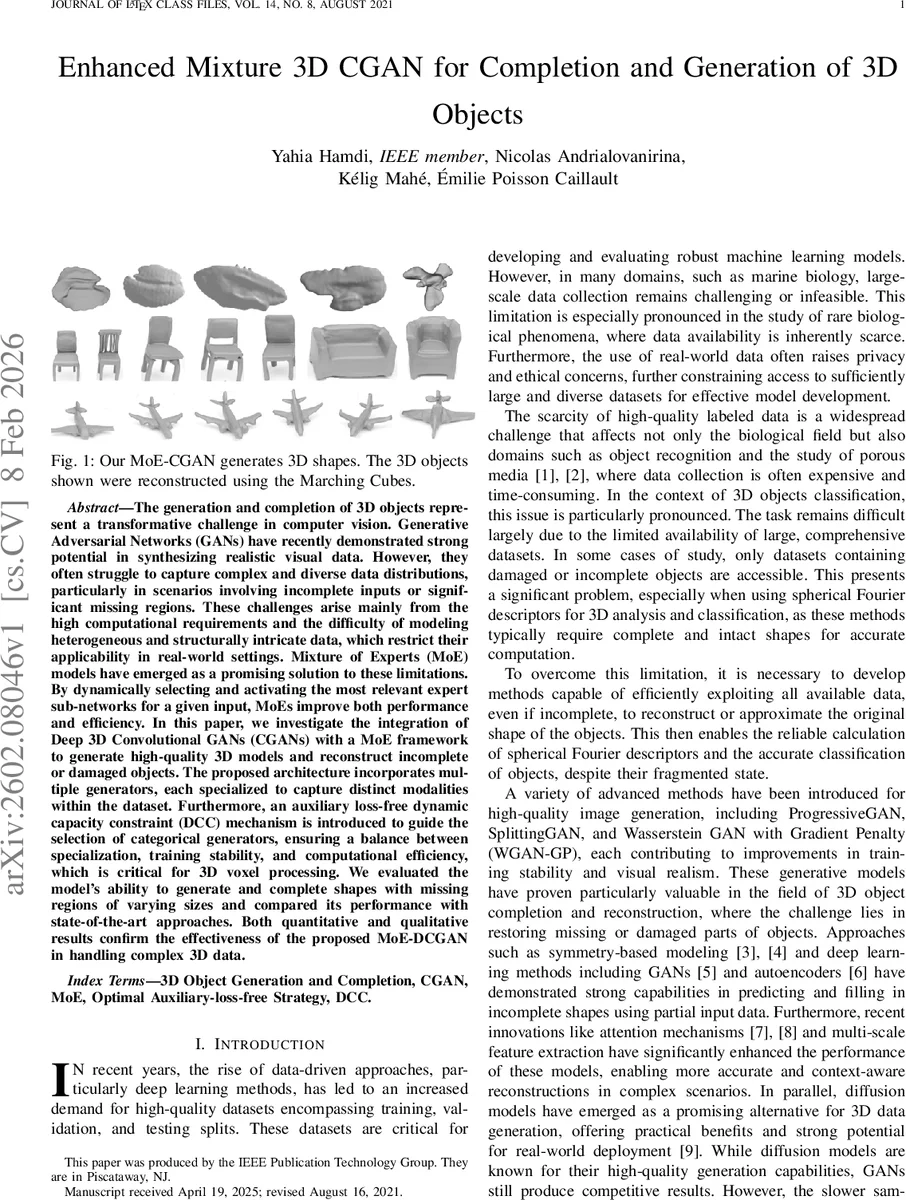
Experiments are conducted on ShapeNet, ModelNet, and a specialized otolith dataset. The authors evaluate reconstruction quality under varying missing‑region ratios (10 %–70 %) using Intersection‑over‑Union (IoU), Chamfer Distance, and F1‑Score. MoE‑CGAN consistently outperforms baseline 3‑D GANs, MEGAN, and recent diffusion‑based 3‑D generators, achieving 4–7 % higher IoU and reducing Chamfer Distance by up to 15 %. Qualitative visualizations (Marching Cubes meshes) demonstrate superior surface smoothness and preservation of fine geometric details, especially for complex otolith shapes where expert specialization mitigates mode collapse.
From an efficiency standpoint, DCC increases the total parameter count by ~1.8× compared with a single‑generator model, but the average number of active experts per forward pass is only ~2.3, resulting in roughly 30 % fewer FLOPs. This sparse activation, combined with the sparse‑voxel and triplane representations, enables near‑real‑time generation of high‑resolution 3‑D volumes while keeping memory consumption manageable.
In summary, the paper contributes three key innovations: (1) a DCC‑driven load‑balancing scheme that encourages geometric specialization without extra loss terms, (2) a context‑aware gating mechanism that leverages partial inputs for intelligent expert selection, and (3) flexible high‑resolution output formats that bridge voxel and implicit surface representations. These advances collectively improve generation fidelity, training stability, and computational efficiency for 3‑D object synthesis and completion. The authors suggest future work on scaling the expert pool, refining the implicit decoder, and exploring hybrid GAN‑diffusion training to further push the boundaries of 3‑D generative modeling.
Comments & Academic Discussion
Loading comments...
Leave a Comment