Analyzing the Impact of Simulation Fidelity on the Evaluation of Autonomous Driving Motion Control
Simulation is crucial in the development of autonomous driving software. In particular, assessing control algorithms requires an accurate vehicle dynamics simulation. However, recent publications use models with varying levels of detail. This disparity makes it difficult to compare individual control algorithms. Therefore, this paper aims to investigate the influence of the fidelity of vehicle dynamics modeling on the closed-loop behavior of trajectory-following controllers. For this purpose, we introduce a comprehensive Autoware-compatible vehicle model. By simplifying this, we derive models with varying fidelity. Evaluating over 550 simulation runs allows us to quantify each model’s approximation quality compared to real-world data. Furthermore, we investigate whether the influence of model simplifications changes with varying margins to the acceleration limit of the vehicle. From this, we deduce to which degree a vehicle model can be simplified to evaluate control algorithms depending on the specific application. The real-world data used to validate the simulation environment originate from the Indy Autonomous Challenge race at the Autodromo Nazionale di Monza in June 2023. They show the fastest fully autonomous lap of TUM Autonomous Motorsport, with vehicle speeds reaching 267 kph and lateral accelerations of up to 15 mps2.
💡 Research Summary
The paper investigates how the fidelity of vehicle‑dynamics simulation influences the closed‑loop performance of trajectory‑following controllers for autonomous driving. Recognizing that recent literature employs vehicle models ranging from simple single‑track representations to full multibody simulations, the authors aim to quantify the impact of these modeling choices on controller behavior and to determine under which operating conditions a simplified model is sufficient.
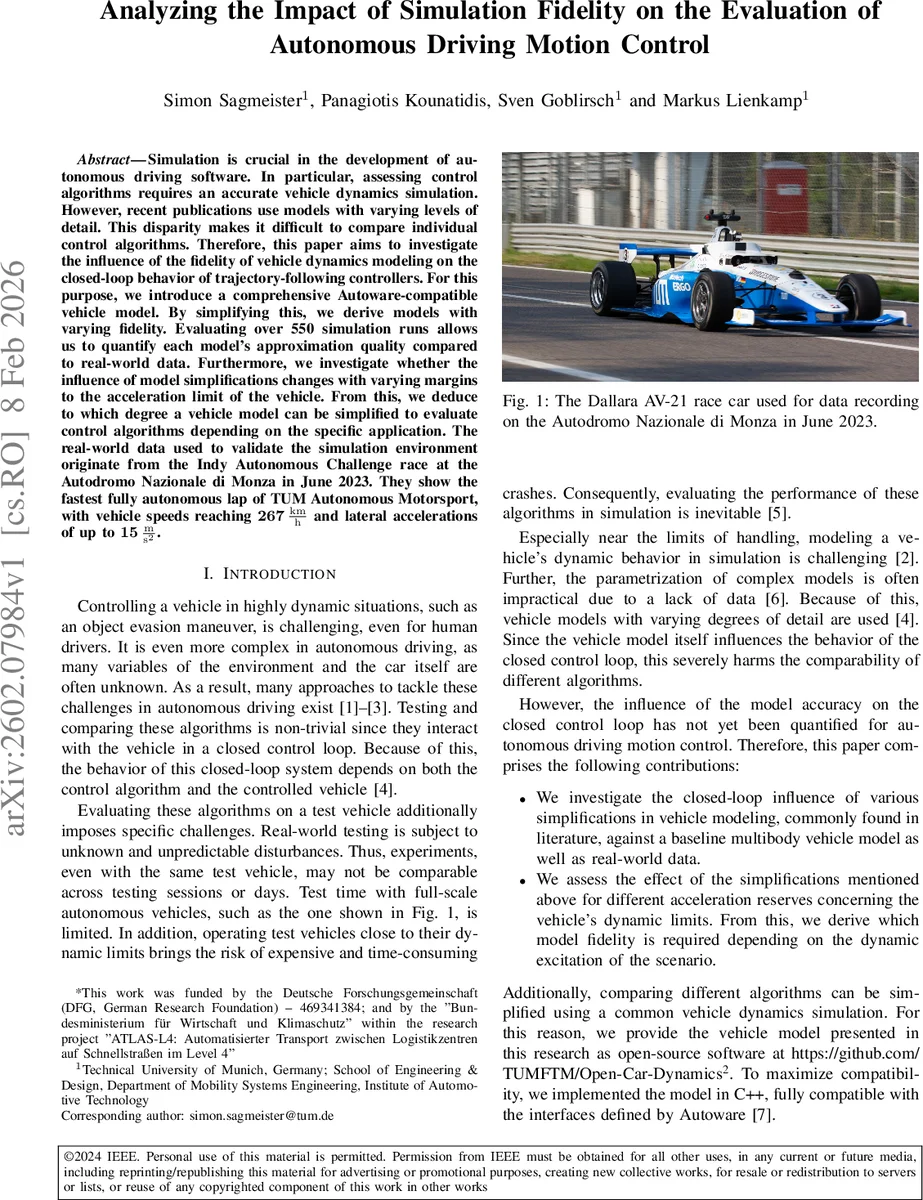
To this end, they develop an Autoware‑compatible multibody vehicle model (named V base) derived from the CommonRoad vehicle suite. The model incorporates a 2006 Pacejka magic‑formula tire model (including scaling factors and tire delay), independent unsprung masses for each wheel, a composite suspension model (springs, dampers, anti‑roll bars, and axle forces), squat and lift effects, and aerodynamic drag, lift, and pitch moment. The resulting state‑space representation contains 35 states and 14 degrees of freedom and is integrated with a fixed‑step Dormand‑Prince 45 (ode45) solver at 800 µs steps, achieving real‑time execution on a modern laptop CPU. Parameter values are taken from the Dallara AV‑21 race car used in the Indy Autonomous Challenge, with missing data (e.g., tire scaling, suspension geometry) calibrated by fitting closed‑loop simulation results to real‑world data recorded at the Monza circuit (maximum speed 267 km/h, lateral acceleration up to 15 m/s²).
From this high‑fidelity baseline, the authors generate four simplified variants by progressively removing modeling detail: (1) replacing the Pacejka tire with a linear tire model, (2) collapsing the independent suspension masses into a single axle mass per side, (3) omitting aerodynamic forces, and (4) reducing the entire vehicle to a single‑track (bicycle) model with only two degrees of freedom. Each simplification isolates a specific physical effect (tire non‑linearity, suspension dynamics, aero drag/lift, and full 3‑D dynamics) to assess its contribution to controller performance.
The experimental methodology consists of two parts. First, the authors replay the exact reference trajectory recorded during the Monza race (including three‑dimensional track geometry) in simulation, feeding it to the same trajectory‑tracking controller used in the real vehicle. They compare key closed‑loop metrics—lateral tracking error, speed tracking error, and the margin to the vehicle’s acceleration limits—between simulation and the recorded run. Second, they vary the available acceleration margin (i.e., how close the vehicle operates to its dynamic limits) by scaling the reference speed profile, thereby creating “large‑margin” and “near‑limit” scenarios. For each scenario, they run more than 550 simulation trials across all model variants, enabling statistical analysis of error distributions.
Results show a clear dependency on the dynamic margin. When the vehicle operates with a generous acceleration reserve (≥ 20 % of its limit), even the most reduced single‑track model yields average lateral errors below 0.15 m, essentially indistinguishable from the high‑fidelity baseline and the real‑world data. In contrast, under tight margin conditions (≤ 5 % reserve), the single‑track model’s error spikes to ~0.45 m, especially in high‑curvature sections where roll and pitch dynamics, omitted in the simplified model, become critical. The suspension‑simplified model fails to capture squat and lift, leading to a ~10 % discrepancy in longitudinal acceleration response during hard braking or acceleration. Removing aerodynamics causes systematic speed under‑prediction on long straights, with errors up to 3 km/h at 260 km/h.
These findings lead to the central conclusion: the required vehicle‑model fidelity is directly proportional to the dynamic excitation of the scenario. For high‑performance racing, autonomous maneuvers near handling limits, or safety‑critical emergency braking, a full multibody model is indispensable. For everyday driving, urban navigation, or testing of higher‑level planning algorithms where large safety margins exist, a lightweight single‑track or even linear‑tire model can provide sufficient accuracy while reducing computational load by a factor of three or more.
The paper’s contributions are threefold. First, it releases an open‑source, Autoware‑compatible vehicle dynamics library, enabling reproducible research. Second, it provides the first systematic, closed‑loop evaluation of how vehicle‑model simplifications affect motion‑control performance, grounded in extensive real‑world data. Third, it offers practical guidelines for selecting an appropriate model fidelity based on the intended test scenario, balancing simulation speed against predictive accuracy. These insights are valuable for researchers designing simulation pipelines, for developers of autonomous stacks who need to benchmark controllers, and for industry practitioners seeking to streamline virtual testing without compromising safety.
Comments & Academic Discussion
Loading comments...
Leave a Comment