The Gaussian Conjugate Rogers-Shephard Inequality
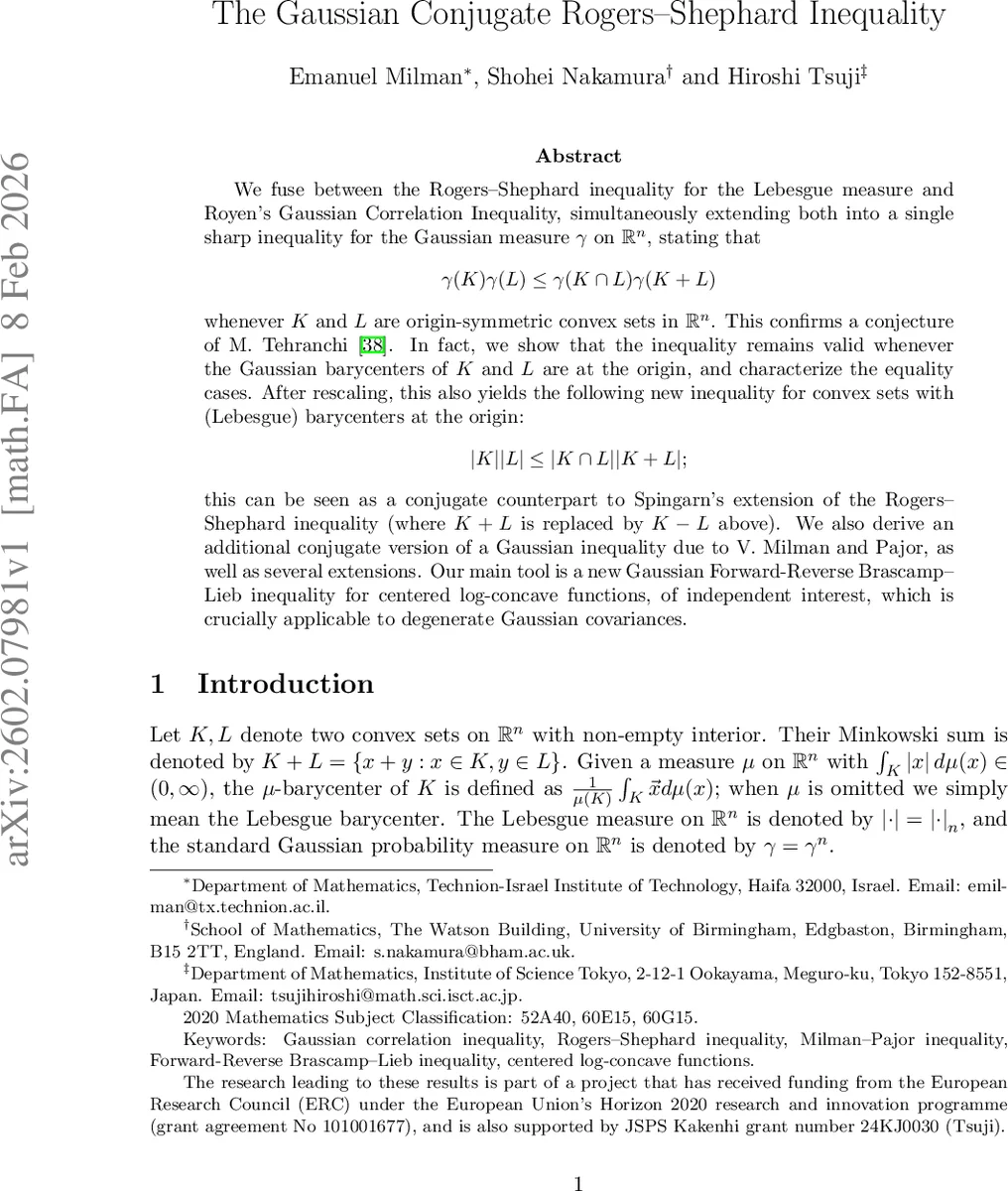
We fuse between the Rogers-Shephard inequality for the Lebesgue measure and Royen’s Gaussian Correlation Inequality, simultaneously extending both into a single sharp inequality for the Gaussian measure $γ$ on $\mathbb{R}^n$, stating that [ γ(K) γ(L) \leq γ(K\cap L) γ(K+L) ] whenever $K$ and $L$ are origin-symmetric convex sets in $\mathbb{R}^n$. This confirms a conjecture of M. Tehranchi [https://doi.org/10.1214/17-ECP89]. In fact, we show that the inequality remains valid whenever the Gaussian barycenters of $K$ and $L$ are at the origin, and characterize the equality cases. After rescaling, this also yields the following new inequality for convex sets with (Lebesgue) barycenters at the origin: [ |K| |L| \leq |K \cap L| |K + L | ; ] this can be seen as a conjugate counterpart to Spingarn’s extension of the Rogers-Shephard inequality (where $K+L$ is replaced by $K-L$ above). We also derive an additional conjugate version of a Gaussian inequality due to V. Milman and Pajor, as well as several extensions. Our main tool is a new Gaussian Forward-Reverse Brascamp-Lieb inequality for centered log-concave functions, of independent interest, which is crucially applicable to degenerate Gaussian covariances.
💡 Research Summary
The paper establishes a novel inequality for the standard Gaussian measure γ on ℝⁿ that simultaneously generalizes the classical Rogers–Shephard inequality for Lebesgue measure and the Gaussian Correlation Inequality (GCI). The main result, called the Gaussian Conjugate Rogers–Shephard Inequality (GCRSI), states that for any convex sets K, L ⊂ ℝⁿ with non‑empty interior whose Gaussian barycenters are at the origin (in particular for origin‑symmetric sets),
γ(K) γ(L) ≤ γ(K ∩ L) γ(K + L),
with equality precisely when K and L decompose as orthogonal products K = K₀ × E⊥, L = E × L₀ for some one‑dimensional subspace E. This inequality strengthens GCI (which only has γ(K) γ(L) ≤ γ(K ∩ L)) by inserting the factor γ(K + L) on the right‑hand side, and it reduces to the Rogers–Shephard–Spingarn inequality |K||L| ≤ |K ∩ L||K − L| after a scaling limit λ→0, but with a “conjugate” version involving K + L instead of K − L.
The authors also derive a purely Lebesgue version:
|K| |L| ≤ |K ∩ L| |K + L|,
which they call the Conjugate Rogers–Shephard–Spingarn inequality (CRSSI). The constant 1 is shown to be optimal.
Beyond the basic case, the paper presents several extensions:
-
Scaling with coefficients – Theorem 1.3 shows that for any |a|,|b| ≥ 1 with |a + b| ≥ 1, γ(K) γ(L) ≤ γ(K ∩ L) γ(aK + bL). The cases a = b = 1 recover GCRSI; a = 2, b = −1 yields a new inequality not comparable to the original when L is not symmetric. The case a = 1, b = −1 (i.e., K − L) remains open.
-
Conjugate Milman–Pajor inequality – For any a, b with a² + b² = 1, γ(K) γ(L) ≤ γ( (1/b)K ∩ (1/a)L ) γ(aK + bL). Theorem 1.5 expands the admissible region to |a|,|b| ≤ 1 and 3 min(a²,b²)+max(a²,b²) ≥ 1, providing a full characterization of equality cases. In particular, when |a| = |b| = λ, equality holds iff λ∈
Comments & Academic Discussion
Loading comments...
Leave a Comment