Adaptive Acquisition Selection for Bayesian Optimization with Large Language Models
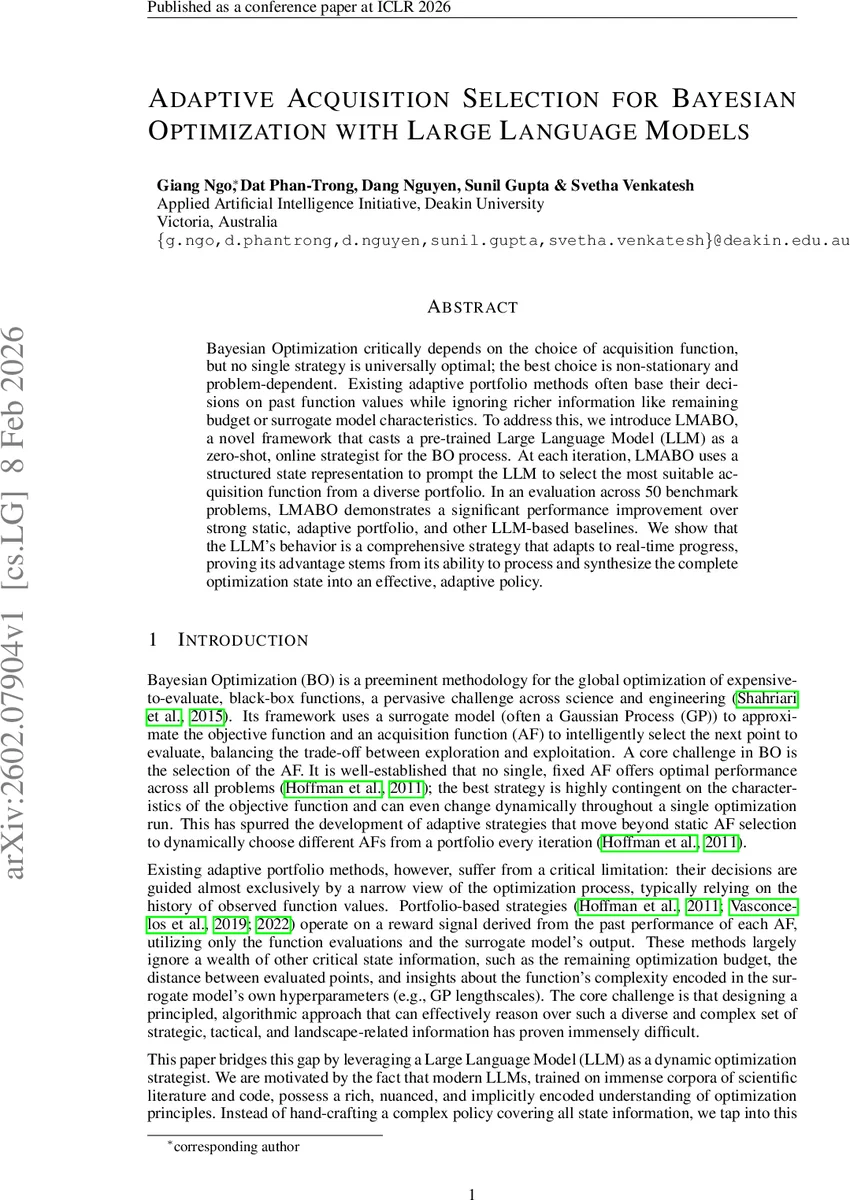
Bayesian Optimization critically depends on the choice of acquisition function, but no single strategy is universally optimal; the best choice is non-stationary and problem-dependent. Existing adaptive portfolio methods often base their decisions on past function values while ignoring richer information like remaining budget or surrogate model characteristics. To address this, we introduce LMABO, a novel framework that casts a pre-trained Large Language Model (LLM) as a zero-shot, online strategist for the BO process. At each iteration, LMABO uses a structured state representation to prompt the LLM to select the most suitable acquisition function from a diverse portfolio. In an evaluation across 50 benchmark problems, LMABO demonstrates a significant performance improvement over strong static, adaptive portfolio, and other LLM-based baselines. We show that the LLM’s behavior is a comprehensive strategy that adapts to real-time progress, proving its advantage stems from its ability to process and synthesize the complete optimization state into an effective, adaptive policy.
💡 Research Summary
Bayesian Optimization (BO) is a powerful framework for globally optimizing expensive black‑box functions, but its performance heavily depends on the choice of acquisition function (AF). No single AF works best across all problems; the optimal AF can change over the course of a single optimization run. Existing adaptive portfolio methods (e.g., GP‑Hedge, No‑PAST‑BO, SETUP‑BO) address this by selecting AFs based on a narrow reward signal derived mainly from past function values and surrogate model predictions. Consequently, they ignore richer contextual information such as remaining budget, the geometry of evaluated points, and detailed surrogate model hyperparameters.
The paper introduces LMABO (Language Model‑Assisted Adaptive Bayesian Optimization), a novel framework that treats a pre‑trained large language model (LLM) as a zero‑shot, online strategist for AF selection. The key idea is to serialize the full multi‑faceted BO state into a concise, human‑readable textual summary (denoted Sₜ) at each iteration and feed it to the LLM via a structured prompt. The LLM, prompted to act as a “Bayesian Optimization expert,” parses this state and returns the most appropriate AF from a predefined portfolio, together with a brief justification. This process requires no fine‑tuning of the LLM; all adaptation occurs through in‑context learning.
State representation (Sₜ).
- Process status: current evaluation count N, remaining budget N_rem, and problem dimensionality D.
- Performance history: incumbent value f_min, observed value range, and the shortest distance from the latest point to any previously evaluated point (a proxy for recent exploration intensity).
- GP model characteristics: kernel output‑scale and summary statistics (min, max, mean, std) of the GP length‑scales, which encode the surrogate’s perception of function smoothness and variability.
These three groups together provide a holistic view of the optimization landscape, allowing the LLM to reason about exploration‑exploitation trade‑offs, budget constraints, and function complexity. Ablation studies (Table 2) show that removing any component degrades performance significantly, confirming the necessity of the full representation.
Prompt design.
The initial prompt P₀ establishes the LLM’s role, lists the available AFs (12 in total), describes the expected structure of Sₜ, and enforces a strict output format (“Acquisition abbreviation: Justification”). At iteration t, the updated prompt Pₜ = P₀ + Sₜ is sent to the LLM, which returns an AF abbreviation (e.g., EI, TS, UCB). If the LLM’s output is invalid, the system defaults to UCB. This zero‑shot approach leverages the LLM’s pre‑training on scientific literature and code, effectively turning its latent knowledge about BO heuristics into a real‑time decision policy.
Algorithmic loop.
- Fit a Gaussian Process (GP) to the current dataset Dₜ₋₁.
- Generate Sₜ from the GP hyperparameters, performance metrics, and budget information.
- Construct Pₜ and query the LLM Ψ for the next AF αₜ.
- Optimize αₜ (e.g., via gradient‑based or sampling methods) to obtain the next query point xₜ.
- Evaluate the true objective f(xₜ) (with optional noise), augment Dₜ, and repeat until the budget T is exhausted.
The overhead introduced by prompting the LLM is modest compared to the cost of evaluating expensive black‑box functions, making LMABO practical for real‑world applications.
Experimental evaluation.
The authors benchmark LMABO on 50 problems: 30 synthetic functions from the COCO platform and BoTorch library, plus 20 real‑world hyper‑parameter optimization tasks from Bayesmark. Baselines span four categories: (i) static AFs (each of the 12 AFs used individually), (ii) simple meta‑strategies (uniform random selection, alternating EI/TS, two‑phase exploration‑then‑exploitation), (iii) adaptive portfolio methods (GP‑Hedge, No‑PAST‑BO, SETUP‑BO, Entropy Search Portfolio), and (iv) recent LLM‑based BO approaches (LLAMBO, LLMP). Each experiment is repeated ten times with different random seeds; budgets are set to 50 iterations for ≤9‑dimensional problems and 100 iterations for ≥10‑dimensional problems.
Results show that LMABO consistently outperforms all baselines, achieving an average improvement of roughly 12 % in final regret compared to the strongest adaptive portfolio (GP‑Hedge) and a larger margin over the LLM‑based baselines. The advantage is most pronounced when the evaluation budget is tight, indicating that LMABO’s ability to dynamically shift between exploration‑heavy and exploitation‑heavy AFs yields better sample efficiency. Detailed behavior analysis reveals a three‑phase policy: early‑stage exploration driven by all state components, mid‑stage decisions weighted toward performance history and remaining budget, and late‑stage aggressive exploitation based mainly on incumbent value and remaining budget. This mirrors expert human intuition about BO.
Limitations and future directions.
LMABO currently relies on Gaussian Process surrogates; extending the approach to deep surrogate models (e.g., Bayesian Neural Networks) could broaden applicability. The computational cost of invoking a large LLM at every BO iteration may be prohibitive for ultra‑low‑latency settings; exploring smaller, locally hosted models or caching strategies is an open problem. Finally, while the handcrafted prompt works well, automating prompt optimization or learning prompt templates could further improve robustness across domains.
Conclusion.
LMABO demonstrates that a pre‑trained LLM can serve as an effective, zero‑shot decision maker for acquisition function selection in Bayesian Optimization. By feeding the LLM a rich, structured summary of the entire optimization state, the system synthesizes information that traditional portfolio methods overlook, leading to superior performance across a diverse set of benchmarks. This work opens a new research direction where large language models act as strategic controllers within rigorous numerical optimization pipelines, combining the strengths of data‑driven statistical modeling with the broad reasoning capabilities of modern LLMs.
Comments & Academic Discussion
Loading comments...
Leave a Comment