Vafa-Witten invariants from wall-crossing for framed sheaves
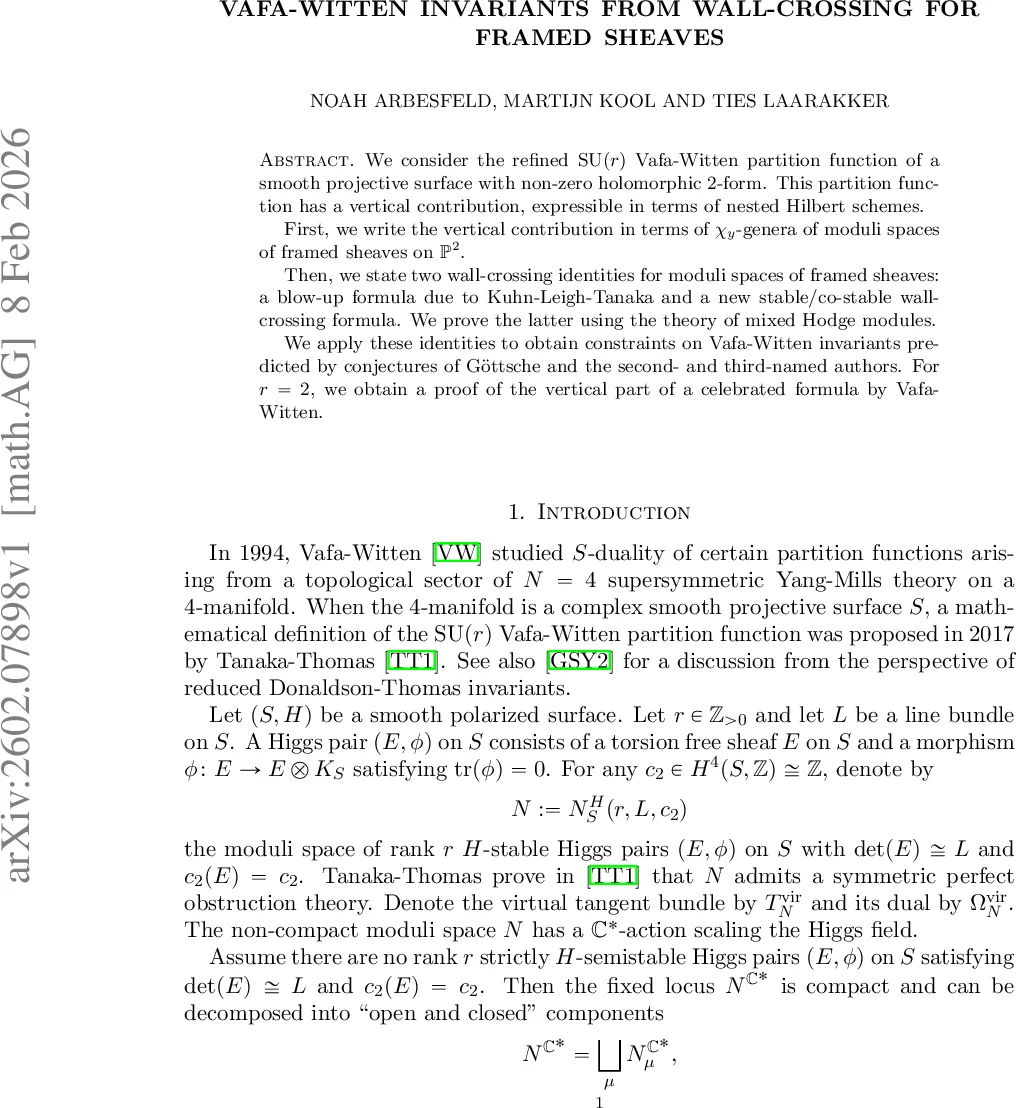
We consider the refined $\mathrm{SU}(r)$ Vafa-Witten partition function of a smooth projective surface with non-zero holomorphic 2-form. This partition function has a vertical contribution, expressible in terms of nested Hilbert schemes. First, we write the vertical contribution in terms of $χ_y$-genera of moduli spaces of framed sheaves on ${\mathbb P}^2$. Then, we state two wall-crossing identities for moduli spaces of framed sheaves: a blow-up formula due to Kuhn-Leigh-Tanaka and a new stable/co-stable wall-crossing formula. We prove the latter using the theory of mixed Hodge modules. We apply these identities to obtain constraints on Vafa-Witten invariants predicted by conjectures of Göttsche and the second- and third-named authors. For $r=2$, we obtain a proof of the vertical part of a celebrated formula by Vafa-Witten.
💡 Research Summary
The paper investigates the refined SU(r) Vafa‑Witten partition function on a smooth projective surface S that possesses a non‑zero holomorphic 2‑form (pg(S)>0). The authors begin by recalling the construction of the moduli space N_H^r(L,c₂) of rank‑r, H‑stable Higgs pairs (E,φ) with fixed determinant L and second Chern class c₂, equipped with a symmetric perfect obstruction theory as introduced by Tanaka‑Thomas. The C*‑action scaling the Higgs field yields a fixed‑locus decomposition indexed by weight sequences μ. The component with μ=(r) (the “horizontal” part) is identified with the usual Gieseker‑Maruyama moduli space M_H(S;r,L,c₂); its contribution to the partition function reduces to the virtual Euler characteristic and χ_y‑genus of M_H, which are classical when S has trivial canonical class.
When pg(S)>0, the “vertical” component μ=(1,…,1) becomes non‑trivial. In this case the Higgs field forces a decomposition of the underlying sheaf into rank‑1 torsion‑free pieces, which can be described by nested Hilbert schemes Hilb_n^β(S) of points and curves. Gholampour‑Thomas’s description of these nested Hilbert schemes as degeneracy loci provides a perfect obstruction theory whose virtual cycle coincides with the C*‑localized virtual cycle of Tanaka‑Thomas, making the vertical contribution computable.
The central observation of the paper is that the vertical contribution can be expressed in terms of χ_y‑genera of moduli spaces of framed sheaves on the projective plane P². A framed sheaf (E,Φ) on P² is a rank‑r torsion‑free sheaf locally free near a fixed line ℓ∞ together with an isomorphism Φ:E|{ℓ∞}→O{ℓ∞}^{⊕r}. The moduli space M_{P²}(r,n) of such objects is smooth of dimension 2rn and carries a natural action of a three‑torus T=C*×C*×C*. Its equivariant χ_y‑genus \
Comments & Academic Discussion
Loading comments...
Leave a Comment