Geometry-Enabled Radiation from Structured Paraxial Electrons
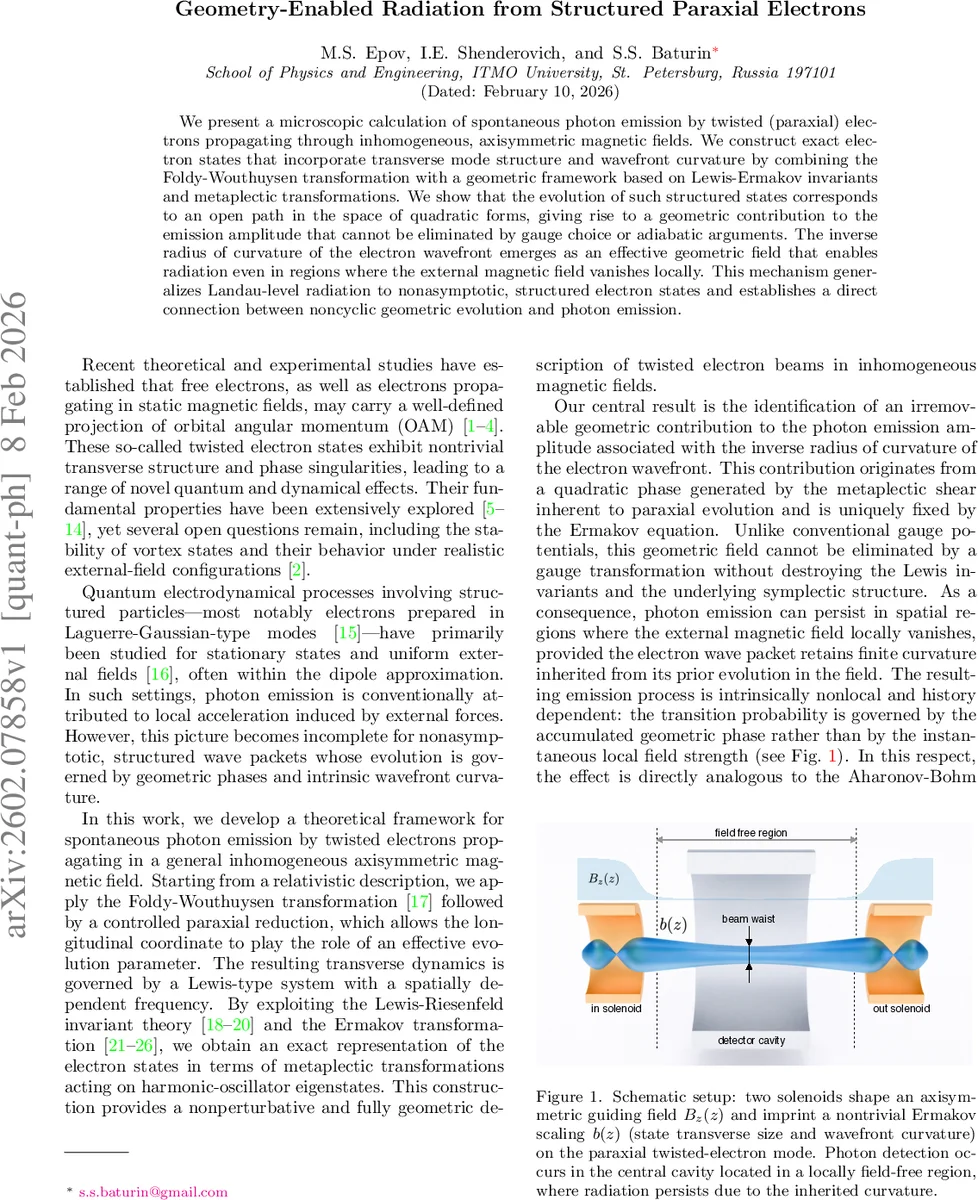
We present a microscopic calculation of spontaneous photon emission by twisted (paraxial) electrons propagating through inhomogeneous, axisymmetric magnetic fields. We construct exact electron states that incorporate transverse mode structure and wavefront curvature by combining the Foldy-Wouthuysen transformation with a geometric framework based on Lewis-Ermakov invariants and metaplectic transformations. We show that the evolution of such structured states corresponds to an open path in the space of quadratic forms, giving rise to a geometric contribution to the emission amplitude that cannot be eliminated by gauge choice or adiabatic arguments. The inverse radius of curvature of the electron wavefront emerges as an effective geometric field that enables radiation even in regions where the external magnetic field vanishes locally. This mechanism generalizes Landau-level radiation to nonasymptotic, structured electron states and establishes a direct connection between noncyclic geometric evolution and photon emission.
💡 Research Summary
The paper presents a microscopic theory of spontaneous photon emission by twisted (paraxial) electrons moving through inhomogeneous, axis‑symmetric magnetic fields. Starting from the relativistic Dirac equation, the authors apply the Foldy‑Wouthuysen transformation to obtain a Pauli‑type Hamiltonian and then perform a paraxial reduction in which the longitudinal coordinate (z) plays the role of an evolution “time”. In this picture the transverse dynamics reduces to a two‑dimensional Schrödinger‑like equation with a (z)-dependent harmonic‑oscillator frequency (\Omega(z)).
The key technical step is the identification of Lewis‑Riesenfeld invariants (I_x) and (I_y) (Eqs. 10‑11) that render the system exactly solvable. The invariants are built from a scaling function (b(z)) that satisfies the Ermakov equation (b’’+\Omega^2 b = 1/b^3). The solution (b(z)) is uniquely fixed by the magnetic‑field profile and the initial conditions. By employing metaplectic operators ( \hat S) (squeezing) and ( \hat M) (shear) the authors lift the classical symplectic transformation generated by (b(z)) to the quantum level. The full electron wavefunction is then expressed as a squeezed coherent state \
Comments & Academic Discussion
Loading comments...
Leave a Comment