Instability of shear flows with neutral embedded eigenvalues
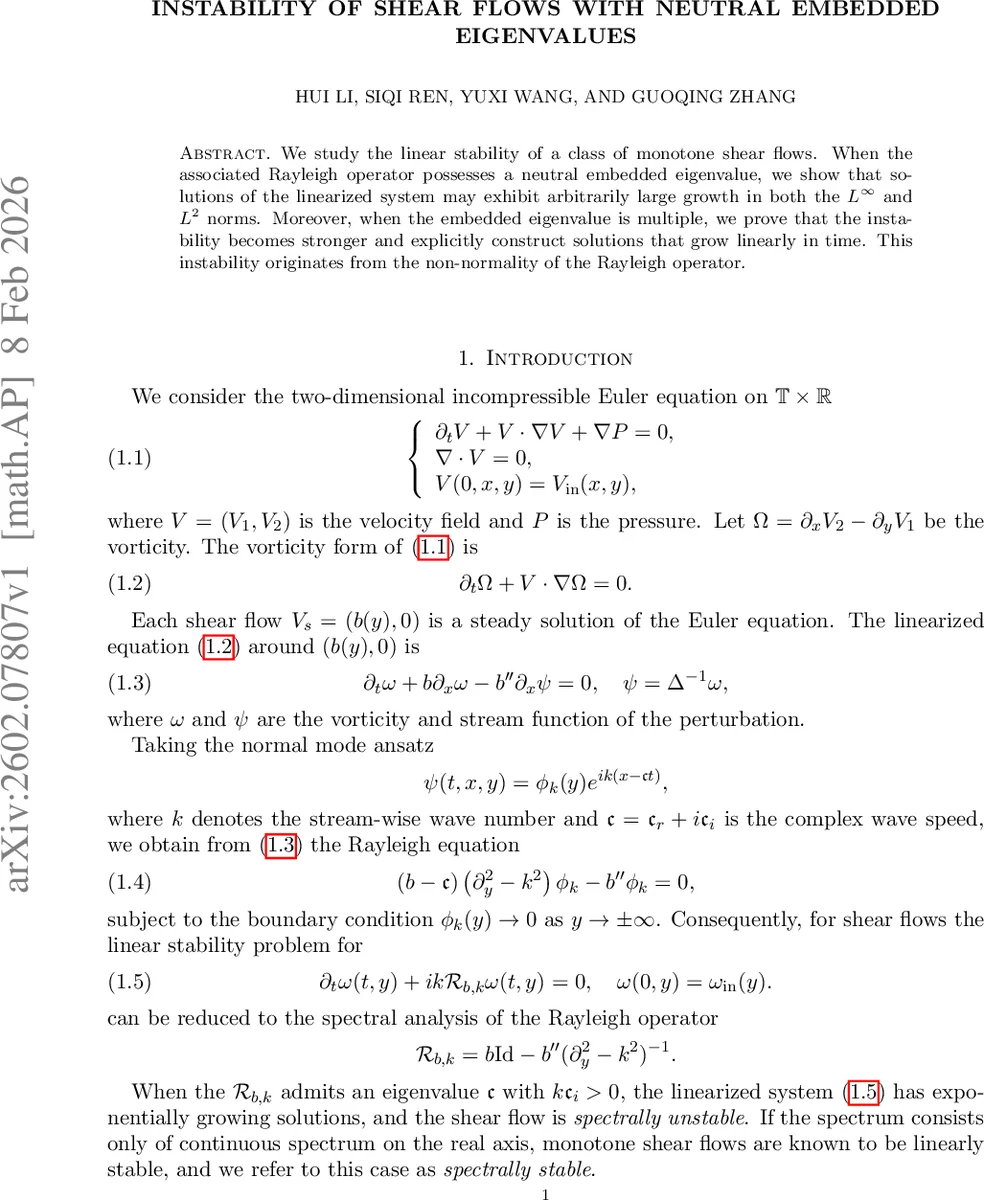
We study the linear stability of a class of monotone shear flows. When the associated Rayleigh operator possesses a neutral embedded eigenvalue, we show that solutions of the linearized system may exhibit arbitrarily large growth in both the $L^\infty$ and $L^2$ norms. Moreover, when the embedded eigenvalue is multiple, we prove that the instability becomes stronger and explicitly construct solutions that grow linearly in time. This instability originates from the non-normality of the Rayleigh operator.
💡 Research Summary
This paper investigates the linear stability of a broad class of monotone shear flows in two‑dimensional incompressible Euler dynamics, focusing on the regime where the associated Rayleigh operator possesses a neutral (real) embedded eigenvalue. The authors show that, despite the absence of exponentially growing eigenmodes, solutions of the linearized vorticity equation can experience arbitrarily large amplification in both the $L^\infty$ and $L^2$ norms. The source of this phenomenon is the non‑normality of the Rayleigh operator, which allows energy to be transferred from the continuous spectrum to the discrete (embedded) mode in a way that is not captured by the spectral theorem for normal operators.
The paper begins with a thorough literature review, recalling classical results such as Rayleigh’s inflection‑point criterion, the semicircle theorem, and recent advances on inviscid damping for spectrally stable monotone flows. The authors then introduce their main setting: a monotone background velocity $b(y)$ satisfying $0<c_m\le b’(y)\le c_M$, with $b’’\in H^4(\mathbb R)$, and a fixed streamwise wavenumber $k$. Under Assumption 1.1 the Rayleigh operator $R_{b,k}=b,\mathrm{Id}-b’’(\partial_y^2-k^2)^{-1}$ has exactly one embedded eigenvalue $c_*$ on the real axis and no other point spectrum.
Two principal theorems are proved.
Theorem 1.2 (simple eigenvalue) states that for any prescribed magnitude $M>0$ there exist unit‑size initial data $\omega_{\rm in}$ and a finite time $T$ such that the solution $\omega(t)$ of $\partial_t\omega+ikR_{b,k}\omega=0$ satisfies $|\omega(T)|{L^\infty}\ge M$ and $|\omega(T)|{L^2}\ge M$. In other words, the linearized dynamics can produce arbitrarily large transient growth.
Theorem 1.3 (multiple eigenvalue) shows that if the embedded eigenvalue $c_*$ has algebraic multiplicity greater than one, then there exist initial data for which the solution grows at least linearly in time: $|\omega(t)|{L^\infty},|\omega(t)|{L^2}\ge C,t$ for all $t\ge0$. This is a stronger form of instability, directly linked to the presence of a Jordan block in the spectral decomposition.
The authors illustrate the underlying mechanism with a 2×2 toy model introduced by Trefethen et al., which captures the essence of non‑normal transient growth and the linear growth associated with a defective matrix. They then translate these ideas to the infinite‑dimensional Rayleigh operator.
For the simple eigenvalue case, the solution is decomposed into a discrete part $\omega_1(t)=e^{-ikc_t}P(\omega_{\rm in})\omega_$ (pure oscillation) and a continuous part $\omega_2(t)=e^{-ikR_{b,k}t}(\omega_{\rm in}-P(\omega_{\rm in})\omega_)$. The key step is to construct initial data for which the projection coefficient $P(\omega_{\rm in})$ can be made arbitrarily large while keeping $|\omega_{\rm in}|{L^2}=1$. This is achieved by a delicate analysis of the Wronskian $W(c)$ associated with the Rayleigh equation. Because $W(c)$ is not analytic at the embedded eigenvalue, the authors introduce a modified Wronskian that is analytic in $c$, allowing them to evaluate the limit $\lim{c\to c_}W(c)/c$ and to express $P(\omega_{\rm in})$ as a singular integral. By choosing $\omega_{\rm in}$ supported on a far‑away interval and scaling appropriately, they obtain $|P(\omega_{\rm in})|\gg1$.
The continuous component $\omega_2$ experiences inviscid damping: the associated stream function $\Psi_2=\Delta_k^{-1}\omega_2$ satisfies $|\Psi_2(t)|{L^2}\lesssim t^{-1}$. Consequently, for large $t$ the total stream function $\Psi(t)=\Psi_1+\Psi_2$ is dominated by $\Psi_1$, whose $L^2$ norm is essentially $|P(\omega{\rm in})|$. Hence the vorticity norm inherits the same large growth, establishing Theorem 1.2.
When the embedded eigenvalue is multiple, the authors construct an “associated function” $\eta$ solving $(R_{b,1}-c_)\eta=\omega_$. This function plays the role of a generalized eigenvector in a Jordan block. Taking $\omega_{\rm in}=\eta$ yields a solution $\omega(t)=t e^{-ikc_t}\omega_+i e^{-ikc_t}\eta$, which grows linearly in time, proving Theorem 1.3. The existence of $\eta$ is demonstrated by differentiating the two fundamental solutions $\phi_\pm(y,c)$ (which decay exponentially as $y\to\pm\infty$) with respect to $c$ at $c=c_$ and matching them at the critical layer $y_c=b^{-1}(c_)$. The condition $\partial_c W(c_)=0$ precisely characterizes the multiplicity of the embedded eigenvalue.
A corollary extends the instability to the viscous setting. Adding a small viscosity $\nu$ leads to the Orr–Sommerfeld operator $O_{b,k,\nu}=ikR_{b,k}-\nu(\partial_y^2-k^2)$. For sufficiently small $\nu$, the non‑normal transient growth persists, and one can still find initial data and a time $T$ such that $|\omega(T)|_{L^2}\ge M$. This shows that the enhanced dissipation mechanisms proved for spectrally stable monotone flows break down when an embedded eigenvalue is present.
The paper concludes with remarks on the generality of the results (they extend to finitely many embedded eigenvalues, to bounded channels, and to non‑monotone flows provided suitable eigenfunctions exist) and on the physical interpretation: the instability is analogous to the lift‑up effect in three‑dimensional viscous flows, but here it manifests in two‑dimensional inviscid dynamics through the non‑normal Rayleigh operator.
Overall, the work provides a rigorous, constructive demonstration that neutral embedded eigenvalues can trigger arbitrarily large (or linearly growing) perturbations in monotone shear flows, highlighting the crucial role of operator non‑normality beyond classical spectral criteria. This bridges a gap between spectral stability theory and observed transient phenomena, and opens new directions for studying nonlinear consequences and for exploring similar mechanisms in more complex fluid configurations.
Comments & Academic Discussion
Loading comments...
Leave a Comment