MaD-Mix: Multi-Modal Data Mixtures via Latent Space Coupling for Vision-Language Model Training
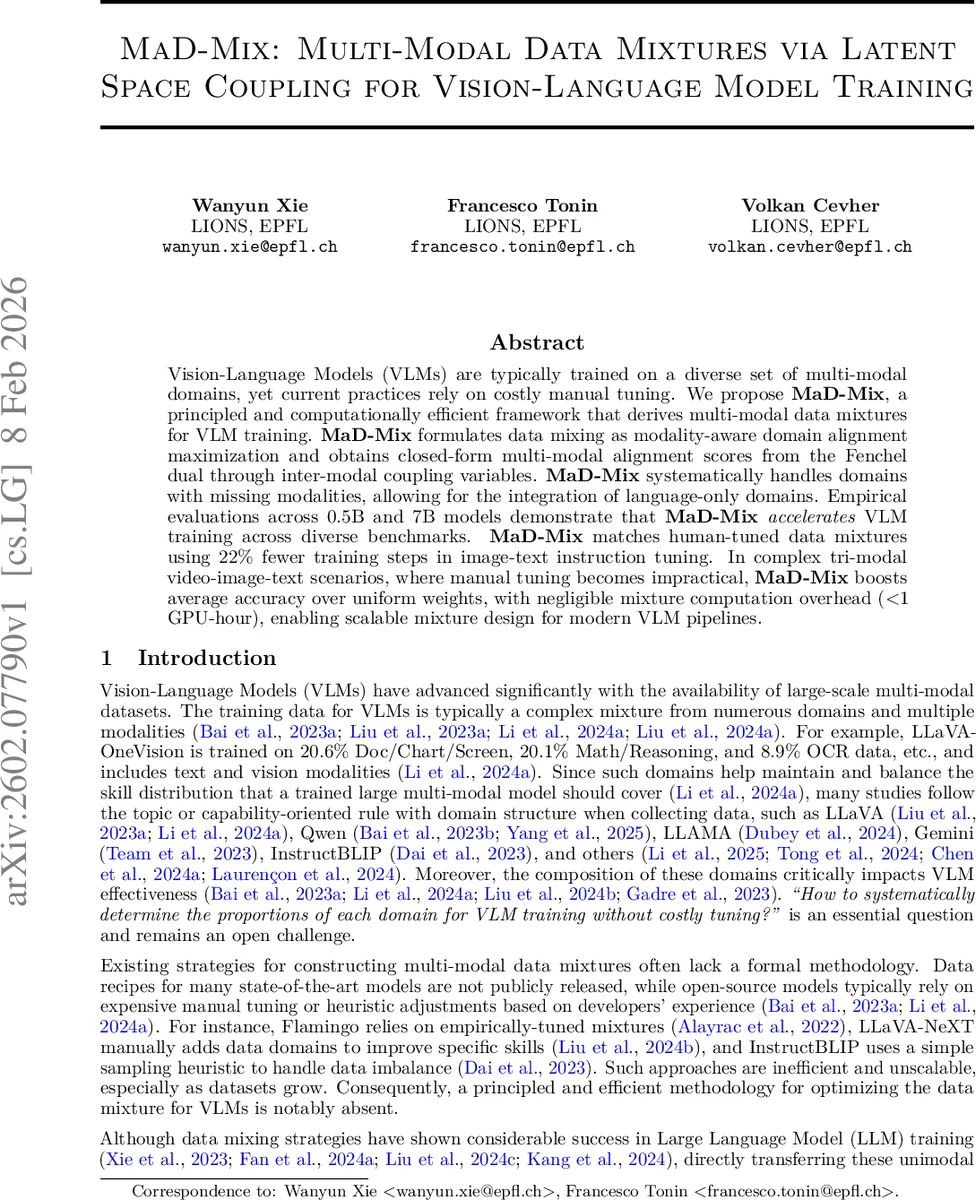
Vision-Language Models (VLMs) are typically trained on a diverse set of multi-modal domains, yet current practices rely on costly manual tuning. We propose MaD-Mix, a principled and computationally efficient framework that derives multi-modal data mixtures for VLM training. MaD-Mix formulates data mixing as modality-aware domain alignment maximization and obtains closed-form multi-modal alignment scores from the Fenchel dual through inter-modal coupling variables. MaD-Mix systematically handles domains with missing modalities, allowing for the integration of language-only domains. Empirical evaluations across 0.5B and 7B models demonstrate that MaD-Mix accelerates VLM training across diverse benchmarks. MaD-Mix matches human-tuned data mixtures using 22% fewer training steps in image-text instruction tuning. In complex tri-modal video-image-text scenarios, where manual tuning becomes impractical, MaD-Mix boosts average accuracy over uniform weights, with negligible mixture computation overhead (< 1 GPU-hour), enabling scalable mixture design for modern VLM pipelines.
💡 Research Summary
MaD‑Mix addresses a fundamental bottleneck in Vision‑Language Model (VLM) training: the manual, costly tuning of data mixture ratios across many multi‑modal domains. The authors formalize data mixing as a modality‑aware domain‑alignment maximization problem. For each domain (D_i) and each modality (v) (e.g., vision, text), they compute a centroid embedding (x_i^{
Comments & Academic Discussion
Loading comments...
Leave a Comment