La$_{2-x}$Ba$_x$CuO$_4$ ($x= rac{1}{8}$) $μ$SR data are inconsistent with spin stripe but consistent with spin spiral
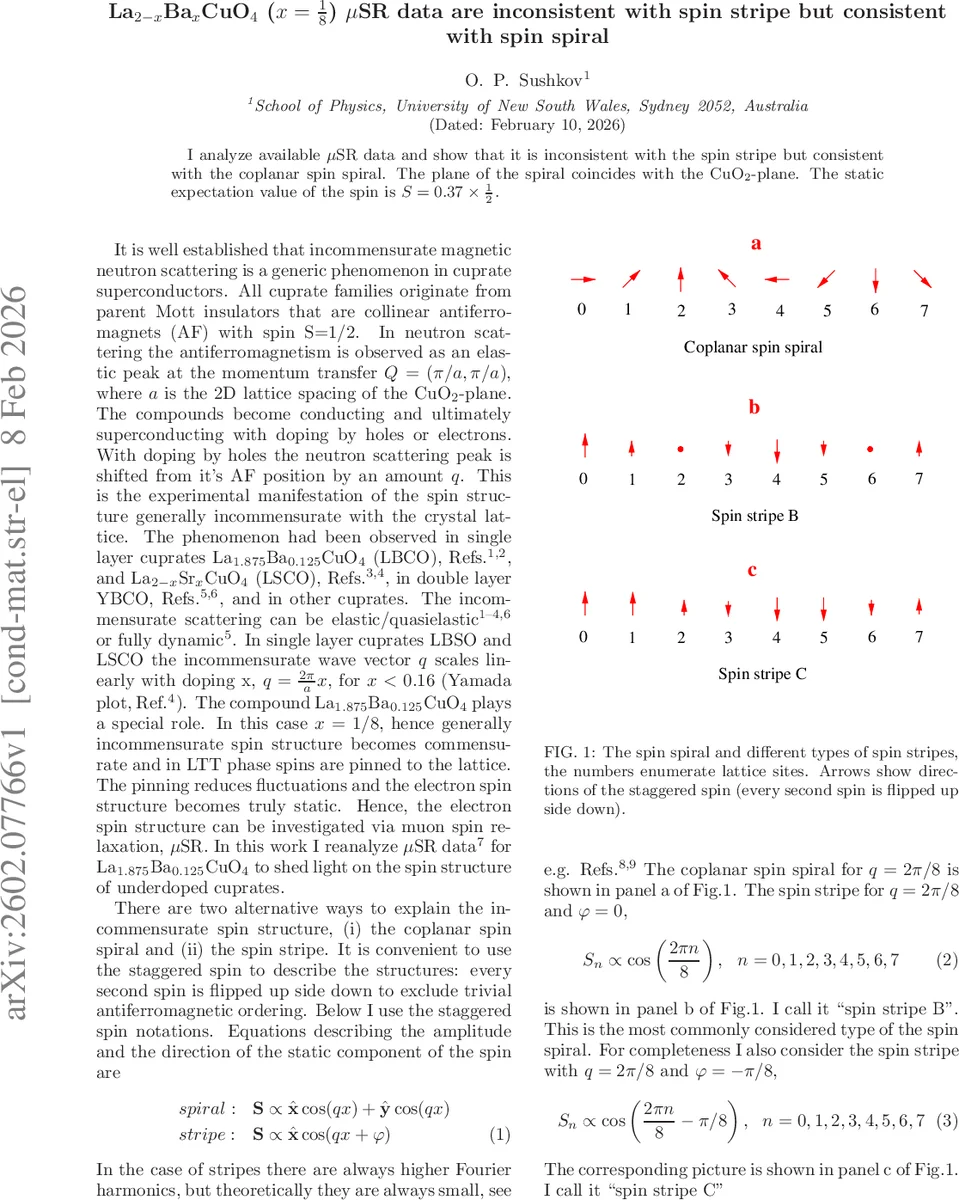
I analyze available $μ$SR data and show that it is inconsistent with the spin stripe but consistent with the coplanar spin spiral. The plane of the spiral coincides with the CuO$_2$-plane. The static expectation value of the spin is $S=0.37\times\frac{1}{2}$.
💡 Research Summary
The paper revisits the muon‑spin‑relaxation (μSR) measurements on the cuprate superconductor La₂₋ₓBaₓCuO₄ with x = 1/8, a composition that is known to exhibit static spin order because the incommensurate wave vector q = 2πx locks to a commensurate period of eight lattice spacings in the low‑temperature tetragonal (LTT) phase. The author’s goal is to determine whether the static spin texture is better described by the widely discussed “spin‑stripe” picture or by a coplanar spin‑spiral (nanoscopic helix) lying in the CuO₂ plane.
First, the author reproduces the original μSR time‑dependent polarization P(t) data (blue squares in Fig. 2) and fits them with the standard single‑field depolarization function, Eq. (4) (or its simplified version Eq. (5)). The fit yields a precession frequency ω = 2.2 × 10⁶ s⁻¹, a transverse relaxation rate λ_T = 0.9 × 10⁶ s⁻¹, and a magnetic volume fraction V_m ≈ 0.67. The functional form is essentially a Bessel function J₀(ωt) multiplied by an exponential decay, which matches the data extremely well (red solid curve in Fig. 2a). This single‑field description implies that every muon stopping at an apical oxygen experiences the same magnitude of the internal magnetic field, i.e. the staggered Cu spins have the same amplitude everywhere. Such a situation is naturally realized by a planar spin‑spiral with wave vector q = 2π/8, where the spin direction rotates smoothly from site to site but the magnitude stays constant.
Next, the author constructs two canonical stripe models. In “stripe B” the staggered spin amplitude alternates between a large value S₀ and a reduced value S₁ = S₀/√2 (phase ϕ = 0). In “stripe C” the amplitude ratio is p = cos(3π/8)/cos(π/8) ≈ 0.41 (phase ϕ = −π/8). Because muons stop at two inequivalent Cu sites (under the apical oxygen), the internal field distribution becomes bimodal. Consequently the polarization function must be replaced by a weighted sum of two Bessel functions, Eq. (7) for stripe B and Eq. (8) for stripe C. When these forms are fitted to the same μSR data, the resulting curves (red lines in Fig. 2b and 2c) deviate markedly from the experimental points; the χ² values are substantially larger than for the single‑field fit. Therefore, the pure stripe pictures are incompatible with the observed relaxation.
The author then allows the amplitude ratio p to vary (“modified stripe” models). By scanning p between 0.9 and 1.0, the best fits are obtained for p ≈ 0.95–1.0, i.e. when the two sublattice moments are almost equal. In this limit the two‑field model collapses back to the single‑field spiral description, and the fit quality approaches that of the original spiral fit. However, such a near‑unity p would imply that the holes are almost completely localized on the “stripe” sites, producing a charge modulation amplitude δn ≈ 1, which contradicts X‑ray and STM measurements that report a very small modulation (δn ≈ 0.03). Hence the stripe scenario can only be reconciled with μSR if it is essentially indistinguishable from a uniform spiral, which defeats the purpose of invoking stripes.
To calibrate the magnetic moment, the author also fits μSR data from the parent antiferromagnet La₂CuO₄ (Fig. 3). The precession frequency is ω ≈ 36 × 10⁶ s⁻¹, corresponding to an ordered Cu moment μ_e ≈ 0.6 μ_B (as known from neutron scattering). Assuming the same hyperfine coupling, the ordered moment in the 1/8‑doped compound follows from the ratio of frequencies: μ_e(LBCO) = (2.2/36) × 0.6 μ_B ≈ 0.37 μ_B. Translating this into a spin expectation value gives S = 0.37 × ½ ≈ 0.185, which the author reports as S = 0.37 × ½.
In the concluding section the author emphasizes that (i) the μSR data are perfectly described by a coplanar spin‑spiral lying in the CuO₂ plane, (ii) the static spin magnitude is S ≈ 0.185, and (iii) the stripe models are ruled out unless they are tuned to an almost trivial limit that is inconsistent with independent charge‑order measurements. The work therefore supports the view that, at the special 1/8 doping where spin order is locked to the lattice, the ground state of La₂₋ₓBaₓCuO₄ is a uniform helical spin texture rather than a set of charge‑driven spin stripes. This conclusion has implications for theories of intertwined charge‑spin order in cuprates and suggests that spin‑spiral states should be considered more seriously in modeling the magnetic properties of underdoped high‑Tc superconductors.
Comments & Academic Discussion
Loading comments...
Leave a Comment