GrepRAG: An Empirical Study and Optimization of Grep-Like Retrieval for Code Completion
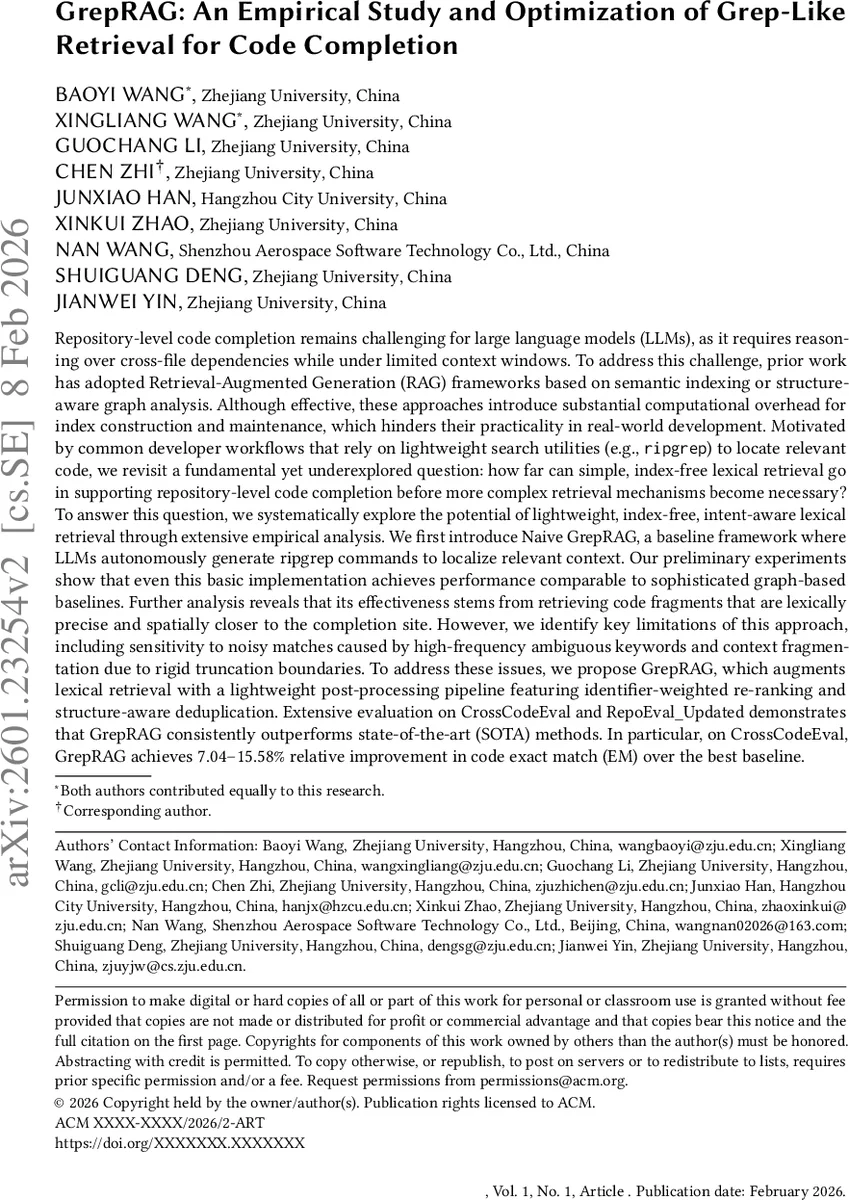
Repository-level code completion remains challenging for large language models (LLMs) due to cross-file dependencies and limited context windows. Prior work addresses this challenge using Retrieval-Augmented Generation (RAG) frameworks based on semantic indexing or structure-aware graph analysis, but these approaches incur substantial computational overhead for index construction and maintenance. Motivated by common developer workflows that rely on lightweight search utilities (e.g., ripgrep), we revisit a fundamental yet underexplored question: how far can simple, index-free lexical retrieval support repository-level code completion before more complex retrieval mechanisms become necessary? To answer this question, we systematically investigate lightweight, index-free, intent-aware lexical retrieval through extensive empirical analysis. We first introduce Naive GrepRAG, a baseline framework in which LLMs autonomously generate ripgrep commands to retrieve relevant context. Despite its simplicity, Naive GrepRAG achieves performance comparable to sophisticated graph-based baselines. Further analysis shows that its effectiveness stems from retrieving lexically precise code fragments that are spatially closer to the completion site. We also identify key limitations of lexical retrieval, including sensitivity to noisy matches from high-frequency ambiguous keywords and context fragmentation caused by rigid truncation boundaries. To address these issues, we propose GrepRAG, which augments lexical retrieval with a lightweight post-processing pipeline featuring identifier-weighted re-ranking and structure-aware deduplication. Extensive evaluation on CrossCodeEval and RepoEval-Updated demonstrates that GrepRAG consistently outperforms state-of-the-art (SOTA) methods, achieving 7.04-15.58 percent relative improvement in code exact match (EM) over the best baseline on CrossCodeEval.
💡 Research Summary
The paper “GrepRAG: An Empirical Study and Optimization of Grep‑Like Retrieval for Code Completion” investigates whether a lightweight, index‑free lexical retrieval approach can rival the more heavyweight semantic‑ or graph‑based Retrieval‑Augmented Generation (RAG) methods for repository‑level code completion. The authors first introduce Naive GrepRAG, a baseline system where a large language model (LLM) is prompted to generate ripgrep commands that locate relevant code fragments across a codebase. Despite its simplicity, Naive GrepRAG achieves performance comparable to sophisticated graph‑based baselines such as GraphCoder, while incurring dramatically lower latency (≈0.4 s on small repositories, ≈1.4 s on a 750 k LOC Java repository).
The study is organized around three research questions (RQs).
- RQ1 – Performance of Naive GrepRAG: Experiments on the CrossCodeEval and RepoEval‑Updated benchmarks show that Naive GrepRAG matches or slightly exceeds the exact‑match (EM) scores of vanilla BM25/Dense retrievers and graph‑based methods, while staying well under the 2‑second latency threshold expected for interactive IDE assistance.
- RQ2 – Why it works: The authors analyze the retrieved keywords and identify four dominant patterns—class names, method names, variable names, and “other”. When the query contains a unique identifier (e.g., a class or method name), ripgrep directly returns the definition and usage examples that are physically close to the completion site. This lexical precision supplies the LLM with highly relevant context, which is more effective than the broader but noisier results produced by semantic similarity scores.
- RQ3 – Limitations: Two main weaknesses emerge. First, keyword ambiguity: high‑frequency generic terms such as “init” or “run” generate many irrelevant matches, diluting the signal. Second, context fragmentation and redundancy: ripgrep truncates results at file boundaries and returns multiple overlapping snippets, consuming valuable context window space and breaking code flow.
To address these issues, the authors propose GrepRAG, an enhanced pipeline that adds two lightweight post‑processing stages:
- Identifier‑weighted re‑ranking – the initial Jaccard similarity ranking is multiplied by TF‑IDF‑style weights derived from identifier frequency, promoting unique symbols and demoting generic ones.
- Structure‑aware deduplication – using a shallow AST analysis, the system detects duplicate definitions across snippets and retains the longest contiguous block, eliminating redundant fragments.
These steps add negligible overhead (≈0.05 s) but yield substantial gains: on CrossCodeEval, GrepRAG improves EM by 7.04 %–15.58 % relative to the best prior baseline, and similar improvements are observed on RepoEval‑Updated. Moreover, the retrieval latency remains well within interactive limits even for large repositories, making the approach practical for real‑time IDE plugins.
The paper’s contributions are threefold: (1) demonstrating that a simple grep‑based RAG framework can achieve competitive accuracy, (2) providing a detailed analysis of why lexical retrieval succeeds and where it fails, and (3) presenting a practical, low‑cost optimization that resolves the identified shortcomings and sets a new state‑of‑the‑art on multiple benchmarks. The work challenges the prevailing assumption that heavy semantic indexing is indispensable for repository‑level code completion, opening a path toward more agile, developer‑friendly retrieval mechanisms. Future directions include learning identifier weights automatically across languages, extending the pipeline to multi‑language projects, and integrating dynamic, on‑the‑fly updates for continuously evolving codebases.
Comments & Academic Discussion
Loading comments...
Leave a Comment