Differential calculus on Hopf-Galois extension via the Durdevic braiding
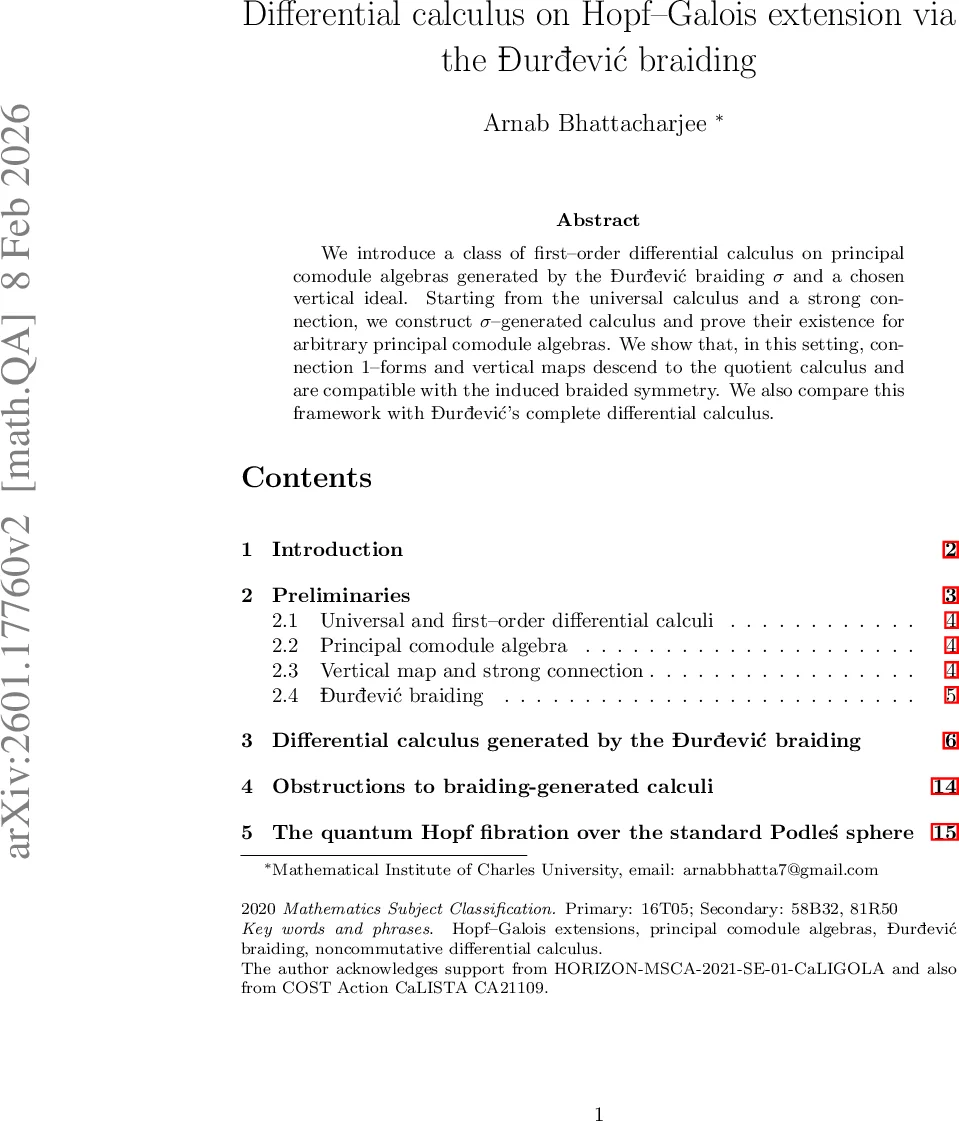
We introduce a class of first-order differential calculus on principal comodule algebras generated by the Durdevic braiding $σ$ and a chosen vertical ideal. Starting from the universal calculus and a strong connection, we construct $σ$-generated calculus and prove their existence for arbitrary principal comodule algebras. We show that, in this setting, connection $1$-forms and vertical maps descend to the quotient calculus and are compatible with the induced braided symmetry. We also compare this framework with Durdevic’s complete differential calculus.
💡 Research Summary
The paper develops a new class of first‑order differential calculi on Hopf‑Galois extensions (quantum principal bundles) that are generated by the Durdevic braiding σ together with a chosen vertical ideal I_H ⊂ H⁺ (the kernel of the counit). Starting from the universal calculus Ω¹_u(A) and a strong connection ℓ on a principal right H‑comodule algebra A, the author defines the associated connection 1‑form ω and studies its image under the canonical projection π:Ω¹_u(A) → A ⊗_B A, where B = A^{co H}. The σ‑generated calculus is obtained by taking the smallest σ‑stable subspace of A ⊗_B A that contains π(ω(I_H)) and then pulling it back to a sub‑bimodule N ⊂ Ω¹_u(A). The quotient Ω¹(A) = Ω¹_u(A)/N is shown to be a right‑H‑covariant first‑order calculus.
The main results are:
-
Existence – For any principal comodule algebra A and any right ideal I_H ⊂ H⁺, a σ‑generated calculus exists. The proof uses the fact that every principal comodule algebra admits a strong connection, and that the short exact sequence 0 → A Ω¹(B) A → Ω¹_u(A) → A ⊗_B A → 0 splits H‑equivariantly whenever a right H‑colinear section s exists (e.g., when H is cosemisimple). This section provides an equivariant horizontal lift, allowing the construction of the required submodule N.
-
Compatibility – Lemma 3.6 shows that the σ‑stable subspace N_bal = ⟨π(ω(I_H))⟩_σ is automatically a right‑H‑subcomodule provided I_H is invariant under the right adjoint coaction of H. Consequently, the connection 1‑form and the vertical map descend to the quotient calculus, preserving the braided symmetry. Proposition 3.9 establishes that σ induces a well‑defined endomorphism on the quotient (A ⊗B A)/N_bal and that the vertical subspace V{I_H} = can^{-1}(A ⊗ I_H) remains invariant.
-
Obstructions – The paper identifies necessary conditions for σ‑generation. If I_H fails to be adjoint‑invariant, the σ‑stable subspace may not be H‑covariant, obstructing the construction. Moreover, certain choices of I_H can lead to incompatibility between the braiding and the vertical ideal, preventing the formation of a σ‑generated calculus.
-
Relation to Complete Calculi – Durdevic’s complete differential calculus requires a full graded differential algebra with higher‑order forms and strong compatibility (exact Atiyah sequence in all degrees). The σ‑generated calculus can be viewed as a first‑order approximation: it retains the essential braided symmetry and the descent of connection forms but does not impose higher‑order constraints. Thus it offers a more flexible framework applicable to a broader class of quantum bundles.
-
Example – The theory is illustrated on the quantum Hopf fibration over the standard Podleś sphere S²_q. Here H = U_q(su(2)), A is the total space algebra, and B = A^{co H} is the coordinate algebra of the quantum sphere. Choosing a concrete right ideal I_H ⊂ H⁺, the author writes down an explicit strong connection, computes the associated ω, and determines the σ‑stable subspace. The resulting σ‑generated calculus is presented explicitly, confirming that the abstract construction works in a non‑trivial quantum geometry.
In conclusion, the work provides a systematic method to construct first‑order differential calculi that respect the Durdevic braiding on any quantum principal bundle. By avoiding the heavy machinery of complete calculi, it opens the door to practical computations of connections, curvatures, and gauge transformations in non‑commutative geometry, and suggests further applications such as braided gauge theory, quantum characteristic classes, and non‑commutative field theories.
Comments & Academic Discussion
Loading comments...
Leave a Comment