Goldstern's Principle with respect to Hausdorff Measures
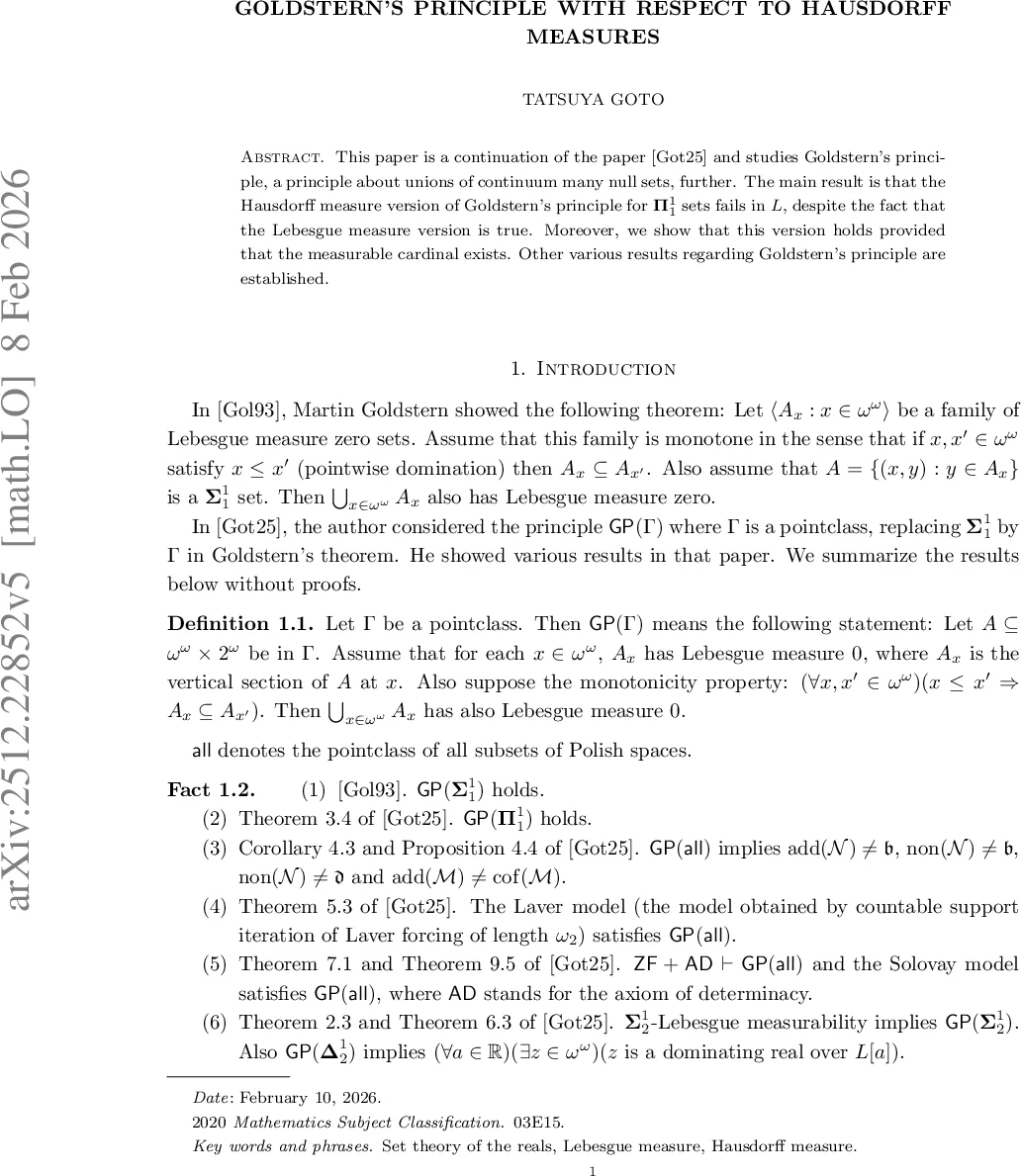
This paper is a continuation of the paper [Got25] and studies Goldstern’s principle, a principle about unions of continuum many null sets, further. The main result is that the Hausdorff measure version of Goldstern’s principle for $\boldsymbolΠ^1_1$ sets fails in $L$, despite the fact that the Lebesgue measure version is true. Moreover, we show that this version holds provided that the measurable cardinal exists. Other various results regarding Goldstern’s principle are established.
💡 Research Summary
The paper investigates extensions of Goldstern’s principle (GP) to Hausdorff measures and to ideals other than the classical null ideal. GP(Γ) asserts that for a pointclass Γ, if a monotone set A⊆ω^ω×2^ω has each vertical section A_x belonging to the null ideal (or another ideal I), then the union ⋃_x A_x also belongs to that ideal. Goldstern originally proved GP(Σ¹₁) for Lebesgue null sets; later work (Got25) generalized this to arbitrary pointclasses and explored consequences for cardinal characteristics such as add(N), non(N), b, d, etc.
The paper is organized into three main parts.
-
Countable Ideal Version – The author shows that GP(Σ¹₁, ctble) holds (Proposition 2.1) by using Sacks forcing and its ω^ω‑bounding property. GP(all, ctble) is equivalent to the inequality b > ℵ₁ (Proposition 2.2). Under V=L, a Π¹₁ scale of length ω₁ exists (Proposition 2.3), which yields a monotone Π¹₁ family of countable sections whose union is uncountable; consequently GP(Π¹₁, ctble) fails in L (Theorem 2.4).
-
Hausdorff Measure Version – For a continuous doubling gauge function f and a compact metric space X, the σ‑finite f‑Hausdorff measure ideal I_σ^f is considered. Lemma 1.5 and Lemma 1.6 establish comparability between H_f and open‑cover versions in doubling spaces. Theorem 3.1 proves GP(Σ¹₁, N_f^X) by splitting into two cases: (i) the union has non‑σ‑finite measure, where a generic real added by the forcing P_{I_σ^f} lies in the union, contradicting ω^ω‑bounding; (ii) the union has σ‑finite measure, where each B_n of finite positive measure is measure‑isomorphic to Lebesgue measure, allowing the original Σ¹₁‑GP to be applied.
The central result, Theorem 3.4, shows that under V=L there exists a monotone Π¹₁ set A⊆ω^ω×2^ω whose sections are countable but whose union has Hausdorff dimension 1. The construction uses a recursive bijection π:ω²→ω, a recursive decoding map, and a Π¹₁ scale S consisting of reals r^_α that are Martin‑Löf random relative to the α‑th L‑real y_α and agree with a fixed recursive set R outside a computable infinite/co‑infinite set. By Lutz–Lutz’s theorem, S has full Hausdorff dimension, and defining A={(x,y): y∈S and decode(y)≤^ x} yields the desired counterexample. Hence GP(Π¹₁, N_f^{2^ω}) fails for every power‑law gauge f(x)=x^s (0<s<1) in L.
-
Capacities and Forcing – The paper introduces capacities and pavement submeasures, recalling Zapletal’s theorem that outer‑regular capacities are preserved by Lav · forcing provided Π¹₁ sets are capacitable. Although Hausdorff measure H_f is not a capacity (compact sets may have infinite measure), the author shows that for a doubling space and a doubling gauge function, the open‑cover version H_{U,f} behaves like a capacity up to a constant factor (Corollary 3.8). Consequently, if a measurable cardinal exists, Π¹₁ sets become capacitable for H_{U,f}, and Lav · forcing preserves the corresponding Hausdorff‑measure ideal. This yields the positive consistency result: assuming a measurable cardinal, GP(Π¹₁, N_f^X) holds for all doubling gauge functions.
Overall, the paper delineates a sharp dichotomy: in the constructible universe L, the Hausdorff‑measure version of Goldstern’s principle fails already at the Π¹₁ level, while the existence of a measurable cardinal restores the principle. The work intertwines descriptive set theory (Π¹₁ scales, effective dimension), forcing theory (Sacks, random, Lav · forcing), and geometric measure theory (doubling spaces, Hausdorff measures), providing a comprehensive picture of how combinatorial regularity principles interact with different notions of smallness.
Comments & Academic Discussion
Loading comments...
Leave a Comment