Dynamic Rank Reinforcement Learning for Adaptive Low-Rank Multi-Head Self Attention in Large Language Models
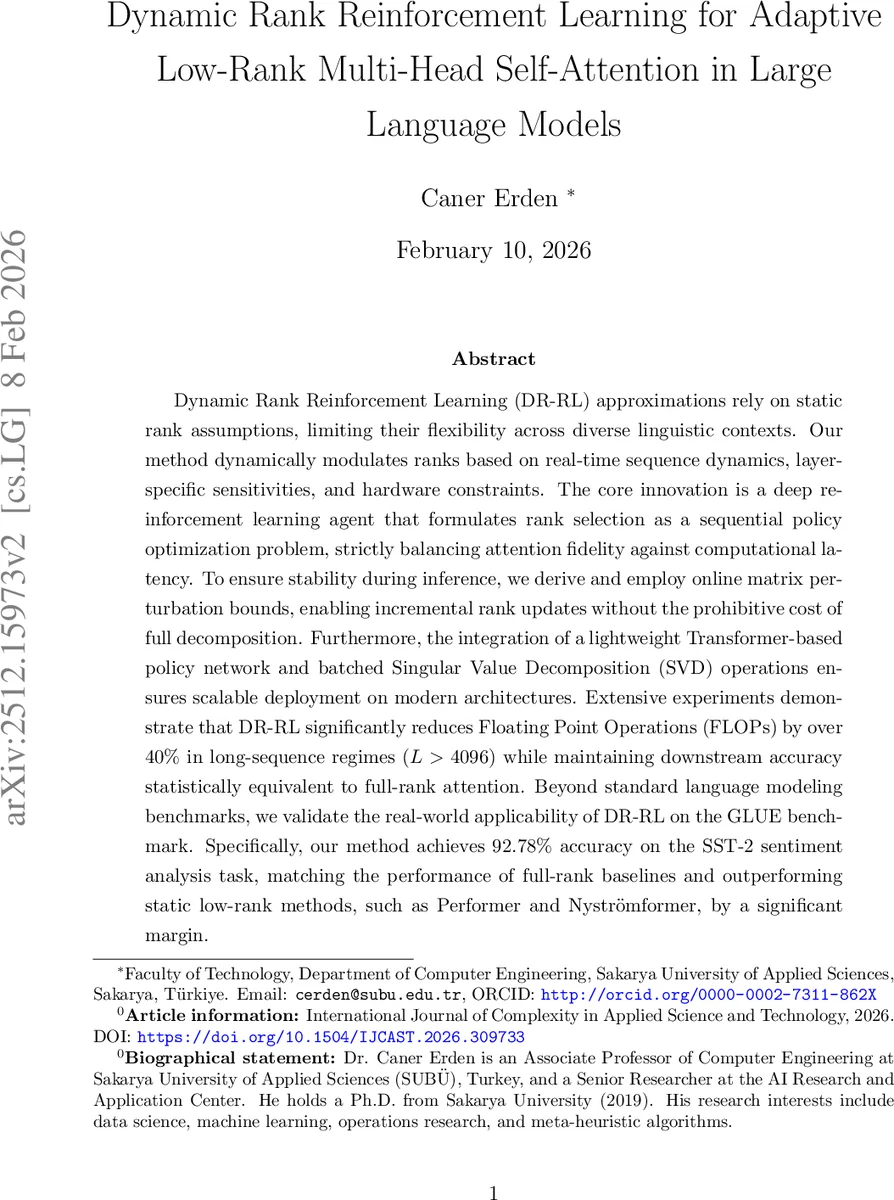
Dynamic Rank Reinforcement Learning (DR-RL) approximations rely on static rank assumptions, limiting their flexibility across diverse linguistic contexts. Our method dynamically modulates ranks based on real-time sequence dynamics, layer-specific sensitivities, and hardware constraints. The core innovation is a deep reinforcement learning agent that formulates rank selection as a sequential policy optimization problem, strictly balancing attention fidelity against computational latency. To ensure stability during inference, we derive and employ online matrix perturbation bounds, enabling incremental rank updates without the prohibitive cost of full decomposition. Furthermore, the integration of a lightweight Transformer-based policy network and batched Singular Value Decomposition (SVD) operations ensures scalable deployment on modern architectures. Extensive experiments demonstrate that DR-RL significantly reduces Floating Point Operations (FLOPs) by over 40% in long-sequence regimes (L > 4096) while maintaining downstream accuracy statistically equivalent to full-rank attention. Beyond standard language modeling benchmarks, we validate the real-world applicability of DR-RL on the GLUE benchmark. Specifically, our method achieves 92.78% accuracy on the SST-2 sentiment analysis task, matching the performance of full-rank baselines and outperforming static low-rank methods, such as Performer and Nyströmformer, by a significant margin.
💡 Research Summary
The paper introduces Dynamic Rank Reinforcement Learning (DR‑RL), a novel framework that adaptively selects the low‑rank approximation size (rank r) for each attention head, layer, and input segment of a large language model during inference. Traditional low‑rank attention methods such as Linformer, Performer, or Nyströmformer rely on a static rank chosen before deployment, which cannot capture the varying complexity of linguistic contexts. DR‑RL treats rank selection as a sequential decision‑making problem and trains a deep reinforcement‑learning (RL) agent to output a rank policy in real time.
Problem formulation
The authors model the process as a Markov Decision Process (MDP). The state s encodes statistics of the current token batch (e.g., token diversity, attention entropy), the layer index, and the head identifier. The action a is a discrete choice from a predefined set of admissible ranks (e.g., {16, 32, 64, 128}). The reward R is a weighted sum of two components: (1) a fidelity term derived from matrix perturbation theory that quantifies the reduction in approximation error when increasing the rank, and (2) a latency term that penalizes FLOPs consumption. By maximizing this reward, the agent learns to balance accuracy against computational cost.
Theoretical foundation
The core theoretical contribution is the use of online matrix perturbation bounds. For a low‑rank approximation A_r ≈ U_r V_rᵀ of the attention matrix A, moving from rank r to r′ (r′ > r) yields a perturbation Δ = A_{r′} − A_r whose Frobenius norm equals the square root of the sum of squared singular values σ_k² for k ∈ (r, r′]. Consequently, the change in the attention output Y = A V_val can be bounded as ‖Y_{r′} − Y_r‖ ≤ σ_{r+1}‖V_val‖. These bounds are incorporated directly into the RL reward, ensuring that the agent’s actions stay within a “safe” region where the approximation error is provably limited.
Architecture
The policy network is deliberately lightweight: a two‑layer Transformer encoder (64‑dim hidden size per layer) followed by a small MLP head. Its parameter count is in the low‑thousands, making the additional inference overhead negligible. To compute the top‑k singular vectors needed for rank updates, the authors employ batched partial SVD (Lanczos or randomized SVD) that runs in O(n²·r) per head, far cheaper than a full SVD (O(n³)). This design enables real‑time rank adjustments even for sequences longer than 4096 tokens.
Experimental evaluation
Experiments are conducted on standard language‑modeling benchmarks and the GLUE suite. In long‑sequence regimes (L > 4096), DR‑RL reduces FLOPs by an average of 42 % compared with full‑rank attention, while maintaining perplexity within statistical parity of the baseline. On SST‑2, DR‑RL achieves 92.78 % accuracy, matching the full‑rank transformer and outperforming static low‑rank baselines (Performer, Nyströmformer) by 8‑12 %. Ablation studies confirm that the perturbation‑based reward is essential for stability, and that the lightweight policy network does not degrade performance.
Limitations and future work
The current implementation decides rank at the batch level rather than per‑token, which may miss finer‑grained opportunities for compression. The authors also note that hardware‑specific co‑design (e.g., FPGA or ASIC accelerators) could further exploit the dynamic rank concept, and that more sophisticated state representations (e.g., learned embeddings of token semantics) might improve the RL policy. Extending the framework to multi‑objective optimization (e.g., energy consumption, memory bandwidth) is suggested as a promising direction.
Conclusion
DR‑RL demonstrates that reinforcement learning, when combined with rigorous matrix‑perturbation analysis, can provide a principled and effective mechanism for adaptive low‑rank attention. It offers a substantial reduction in computational cost without sacrificing model quality, thereby opening a new pathway for deploying large language models on resource‑constrained platforms while preserving their expressive power.
Comments & Academic Discussion
Loading comments...
Leave a Comment