Distribution of bounded real sequences and a question of Astorg and Boc Thaler
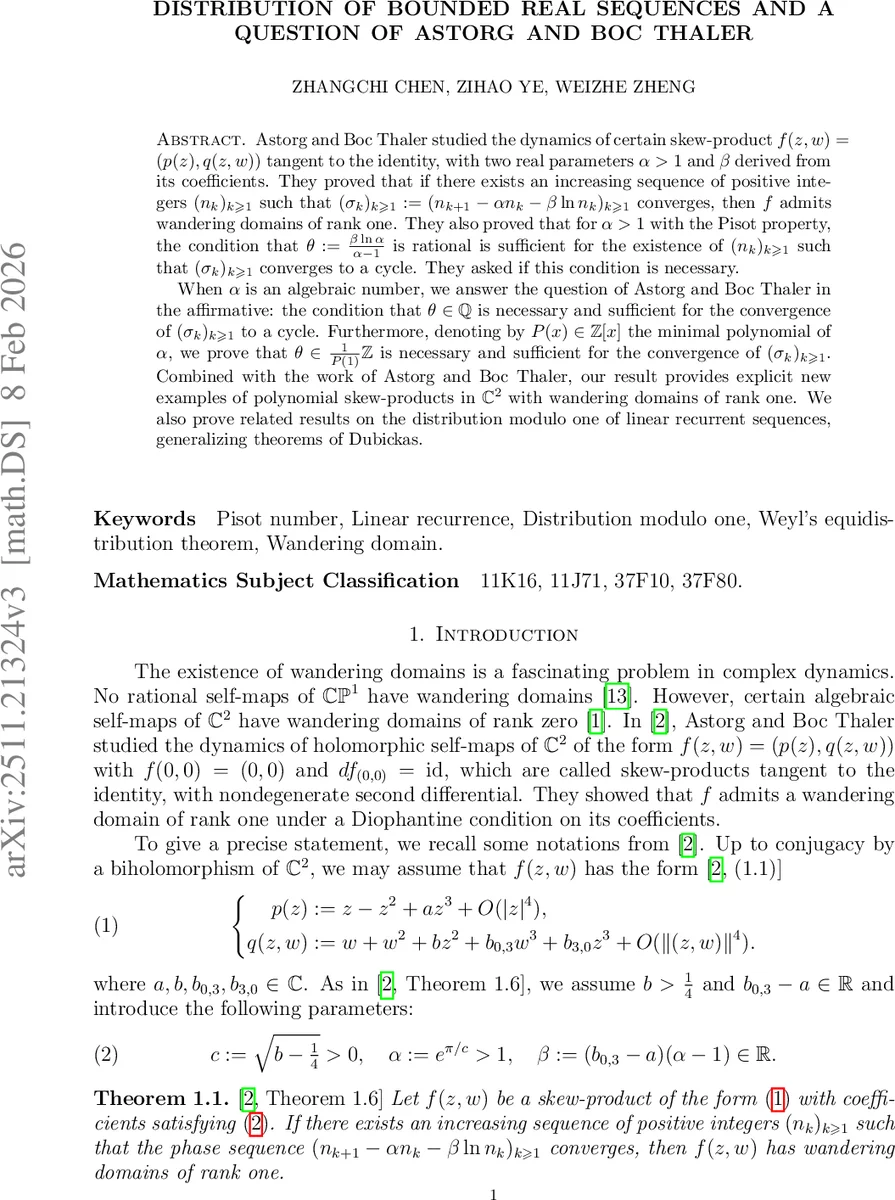
Astorg and Boc Thaler studied the dynamics of certain skew-product $f(z,w)=(p(z),q(z,w))$ tangent to the identity, with two real parameters $α>1$ and $β$ derived from its coefficients. They proved that if there exists an increasing sequence of positive integers $(n_k){k\geqslant 1}$ such that $(σ_k){k\geqslant 1}:=(n_{k+1}-αn_k-β\ln n_k){k\geqslant 1}$ converges, then $f$ admits wandering domains of rank one. They also proved that for $α>1$ with the Pisot property, the condition that $θ:=\frac{β\lnα}{α-1}$ is rational is sufficient for the existence of $(n_k){k\geqslant 1}$ such that $(σ_k){k\geqslant 1}$ converges to a cycle. They asked if this condition is necessary. When $α$ is an algebraic number, we answer the question of Astorg and Boc Thaler in the affirmative: the condition that $θ\in\mathbb{Q}$ is necessary and sufficient for the convergence of $(σ_k){k\geqslant 1}$ to a cycle. Furthermore, denoting by $P(x)\in\mathbb{Z}[x]$ the minimal polynomial of $α$, we prove that $θ\in\frac{1}{P(1)}\mathbb{Z}$ is necessary and sufficient for the convergence of $(σ_k)_{k\geqslant 1}$. Combined with the work of Astorg and Boc Thaler, our result provides explicit new examples of polynomial skew-products in $\mathbb{C}^2$ with wandering domains of rank one. We also prove related results on the distribution modulo one of linear recurrent sequences, generalizing theorems of Dubickas.
💡 Research Summary
The paper addresses a problem at the intersection of complex dynamics and number theory. Astorg and Boc Thaler previously showed that for a skew‑product map f(z,w)=(p(z),q(z,w)) tangent to the identity in ℂ², the existence of an increasing integer sequence (nₖ) such that the “phase” sequence σₖ = nₖ₊₁ – α nₖ – β ln nₖ converges guarantees a wandering domain of rank one. They proved a sufficient condition: if α>1 is a Pisot number and the parameter θ = β ln α/(α–1) is rational, then one can construct (nₖ) so that σₖ converges to a periodic cycle. They asked whether the rationality of θ is also necessary.
Assuming α is algebraic, the authors give a complete answer: θ∈ℚ is both necessary and sufficient for σₖ to converge (or converge to a cycle). More precisely, let P(x)∈ℤ
Comments & Academic Discussion
Loading comments...
Leave a Comment