Constant-Size Cryptographic Evidence Structures for Regulated AI Workflows
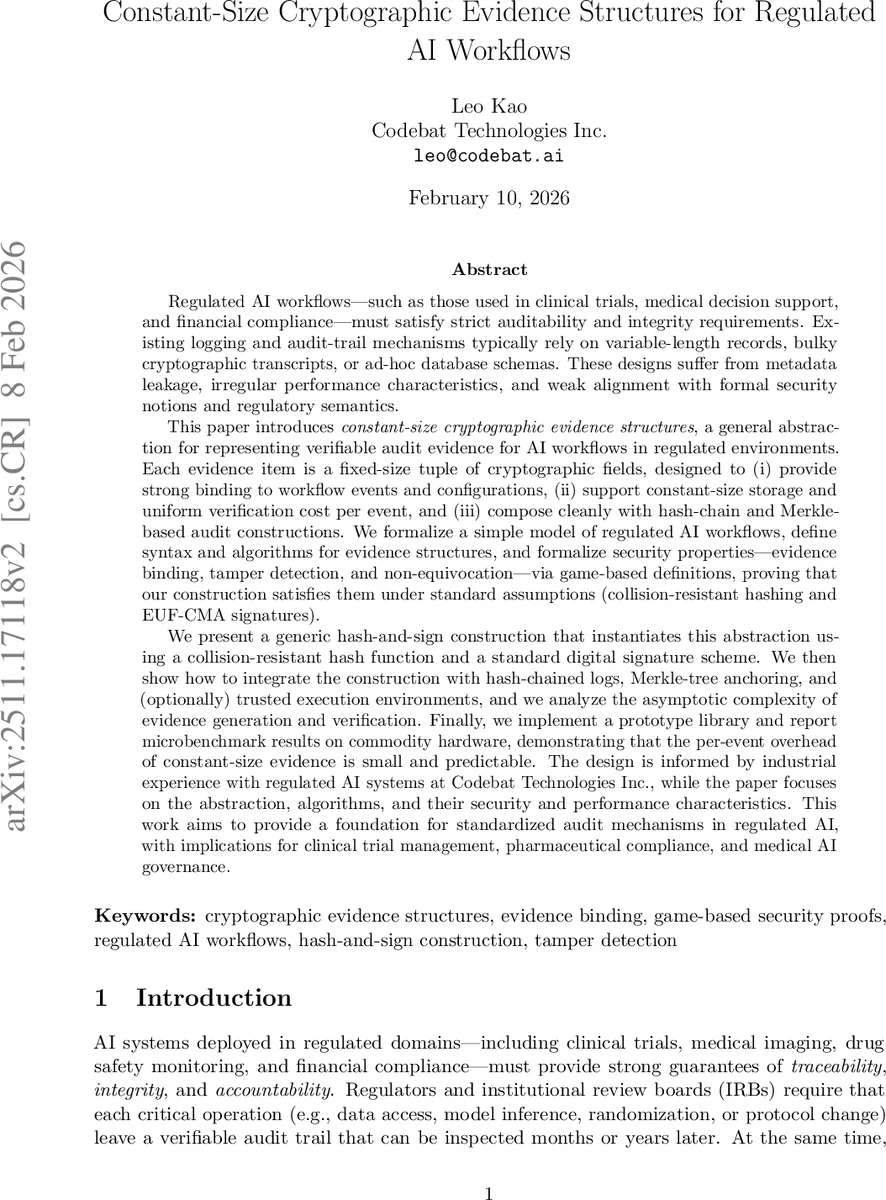
Regulated AI workflows (such as clinical trials, medical decision support, and financial compliance) must satisfy strict auditability and integrity requirements. Existing audit-trail mechanisms rely on variable-length records, bulky cryptographic transcripts, or ad-hoc schemas, suffering from metadata leakage, irregular performance, and weak alignment with formal security notions.This paper introduces constant-size cryptographic evidence structures, a general abstraction for verifiable audit evidence in regulated AI workflows. Each evidence item is a fixed-size tuple of cryptographic fields designed to (i) bind strongly to workflow events and configurations, (ii) support constant-size storage and uniform verification cost per event, and (iii) compose cleanly with hash-chain and Merkle-based audit constructions. We formalize a model of regulated AI workflows, define syntax and algorithms for evidence structures, and prove security properties (evidence binding, tamper detection, and non-equivocation) via game-based definitions under standard assumptions (collision-resistant hashing and EUF-CMA signatures).We present a generic hash-and-sign construction using a collision-resistant hash function and a standard signature scheme, and show how to integrate it with hash-chained logs, Merkle-tree anchoring, and trusted execution environments. We implement a prototype library and report microbenchmarks on commodity hardware, demonstrating that per-event overhead is small and predictable. This work aims to provide a foundation for standardized audit mechanisms in regulated AI, with implications for clinical trial management, pharmaceutical compliance, and medical AI governance.
💡 Research Summary
The paper tackles a pressing problem in regulated artificial‑intelligence deployments: how to provide audit‑ready, tamper‑evident records that satisfy strict regulatory requirements while remaining efficient and scalable. Existing solutions—application logs, ad‑hoc database schemas, or blockchain‑style ledgers—typically produce variable‑length entries, leak metadata, and lack formal security guarantees. The authors propose a new abstraction called constant‑size cryptographic evidence structures. Each evidence item is a fixed‑size tuple of k λ‑bit fields together with a digital signature, regardless of the underlying event’s data size.
The workflow model treats a regulated AI process as a sequence (or DAG) of events E, each carrying a unique identifier, structured metadata, and sets of input and output references. For each event, a set of deterministic encoding functions ϕ_i extracts the relevant pieces of information (e.g., actor, timestamp, model version, environment attestation). These encodings are hashed with a collision‑resistant hash function H to produce the fields f_i = H(ϕ_i(E)). The tuple ev = (f_0,…,f_{k‑1}) is then signed with a private key sk, yielding σ = Sign_sk(ev). Verification recomputes the hashes and checks the signature against a public key pk. Because the number of fields and their bit‑length are fixed at system setup, storage, transmission, and verification costs are constant per event.
Security is formalized through three game‑based definitions: (1) Evidence Binding—preventing a single evidence item from being valid for two distinct events; (2) Tamper Detection (Unforgeability)—ensuring that any accepted evidence either originated from the Generate oracle or required a hash collision or a signature forgery; (3) Non‑Equivocation (Chain Integrity)—guaranteeing that two different evidence sequences cannot produce the same linking value (hash‑chain tip or Merkle root) without a hash collision. The authors prove that the construction satisfies all three properties under standard assumptions: collision resistance of H and EUF‑CMA security of the signature scheme. The proofs rely on the collective injectivity of the encoding functions, which ensures that distinct events differ in at least one field input.
The paper also shows how the constant‑size items integrate seamlessly with existing audit mechanisms. In a hash‑chained log, each new evidence item is hashed together with the previous chain tip, yielding a succinct digest that can be anchored on a blockchain or an append‑only log. In a Merkle tree, a batch of evidence items is reduced to a single root hash, enabling succinct proofs of inclusion. An optional TEE binding can be added by including the TEE’s measurement digest as one of the fields, satisfying regulator demands for execution‑environment attestations.
Implementation details are provided for a prototype library written in Go/Rust. The authors use SHA‑256 as H and Ed25519 as the signature scheme, with typical parameters k = 8 and λ = 256 bits. Micro‑benchmarks on commodity hardware (8‑core x86_64, SSD) show evidence generation in ~15–30 µs and verification in a similar range, with batch verification of 1 000 items taking under a millisecond. The fixed‑size evidence occupies less than 1 KB, a substantial reduction compared with variable‑length logs, and the uniform cost enables predictable performance even under high‑throughput workloads.
The discussion acknowledges practical considerations: the choice of encoding functions must be domain‑specific yet fixed; key management and rotation policies must be addressed; and handling deletions or updates requires careful re‑linking of the hash chain or Merkle tree. The authors suggest extensions such as multi‑signature schemes for multi‑party workflows, and alignment of field semantics with international standards (e.g., ISO 27001, FDA 21 CFR Part 11).
In summary, the work delivers a theoretically sound, practically efficient framework for audit evidence in regulated AI pipelines. By fixing the size of each cryptographic record, it eliminates metadata leakage, guarantees uniform verification cost, and provides provable security properties that align with regulatory expectations. This foundation paves the way for standardized, interoperable audit solutions across healthcare, finance, and other heavily regulated sectors.
Comments & Academic Discussion
Loading comments...
Leave a Comment